The short answer: use it now, but do not mistake it for the whole AI search market
Microsoft Clarity's Topic Insights is one of the few free GEO tools worth putting into a small team's first measurement stack. You can build a topic around a set of prompts, see whether your domain is cited, identify domains that keep appearing, and find likely content gaps.
If your budget is close to zero and you need a first AI visibility baseline, Clarity is a sensible place to begin. Run one topic report, turn the output into a short investigation list, and decide which page to improve. That is much more useful than declaring that your brand is or is not "recommended by AI" from a handful of ChatGPT screenshots.
It should not be treated as full-market monitoring. Topic Insights is still in Beta. Microsoft says the feature uses GPT-5.3 with WebIQ as its search-grounding layer and allows ten reports per project each week. It is a repeatable, directional test environment, not a complete log of every answer a real user receives in ChatGPT, Google, Perplexity, Copilot, and every other AI experience.
Your situation | Is Clarity a sensible first choice? | What to do next |
|---|---|---|
Your budget is tight and you only need to know whether one core topic has AI visibility | Yes | Build one topic with 10-15 prompts and observe it for 3-4 weeks |
You have a clear Copilot/Bing audience or mainly English informational content | Yes | Turn cited pages and grounding queries into a content-improvement queue |
You need to know how your brand performs in ChatGPT, Google AI, Perplexity, and other entry points | No | Add monitoring data that separates platforms |
You need to report overall AI search share to leadership | No | Use a multi-source dashboard and state its platform coverage and methodology |
Clarity is not a free replacement for every GEO tool. Its real value is that it lets more teams replace guessing with a documented starting point.
What Topic Insights actually measures
Microsoft released Topic Insights on July 9, 2026. It extends Clarity's AI Citations capability and turns scattered citation observations into a topic-level decision: how often your domain appears, how much it contributes to answers, which competitor domains take the citations, and where content work may be needed.
A Topic Insights report is built around the topic, prompts, and competitor domains you define. It evaluates AI responses to those prompts, identifies cited domains and pages, and rolls the result up at topic level. It is not a traditional ranking report. Read its signals this way:
Signal | The question it helps answer | What it does not prove |
|---|---|---|
Visibility or citation activity | Did your domain appear in this tracked prompt set? | Every real user will see your domain |
Share of Authority | Which domains receive more citations on this topic? | Search ranking or market share |
Answer contribution | When your content appears, how much does it support the answer? | A final page-quality score |
Opportunity recommendations | Which topic, page, or gap may be worth studying? | A guaranteed citation, traffic, or revenue result |
That is why it is useful for smaller teams. It turns "AI may prefer some of our pages" into a specific list of pages, source patterns, and prompt groups, instead of a generic optimization suggestion.
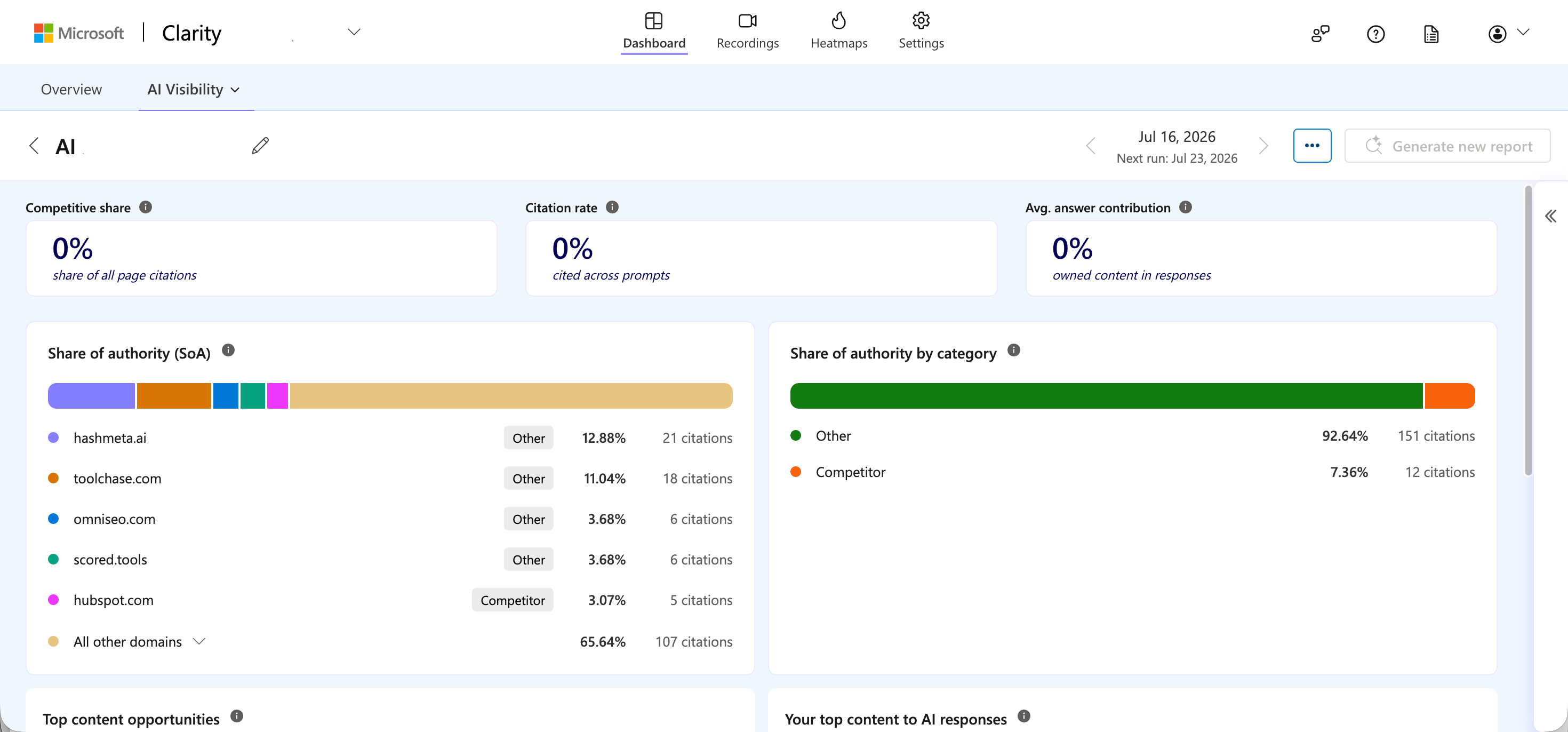
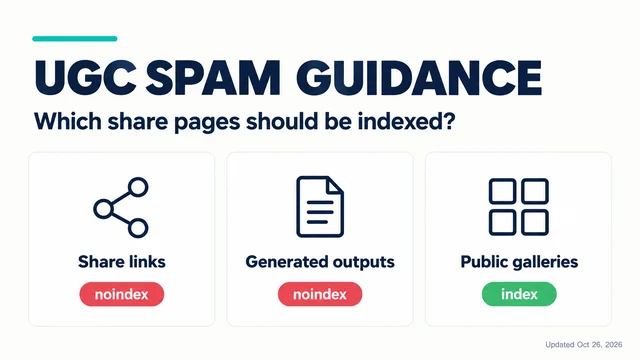
Figure 1. A Topic Insights example report. The 0% metrics and source domains shown here illustrate the interface and how to read it; they are not Auspia performance data or a statement about any platform's overall results.
How to choose 10-15 prompts without filling a report with noise
The current report-creation flow requires a comparable prompt set, and you may encounter a minimum of ten prompts. In practice, 10-15 is enough for a first report if the prompts serve one decision. Do not put every question you can think of into the same report. Topic Insights is in Beta, so use the current in-product limit as the final rule.
Imagine that you sell B2B AI visibility software. Do not mix "what is GEO," "which GEO tools exist," "Auspia pricing," and "how do I write robots.txt" in one topic. They trigger different answer types, source sets, and buying intent. The average that comes back will rarely be actionable.
A cleaner first topic is "how a team chooses an AI search visibility monitoring tool":
Prompt group | Example question | What you want to learn |
|---|---|---|
Buying comparison | "What is the best AI visibility tracking tool for a small SaaS team?" | Does the brand enter tool-selection answers? |
Budget question | "How can a small business track AI search visibility on a budget?" | Which sources support free versus paid options? |
Workflow question | "How do I measure whether AI search optimization is working?" | Do you cover the measurement method and evidence requirements? |
Platform boundary | "Should I track ChatGPT, Perplexity, Google AI Overviews, and Copilot separately?" | Can readers find the right platform-decision framework? |
Split 10-15 prompts across three or four intent groups. Every prompt should be a question a potential customer might ask and should lead to a content, product, or market decision. Avoid filling the set with branded prompts first. Branded prompts mainly confirm awareness you already have; they do not show where you are missing from non-branded demand.
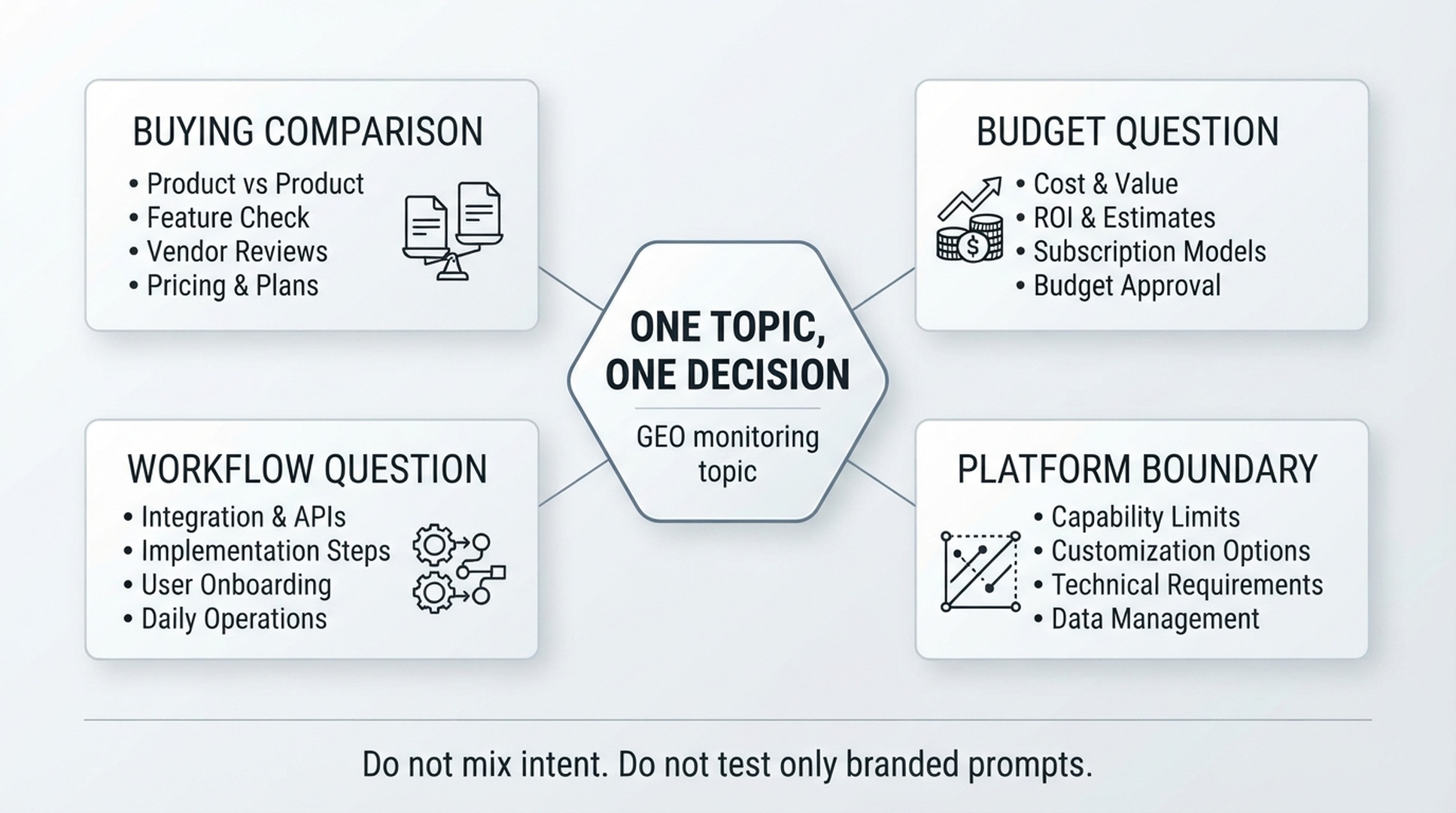
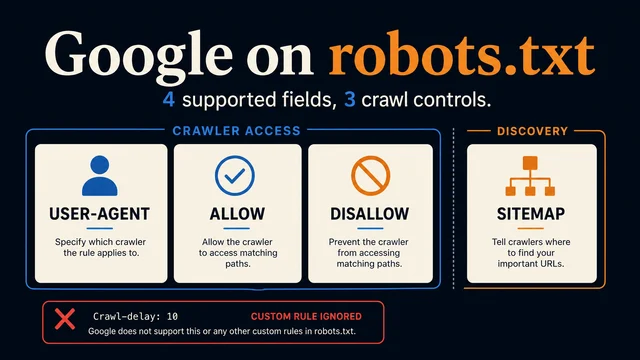
Figure 2. A first prompt set should serve one topic decision. Separate buying comparison, budget, workflow, and platform-boundary questions so the report can lead to action.
"Copilot and select AI partners" does not mean ChatGPT is definitely included
This is the easiest place to overstate the data.
The public description of Bing Webmaster Tools AI Performance says it aggregates citation activity across Microsoft Copilot, AI-generated summaries in Bing, and "select partner integrations." Microsoft Clarity's Citations materials also use phrases such as "supported AI experiences" and "partner AI platforms."
Those official pages do not list every partner and do not state that ChatGPT is a source in the data set. A report number that looks larger than Bing data alone does not prove that it includes ChatGPT. It may combine Copilot, multiple Bing AI experiences, connected partner contexts, different measurement rules, or several of these factors.
The defensible statement is:
Clarity and Bing AI citation data cover Microsoft-supported AI experiences and some partner integrations, but Microsoft has not confirmed ChatGPT as a disclosed data source in these feature descriptions.
This is not a technicality. The first reporting discipline in GEO is to separate platform coverage that has been publicly confirmed from coverage that you would like the data to include. Otherwise a team can use a directional metric to make an unverified platform claim, then let that error shape its content priorities and budget.
The first question a free tool can answer well
Clarity is particularly useful for questions like these:
- Do we already have a page cited in an important topic?
- Which competitors or publishers appear alongside us repeatedly?
- Does our existing content lack a definition, example, comparison, evidence, or a dedicated page?
- Did the trend in the same prompt set change after we updated content?
It cannot answer these questions alone:
- What is our overall visibility across every major AI platform?
- Do ChatGPT users regularly see our brand?
- Did one content update directly create sales growth?
- Should we stop doing conventional SEO and only optimize for AI?
Microsoft provides those boundaries as well. Citations is an aggregated view across supported experiences, refreshed daily with a short processing delay. It is representative grounding and citation activity, not a complete itemized record of every AI reference. The Topic Insights Beta notice likewise says to use it for directional monitoring rather than as a guarantee of accuracy, completeness, or a specific outcome.
That does not reduce its usefulness. It tells you how to use the tool correctly: form a hypothesis, inspect the page, and validate it through subsequent reports instead of treating a percentage point as a conclusion.
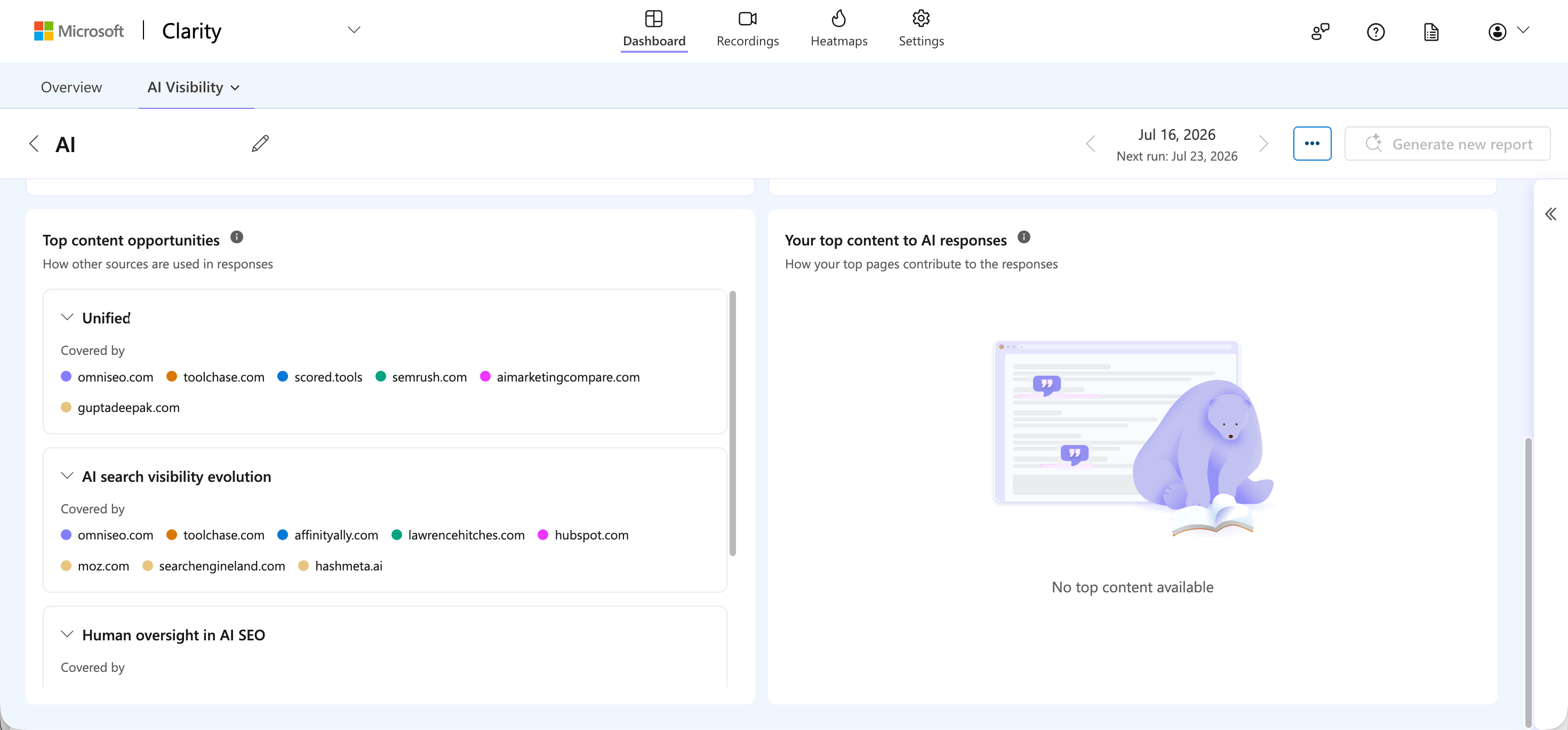
Figure 3. The content-opportunities view helps you investigate topics and sources that deserve review. The domains and "No top content available" state in this screenshot are examples and do not judge Auspia or any other site's performance.
A one-hour first GEO monitoring loop for a small team
You do not need a complicated dashboard for the first pass. Choose a question that affects acquisition and complete this loop in about an hour:
- Choose one narrow topic, such as "small business AI visibility monitoring," rather than "AI SEO."
- Write 10-15 prompts and label each one as comparison, budget, implementation, risk, or alternative.
- Add domains that appear in the same buying situation. Do not list every large site in the industry as a competitor.
- When the report is ready, choose one gap only. For example, competitors may be cited often for budget monitoring questions while you have no relevant page.
- Audit your own page before creating a new one. Is the missing piece a direct answer, a pricing boundary, a platform-coverage explanation, or a full buying guide?
- Record the report date, prompt version, and page changes. Compare only the same set on the next run.
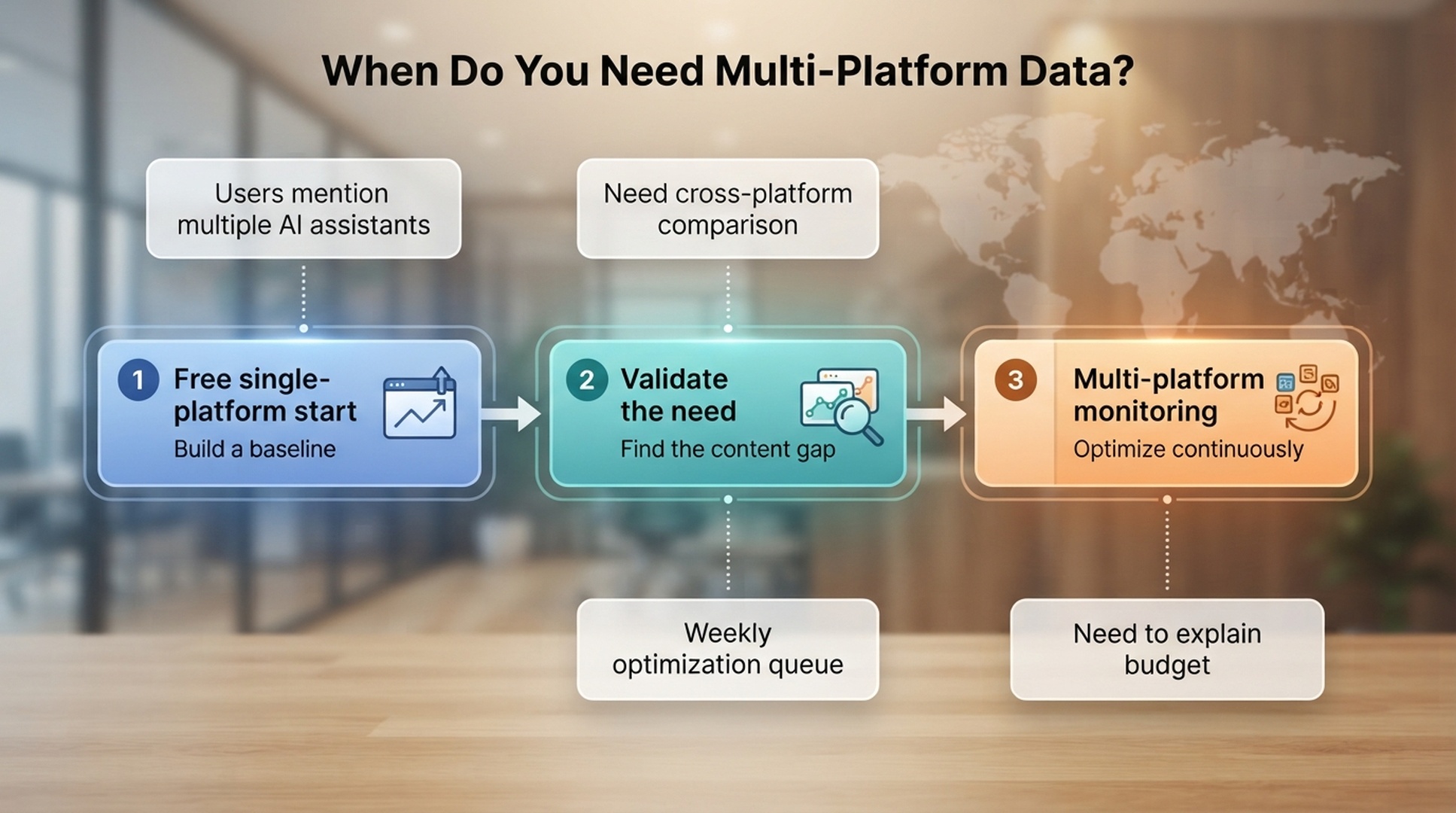
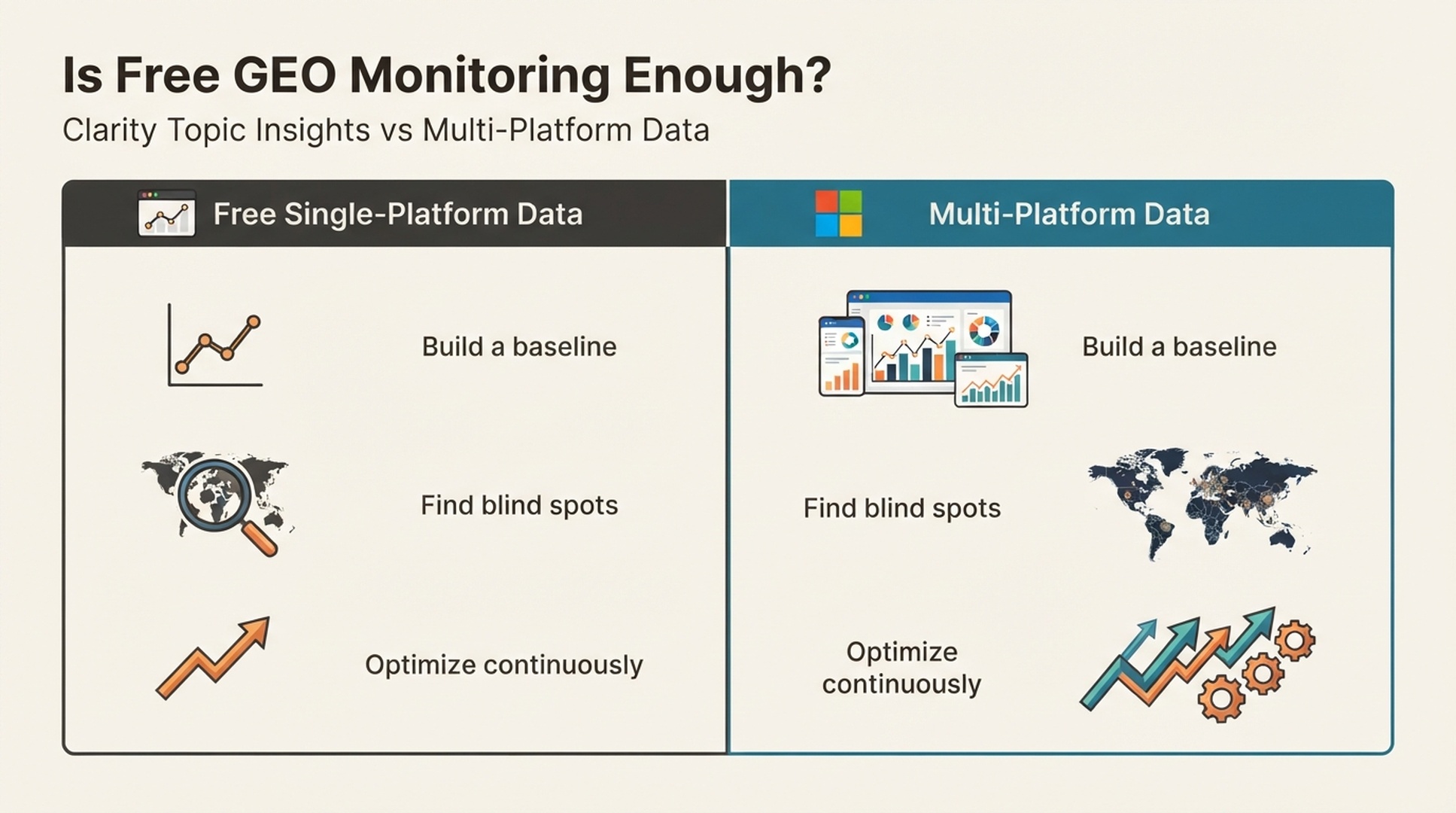
Figure 4. Establish a baseline first, then validate the content gap. Add multi-platform data only when the business needs cross-platform comparison.
When should you move from Clarity to multi-platform data?
The answer is not that Clarity is bad. Your business question has simply grown beyond the coverage boundary Microsoft publicly describes.
Once customers discover you through more than one AI entry point, collapsing every platform into one number can hide the real problem. You may perform well in informational Copilot questions and be absent from purchase-comparison questions in ChatGPT. Google AI search may create relevant exposure while Perplexity more often cites trade publications than product websites. Citation behavior, user intent, and visibility data can differ by platform.
Signal you see | Why a single data layer is no longer enough | Capability you need |
|---|---|---|
Sales calls or customer interviews repeatedly mention different AI assistants | Discovery no longer lives in one ecosystem | Platform-level visibility and prompt data |
The team needs to compare one content update across platforms | An aggregate number cannot show where the difference came from | Comparison across platform, topic, and page |
The content team has a weekly optimization queue | One-off reports cannot support ongoing choices | Unified multi-platform monitoring and prioritization workflow |
Budget approval needs a clear explanation of tool value | A free tool does not answer the full business question | Explainable reporting tied to pages, prompts, and competitive movement |
This is where Auspia fits. If you only need one usable data layer and your budget is very limited, starting with Microsoft Clarity is rational. You do not need to buy an expensive enterprise tool simply to say you are doing GEO.
Once the objective is cross-platform AI search visibility, single-platform data, or data with an undisclosed full coverage list, leaves blind spots. Auspia puts data from multiple AI platforms into one monitoring and optimization workflow so a team can compare prompts, pages, and brand appearances in one place. For teams that need multi-platform coverage, that is usually easier to control than paying separately for expensive tools on each platform and is more useful for sustained optimization.
Start with an Auspia AI Search Visibility Checker to take an initial visibility inventory, then decide which platforms and topics deserve ongoing monitoring. It is not a replacement for Clarity. It is a complement for deciding when to move from a single signal to a more complete data layer.
The final decision: build a free baseline, then pay for the blind spots that matter
Topic Insights is good news. It lowers the entry cost for GEO and forces the industry to separate "appeared once in an AI answer" from being cited consistently.
If you are a small team, start free: run a repeatable prompt report around one topic, find one real content gap, make one improvement, and watch the trend. The process itself filters out a lot of vague GEO claims.
If customers research and compare through ChatGPT, Google, Perplexity, Copilot, and other entry points, the next step is not to pretend that one platform report answered every question. It is to close the platform-coverage gap. The thing worth paying for is not a prettier score. It is knowing where, for which questions, and on which page your team should spend time.
FAQ
Is Microsoft Clarity Topic Insights free?
Microsoft's July 2026 feature announcement says Topic Insights is available to Microsoft Clarity users. The feature is currently in Beta, and eligibility, report counts, and available reports can change with product access and updates. Check the current permissions and limits in your project before relying on a workflow.
Can Topic Insights monitor ChatGPT?
Do not make that claim from the feature description. Microsoft confirms Copilot, Bing AI experiences, and some partner integrations, but it does not list all partners or confirm ChatGPT as a disclosed source. Do not interpret "select partner integrations" as proof of ChatGPT coverage.
Why can Topic Insights and Bing AI Performance show different results?
They can measure different things with different methods. Bing AI Performance aggregates citation activity across supported experiences. Topic Insights generates a topic-level comparison around representative prompts you define and, in Beta, uses GPT-5.3 with a WebIQ grounding layer. Treat them as complementary directional signals, not as identical metrics that can be added or divided.
Can I do GEO with data from only one platform?
Yes, you can begin that way. One platform can teach prompt discipline, reveal content gaps, and support trend reviews. It cannot support a conclusion about performance across every AI platform. The more your business depends on multiple AI entry points, the more important explicit platform-level data becomes.