Most local GEO problems are not ranking problems. They are matching problems.
A business can appear in AI answers, get impressions, and still waste time on people outside its service area. The usual fix is to add the city name more often. That rarely works for long. AI search systems need stronger location evidence: the service area, the local problem, the local proof, the page context, and the conversion boundary.
For local service teams, the goal is not more exposure everywhere. The goal is to be recommended in the moments where a nearby buyer is actually asking for help.
The local GEO problem in one sentence
Local GEO targeting is the process of making your content, business profile, proof, and site structure clear enough for AI search systems to connect you with the right nearby queries.
This matters because AI answers are not just reading one keyword. They synthesize clues from pages, profiles, reviews, business mentions, structured data, maps, directories, and other public sources. If those clues are vague, the system may treat the business as broadly relevant. That sounds good until the leads are from the wrong city, wrong neighborhood, or wrong type of customer.
The painful version looks like this:
The fix is to build a location signal system, not a stack of city keywords.
Why city-name stuffing breaks down
A paragraph that repeats "Austin plumber" or "Brooklyn renovation company" may look local to a human editor, but it does not give AI enough confidence to answer a real local query.
A buyer rarely asks in perfect SEO language. They ask things like:
- "Who can repair a leaking roof near South Congress before the weekend?"
- "Which orthodontist in Park Slope has weekend appointments for teens?"
- "What agency handles B2B SEO for SaaS companies in Boston?"
- "Can a small restaurant in Shoreditch get help with local SEO and reviews?"
Those prompts contain intent, geography, urgency, business type, and constraints. If your content only says the city name, it answers one part of the prompt and leaves the rest uncertain.
For AI search, the stronger page usually does three things:
- Names the service area naturally, including districts or neighborhoods when relevant.
- Describes problems that local buyers actually face.
- Shows proof that the business has done the work in that market.
This is why a generic national page can rank, but still fail at local AI matching. It does not have enough local substance.
The five signals AI systems can use to infer local fit
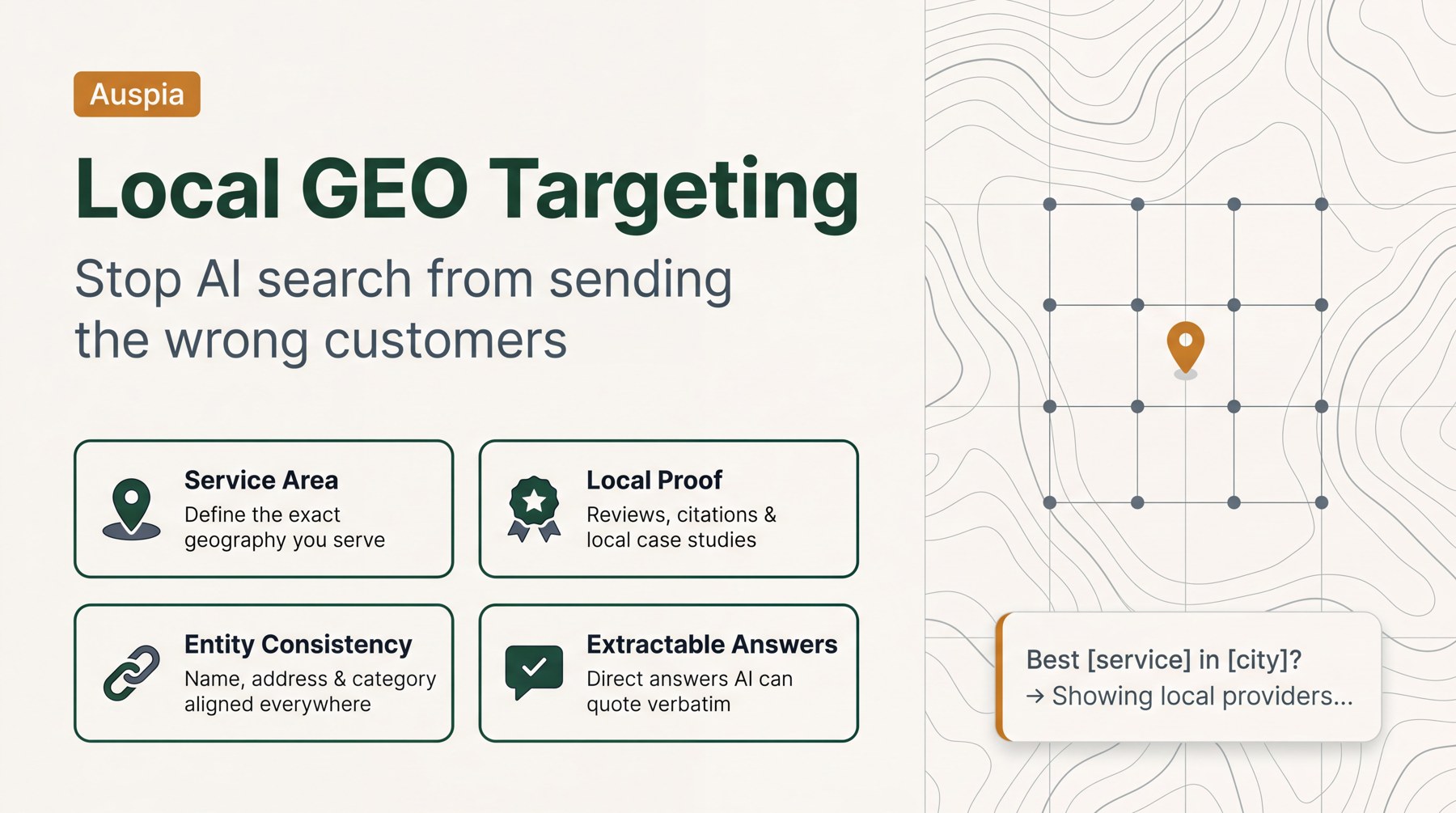
The exact systems vary by platform, and no outside team can see every ranking or answer-generation factor. Still, local GEO audits tend to reveal five practical signal groups that teams can improve.
Five signal groups that help AI search systems understand whether a business is a good local fit.
The important point: none of these signals depends on keyword repetition alone. They depend on clarity.
A practical local GEO workflow
Use this workflow when a service business gets visibility but poor-fit leads, or when a new location needs to appear in AI answers without creating thin doorway pages.
1. Define the real service boundary
Start with the operational truth. Which cities, districts, neighborhoods, or postal codes can the business actually serve? Which ones are priority markets? Which ones should be filtered out?
Write the answer plainly. If a company serves "Greater Seattle" but only takes emergency calls in Bellevue, Redmond, and Kirkland, the content should say that. A vague service area creates vague leads.
2. Build pages around local intent, not just locations
A weak page says: "We provide HVAC repair in Denver."
A stronger page answers: "What should homeowners in Denver do when an older furnace fails during a cold snap, what does a typical diagnostic visit include, and when can we serve different neighborhoods?"
The second version gives AI systems more to work with. It has service, place, situation, and buyer action.
3. Add local proof where it belongs
Local proof does not need to expose private customer details. It can be simple:
- A short project note: "Replaced a failed sump pump in a North Center basement after heavy rain."
- A market-specific observation: "Most same-day calls in this area happen after office hours."
- A review excerpt with permission.
- A photo or diagram from a real local project.
- A neighborhood-specific FAQ.
Do not fake this. Fabricated local proof is risky for customers, reviewers, and the brand. If proof is thin, collect it before scaling the page set.
4. Align profiles and third-party mentions
AI search systems can retrieve more than your website. They may see business profiles, review platforms, directories, maps, local news, partner pages, and social profiles.
Check whether these sources agree on the basics:
- Business name
- Address or service-area model
- Phone number
- Primary category
- Service list
- Opening hours
- Markets served
- Short brand description
If the site says "commercial cleaning in Chicago" while directories emphasize "residential housekeeping in Illinois," the entity signal is muddy. Fixing that mismatch often matters more than writing another blog post.
5. Make the page easy to quote
AI answers often prefer pages that provide clean, compact statements. Give them those statements.
Add a short block near the top of each local page:
We provide [service] for [customer type] in [specific area]. We are a good fit when [situation]. We are not the right fit for [excluded area or service], but we can help with [nearby alternative if true].
Then support it with details, not fluff.
A local GEO page checklist
Before publishing a local page, run this checklist.
A practical audit checklist for local GEO pages before they go live.
This checklist is also useful for refreshing old local SEO pages. Many pages already have search traffic. They simply need stronger local evidence and cleaner answer blocks.
What most teams get wrong
The most common mistake is treating local GEO as a content-only job.
Content matters, but AI visibility is also shaped by entity consistency and proof outside the page. A restaurant, clinic, agency, contractor, or local SaaS consultant cannot fix every local matching issue with blog posts alone. The brand's public footprint has to tell the same story.
The second mistake is chasing every nearby market. If a business cannot serve a location profitably, do not optimize for it. AI search can create demand faster than the team can qualify it. That turns visibility into noise.
The third mistake is publishing pages that are technically local but practically empty. Swapping city names across 50 pages is not a local strategy. It is a thin-page risk.
How Auspia approaches local GEO audits
Auspia looks at local GEO as a signal chain:
- What does the buyer ask?
- What does the site answer?
- What does the brand's public footprint confirm?
- What can AI quote without guessing?
- What should the CTA accept or reject?
You can start with the AI Search Visibility Checker to test how your brand appears across answer-style prompts. For technical and content foundations, the Auspia tools hub can help you audit crawlability, AI crawler access, structured content, and page quality.
The goal is not to manipulate AI answers. The goal is to remove ambiguity so the right recommendation becomes easier to make.
FAQ
What is local GEO targeting?
Local GEO targeting means optimizing your website and public brand signals so AI search systems can understand where you operate, who you serve, and which local queries match your business.
Is local GEO the same as local SEO?
No. Local SEO usually focuses on map rankings, organic search, reviews, citations, and local landing pages. Local GEO includes those foundations but also focuses on whether AI answer systems can synthesize and recommend the business for local prompts.
Do I need a page for every neighborhood?
Only when each page can provide useful, specific information. If the pages would only swap location names, consolidate them. Thin local pages can weaken trust.
What should I fix first if AI search sends poor-fit leads?
Start with service-area clarity. Then check whether your website, Google Business Profile, directories, and reviews describe the same business in the same market.
Can local GEO guarantee more leads?
No. It can improve the clarity and relevance of your signals, but lead volume depends on demand, competition, reputation, pricing, and conversion quality.
Author: Miles Donovan, Local AI Search Analyst Across 500+ Service Queries at Auspia. Miles writes about service-area visibility, local buyer prompts, and practical ways to make local businesses easier for AI search systems to understand.