The Rule That Changes Everything
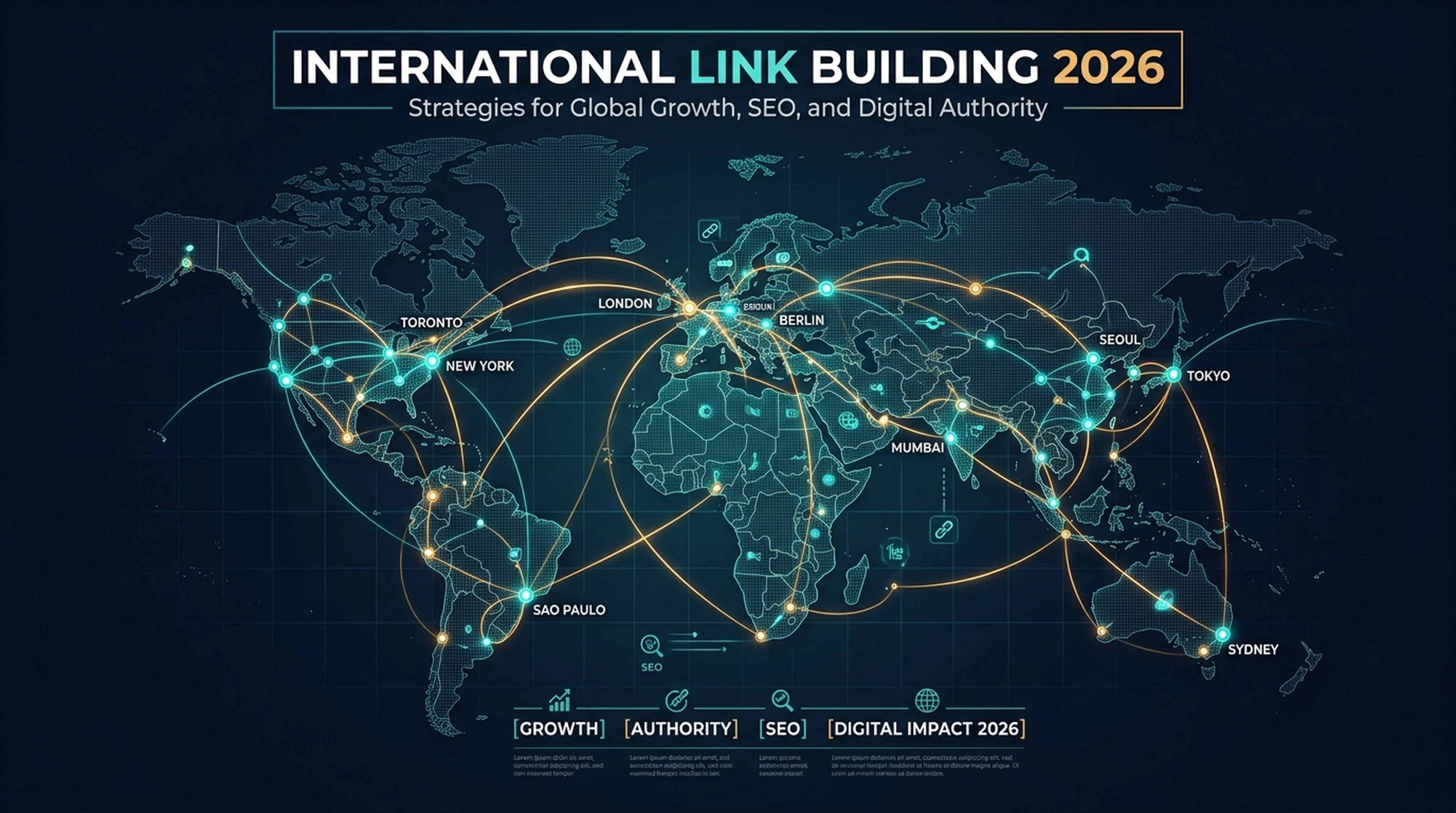
Authority does not cross borders. A US backlink from a DR 80 site does almost nothing for your rankings in Germany, Japan, or Brazil. Each market runs on its own authority graph, and Google treats them as separate.
This is the single most expensive misunderstanding in international SEO. Brands spend months translating content, setting up hreflang tags, and launching country-specific sites — then discover they are ranking nowhere because they built zero local authority.
Here is how to fix that, market by market.
The Hreflang Foundation
Before you build a single international link, get hreflang right. It is the only signal Google uses to decide which language version of a page to serve. If it is broken, your local links point to the wrong pages and your authority leaks into markets you are not targeting.
Three non-negotiable rules:
- Reciprocity. Every language version must link to every other language version AND to itself. A one-way hreflang tag is ignored. If your English page says "the German version is at /de/" but the German page does not say "the English version is at /en/," both tags are discarded.
- Correct codes. Use
en-GBnoten-UK. Use ISO 639-1 for language and ISO 3166-1 Alpha 2 for region. One wrong code and Google serves the wrong page. - Always include x-default. This is the fallback for users whose language/region combination is not covered by any specific tag. Without it, unmatched users get a random version.
Common hreflang failures: missing return tags (the #1 error), inconsistent self-references, wrong language-region codes, and canonicalizing hreflang targets to a single URL. Run a Screaming Frog or Sitebulb crawl on every international deployment. If your hreflang error rate is above 5%, fix it before building links.
Domain Structure: Where Your Links Point
Your URL structure determines how link authority flows:
Structure | Authority Model | Best For |
|---|---|---|
ccTLDs (brand.de, brand.fr) | Per-domain authority. Each market is a separate site requiring its own link building. | Large brands with dedicated per-market teams and budget |
Subdirectories (brand.com/de/) | Consolidated authority. All links point to one domain; hreflang distributes relevance. | Most global brands. Default choice for 2026. |
Subdomains (de.brand.com) | Partial consolidation. Middle ground. | When technical separation is required |
The 2026 default: subdirectories on a single domain. They consolidate link equity, are simplest to maintain, and avoid the per-domain authority treadmill that ccTLDs require. The exception is markets where a local ccTLD carries trust weight with users — .de in Germany, .fr in France — but the SEO benefit of ccTLDs has diminished as Google has improved its handling of subdirectories with proper hreflang.
The 60/40 Rule for International Links
For each target market, aim for 60–80% of your backlinks to come from domains in that market. The remaining 20–40% can be global or cross-market links.
Why the ratio matters: Google uses the geographic distribution of your backlinks as a relevance signal. A page with 90% US backlinks and a de hreflang tag will still struggle to rank in Germany because the link graph says "this is American content."
Benchmark: 30+ market-specific referring domains per priority market within the first 12 months. Not total backlinks — referring domains. One link each from 30 different German websites is worth more than 300 links from 3 German domains.
Local Outreach by Market Type
Established markets (US, UK, Germany, France, Japan):
- Trade press and industry publications in the local language
- Local chambers of commerce and industry associations
- University and research institution domains (.edu equivalents)
- Competitor backlink gap analysis using Ahrefs/Semrush filtered to the target country
Growing markets (Brazil, India, Southeast Asia):
- Local business networks and partner ecosystems
- Regional event sponsorships (conferences, meetups)
- Local influencers and content creators
- English-language international publications that cover the region
Markets with local search engines (China, Russia, South Korea):
- China (Baidu): Links from
.cndomains, Chinese-language content, local hosting. Baidu prioritizes domestic authority far more than Google does. - Russia (Yandex): Russian-language authoritative sources, user behavior signals. Yandex is more sensitive to topical relevance than Google.
- South Korea (Naver): Platform-native content, Korean-language publisher outreach. Naver's ecosystem extends beyond traditional web search.
Outreach That Works Across Languages
Translation fails. Transcreation works.
Translation: "We published a study on B2B SaaS buying behavior and thought your readers would find it valuable."
Transcreation: Adapt the hook, the proof point, and the CTA to the local context. A German editor cares about different angles than a US editor. A Japanese publisher expects a different pitch structure. A Brazilian journalist wants local data, not translated statistics from a US survey.
What to localize in your outreach:
- The story angle (what makes this relevant to a reader in this country)
- The data point (use local statistics when available; flag when data is from another market)
- The spokesperson (a local team member or partner carries more credibility than a US-based executive)
- The asset format (some markets prefer original research reports; others prefer interview-ready expert commentary)
What to keep centralized:
- Brand messaging and positioning
- Anchor text guidelines (translated to the local language, not transliterated)
- Link-quality standards (editorial only, no PBNs, no link purchases)
- A shared repository of localized proof points, quotes, and case studies
The Per-Market KPI Dashboard
Stop measuring international SEO as a global roll-up. A 20% traffic increase across all markets hides the market that grew 80% and the market that dropped 15%. Track per market:
KPI | Target | Measurement |
|---|---|---|
Organic traffic (per market) | 20–40% YoY growth | GSC, per country property |
Top-10 keywords in market | 30%+ of target keywords | Ahrefs/Semrush, country filter |
Hreflang error rate | Below 5% | Screaming Frog crawl, monthly |
Market-specific referring domains | 30+ per year, priority markets | Ahrefs, country filter on referring domains |
Wrong-market cannibalization | Under 10% of clicks | GSC — check if /de/ pages get US clicks |
Local conversion rate | Match or exceed home market rate (within 2 years) | GA4, per-market segment |
The 90-Day International Link Sprint
Days 1–7: Audit. Run a full hreflang crawl. Pull backlink profiles per market. Identify the three markets where authority is weakest relative to revenue potential.
Days 8–14: Build the local prospect list. 50–100 target domains per priority market. Local trade press, industry blogs, association sites, university departments, complementary (non-competing) businesses.
Days 15–30: Outreach wave 1. Pitch local story angles to top-20 prospects per market. Track response rate per market — it will vary. German publishers respond at different rates than Brazilian ones.
Days 31–60: Content for links. Create 2–3 locally relevant linkable assets per market — original research with local data, translated and adapted surveys, market-specific tools or calculators.
Days 61–90: Outreach wave 2 + measurement. Pitch the new assets. Measure link acquisition per market against the 30-referring-domain benchmark. Adjust outreach approach for markets below target.
What to Avoid
Buying links in any market. Google penalties are universal. A penalty earned through German link purchases affects your entire domain. The risk-reward ratio is worse for international sites because one market's bad links can tank your global rankings.
Mass directory submissions. A listing in 500 "international business directories" is not link building. It is noise that dilutes your link profile and wastes the time you could spend on five real local outreach emails.
Relying on home-market authority. Your US backlinks are not going to rank you in Japan. The sooner you accept this, the sooner you start building local authority where it actually counts.
FAQ
Do backlinks from one country help rankings in another?
Minimally. Google uses the geographic distribution of backlinks as a relevance signal. A .com link from the US carries little weight for rankings in Germany. Build market-specific authority for each target country.
How many backlinks do I need per market?
30+ referring domains from within the target market within 12 months is a realistic benchmark for a priority market. Quality matters more than quantity — 30 editorial links from local trade press are worth more than 300 directory submissions.
What is the best URL structure for international SEO?
Subdirectories (brand.com/de/) on a single domain are the 2026 default for most global brands. They consolidate link authority and are simplest to maintain. ccTLDs (brand.de) are stronger local signals but require separate link building per domain.
Can I just translate my content and expect it to rank?
No. Translated content without local backlinks ranks nowhere. Translated content without hreflang cannibalizes your existing pages. You need all three: localized content, correct hreflang, and market-specific backlinks.
Author: Marcus Ellery, Growth Experimenter Behind 150+ SEO Tests at Auspia. Marcus writes about link building, international SEO strategy, and the per-market authority playbooks that global brands miss.