The 30-second version
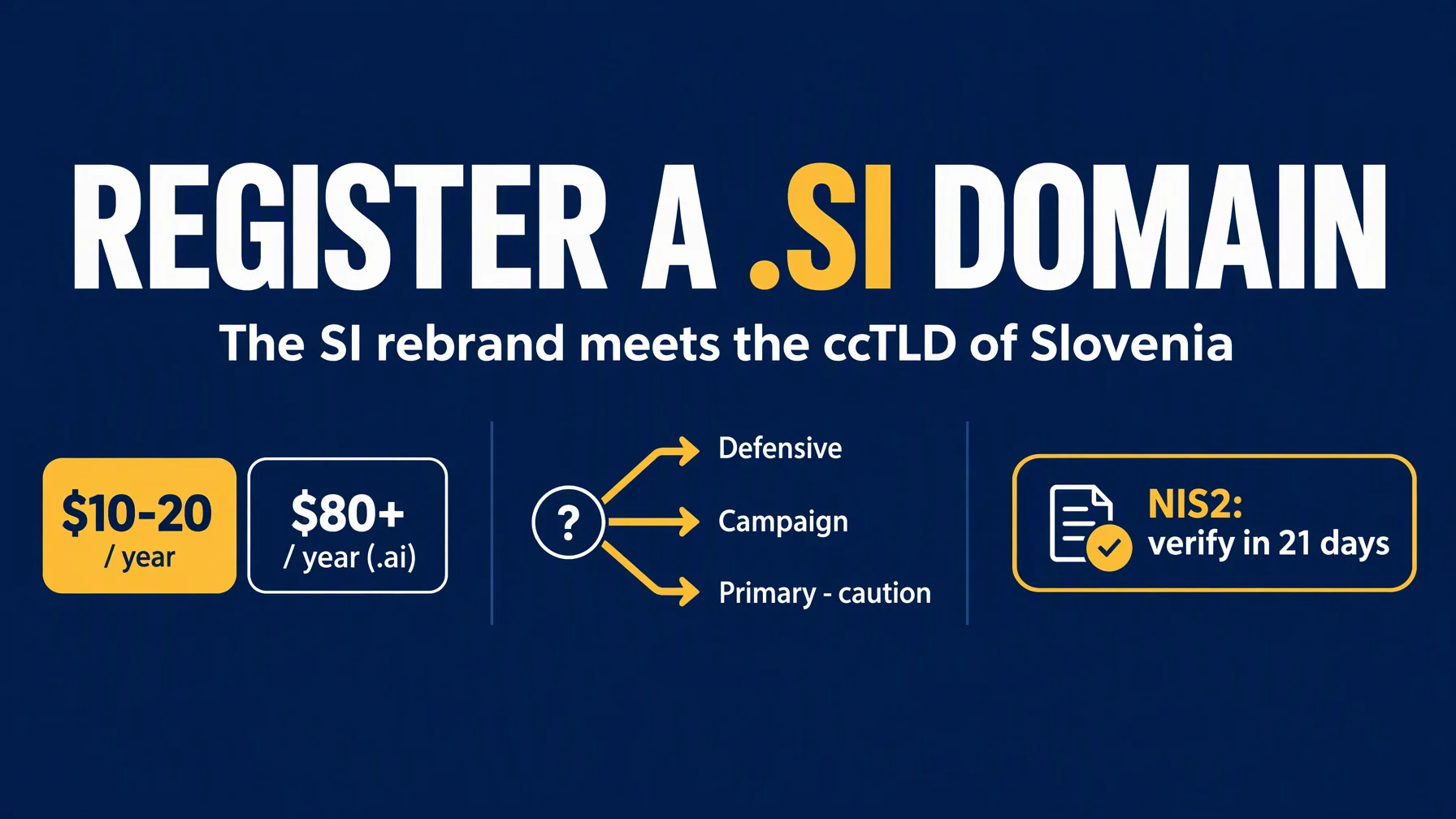
You can register a .si domain this week, from anywhere, for roughly $10 to $20 a year, with no local presence in Slovenia and no approval process. That part is genuinely simple.
The harder question is why you would. .si is Slovenia's country-code domain, and it is trending because the US government renamed "AI" to "Super Intelligence" (SI) in September 2026, not because Slovenia changed anything about how the domain works. That makes .si a real opportunity for some teams (cheap brand protection, short campaign names) and a trap for others (anyone trying to swap it in as a global primary domain or, worse, buy one as an investment in a bubble).
Below is the full registration process, step by step, with a four-question gate up front so you only start it if it actually makes sense for you.
Who this is for: founders, brand owners, and marketing leads who keep seeing .si in their feed and want to make a deliberate call instead of a reactive one.
What "done" looks like: a domain registered in your name (or your company's name) at registry price, nameservers pointing somewhere intentional, contact data that passes verification, and a written decision about what the domain is for. Realistic effort: about an hour of actual work, plus DNS propagation and registry checks that happen on their own schedule.
What you will need: a payment method, an email address that stays alive, and your company's official registration details if the company will own the domain.
What actually happened to make .si hot
On September 22, 2026, at the UN General Assembly, President Trump said the US would call artificial intelligence "super intelligence." On September 29, he signed Executive Order 14434, "Inaugurating the Era of Super Intelligence," directing federal agencies to use "Super Intelligence" and "SI" in official documents, websites, and public communications. The order borrows the existing legal definition of AI (15 U.S.C. § 9401(3)), so this is a renaming, not a new technology tier. The White House science adviser has been directed to propose formal legislative language for a federal SI definition.
The side effect was a run on a 34-year-old country-code domain. Slovenia's registry, Register.si, logged 46,066 new .si registrations in September, up from 3,515 in August. Registry SI spokesperson Klara Herman told the BBC that September purchases rose 2,199%, though she was careful not to attribute the entire surge to the president. Netcraft found that within 25 hours of the UN speech, .si registrations overtook .ai's. The final days of September ran around 12,000 new .si domains per day.
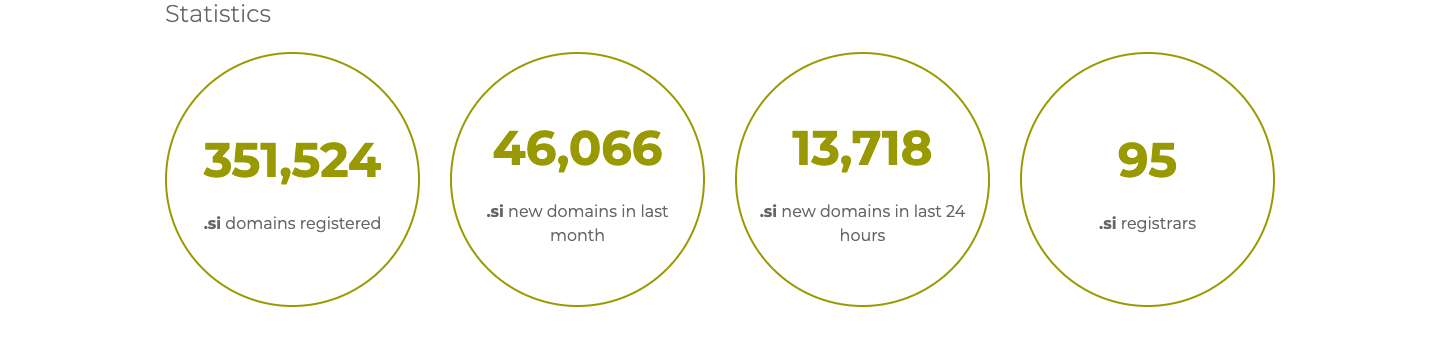
The money context matters. .ai became the AI industry's default extension and turned Anguilla's country code into a significant revenue stream; Anguilla's government licenses it through a registry that now charges around $160 wholesale for the minimum two-year registration. Register.si charges registrars €10 per domain per year, which is why .si street prices sit far below .ai's, and why the registry has publicly pushed back on the idea that the surge is a windfall.
One clarification before you spend anything: "SI" here does not mean the academic concept of superintelligence (that's ASI), and it does not mean any model got smarter. It means the US federal government changed its stationery. The domain trend is downstream of a language decision.
The four-question decision gate
Run your situation through this before touching a registrar. If you answer mostly left-column, register. If mostly right-column, you can skip the rest of this article with a clear conscience.
Question | Register .si if | Stay with .ai (or .com) if |
|---|---|---|
What is the domain's job? | Defensive brand lock, campaign microsite, redirect, or a name that literally ends in "si" | It would be the primary domain of a global product |
Who is the audience? | Slovenia, EU-localized, or an SI-narrative-brand audience | Global English-first customers who know you as your .ai/.com |
What is your budget reality? | $10–20 a year is cheap insurance | You are comfortable with .ai's two-year commitment at $80+ per year |
How good is the name? | Your exact brand or chosen name is still available at registry price | The only version you want is listed on an aftermarket at a premium |
If your honest reason is "I saw people on X making money with these," stop at a single defensive registration of your own brand name and skip the portfolio. More on why in the risk section.
Step 1: Check the name properly before you fall in love with it
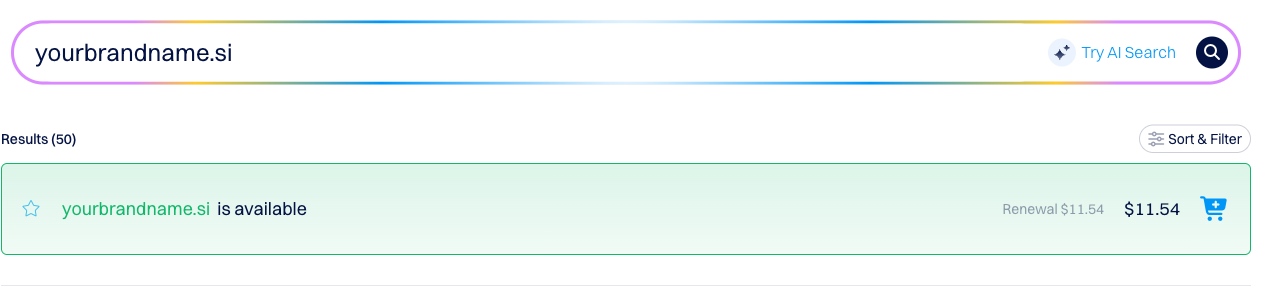
.si names run 2 to 63 characters, hyphens allowed, and registration is first-come, first-served with no document requirements up front. Any .si registrar's search box queries the same registry, so availability checking is instant and free.
Three checks that separate a professional from a panic buy:
- Registry status, not just "available." For a taken name, the ARNES whois at register.si shows the registrar, creation and expiry dates, and nameservers. A domain created 15 years ago with live NS records is someone's business. A domain created two weeks ago is likely a flip.
- Trademark hygiene. The registry operates a dispute process, but winning a name back costs far more than choosing a clean one. If your intended name is someone else's registered trademark in your market, pick another string.
- Watch the aftermarket trap. Netcraft found that over half of the .si names bought on Dynadot during the pre-speech window were listed for resale within days, and more than 44,000 .si names are identical to an existing .ai name, equal to 22% of the whole zone. Asking prices are already absurd in places: ai.si has been listed at $699,995. Walk away from anything priced like that. Even the trend's flagship end-user purchase, the AI startup Recursive buying recursive.si for $20,000, redirects to the company's .com. The company bought a defensive redirect, not an identity.
Quality check: you have two or three candidate names written down, each verified available at registry price, none colliding with an active trademark. Recovery: if your first choice is gone, do not negotiate with the squatter on day one of a hype cycle. Wait or pivot.
Step 2: Pick a registrar and a term you will actually keep
Buying a .si domain works like buying a .com: you open a registrar, search the name, and add it to your cart if the price looks right. The registry, ARNES, does not sell directly to the public, the same way you never buy a .com from Verisign. Around 95 accredited registrars sell .si, and the practical shortlist, all of which sell it internationally: Dynadot ($11.54 per year as of October 2026), Namecheap, Spaceship, Hostinger (promotional first-year rates around $15), Netim, one.com, and 101domain. Price comparison sites showed lows around $10.18 in early October 2026, and the registry fee behind all of them is €10.
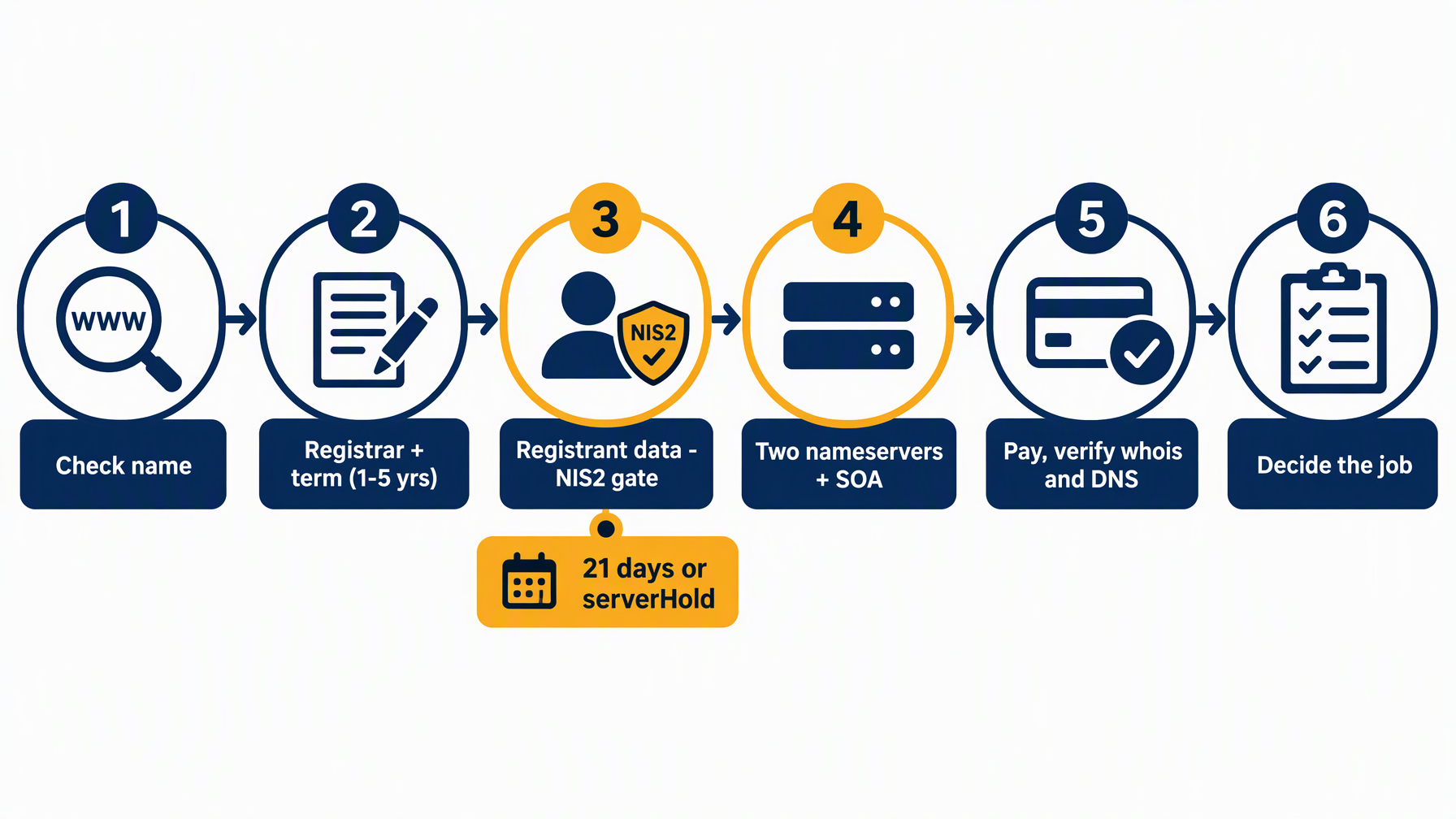
What actually differentiates registrars here is not the sticker price. It is renewal pricing, how cleanly they handle NIS2 contact verification (the next section), and whether they support the registration term length you want. ARNES allows terms of 1 to 5 years. For a defensive registration, one or two years with auto-renew on is enough commitment; do not prepay five years for a trend you might not care about in 2028.
Decide the legal owner now, not later. If your company should own it, register it in the company's name with company contact data from the start. Owner changes after the fact are billable, processed per domain, and require the new owner to confirm within 7 days or the whole request fails. Choosing wrong on day one is a headache you can simply not buy.
Step 3: Enter registrant data that survives verification
This is the step where casual buyers get burned. Under the EU's NIS2 directive, registry contact data has to be accurate and verifiable, and the .si registry has been running risk assessments on registrant contact data since July 1, 2026.
What that means in practice:
- Every field must match official documentation: name or company name, postal address, phone, and email. "Close enough" is not a strategy.
- If the registry flags your contact handle, you have 21 days to complete verification. Miss it and the domain goes into serverHold: it stops resolving, your email and site break, and it stays that way until you fix the data. The domain is not deleted, and it can still be renewed or transferred while suspended, but nothing works.
- There is no WHOIS privacy add-on for .si, and none is needed in the usual sense: ARNES publishes limited whois output (corporate registrations often show the holder as not disclosed), while the registry itself holds verified data. Accuracy protects you, not concealment.
- Keep the contact email alive. Verification requests, renewal reminders, and annual data reminders all land there. Email address changes cannot be made as a simple contact update; they require an owner-change request.
Expected output: an order confirmation and, in many cases, a verification email to click within the first days. Quality check: your ARNES whois record shows your registrar and your chosen nameservers. Recovery: if you get flagged, verify immediately, not on day 20. If the email on file is dead, file an owner change and have the confirming party ready to click within 7 days.
Step 4: Point at least two nameservers at something real
A .si domain needs at least two functional nameservers to activate. They must be authoritative for your zone, and their SOA records have to match. If you are just doing a redirect, your registrar's default DNS is fine. If you are running a real site, use your hosting provider's or a dedicated DNS service's nameservers.
The registry runs automatic predelegation checks every few hours and adds your domain to the DNS once everything validates, so you will not see the domain resolve the second you save settings.
Expected output: dig NS yourname.si returns your nameservers. Quality check: two or more NS records, both resolving, SOA matching. Recovery for the two common failures: a non-authoritative or single nameserver stalls activation until the next predelegation check; a mismatched SOA looks fine in your registrar panel and fails silently at the registry. Fix the zone, then wait one check cycle rather than re-saving repeatedly.
Step 5: Complete the order and verify activation
Payment closes the registration, but confirm the result instead of assuming it. Failures at this stage are rarely technical: in a market where thousands of .si names sell per day, a failed order on a desirable name usually means someone else completed first. Retry with your second-choice name rather than reclicking the same one.
Verify, in order:
- ARNES whois shows the domain created today, your registrar, and the expiry date your term implies.
dig NSanddig Areturn answers rather than NXDOMAIN.- The site or redirect responds over https with a valid certificate.
For a public-facing domain, also confirm search engines can actually fetch it. Auspia's Googlebot Spider Simulator renders your page the way Google's crawler sees it, which catches blocks, redirects, and server errors before they cost you indexing time.
Typical activation runs from minutes to a few hours depending on when the next registry check catches your nameservers.
Step 6: Decide what the domain is for, in writing
Three job descriptions make sense for a .si domain in this moment, and one does not.
- Defensive redirect. Your brand, variations, and common typos 301-redirect to your primary domain. Cheap, permanent, done. This is the most common sensible use.
- Campaign or microsite. A short, memorable .si for a launch tied to the SI wave, pointing at a product page. Fine, as long as you accept it is a costume, not a rebrand.
- Primary domain for a genuinely Slovenia- or EU-anchored brand. Here .si is a positive signal: Google reads ccTLDs as country signals, and for a Slovenian audience that is exactly what you want.
- Primary domain for a global product. This is the trap. Since June 2023, Google has treated .ai as a generic top-level domain with no geographic signal, which is a large part of why AI companies adopted it wholesale. .si is not on that generic list. It starts with a Slovenia association you cannot switch off, and hreflang or CDN choices do not undo a ccTLD's country signal. You can still rank globally with strong content and links, but you are playing with a trailing signal you did not choose. Migrating an existing global site onto .si trades accumulated authority for a cheaper renewal, which is a bad trade every time.
Whatever you choose, write one sentence down: "We registered X.si to do Y, owned by Z, reviewed on DATE." That sentence is what keeps a hype purchase from silently becoming an abandoned renewal.
Verification checklist
Before you call the job done:
- [ ] Name checked against live registry status and trademark search
- [ ] Registered at a registrar whose renewal price you have actually read
- [ ] Registrant data matches official documents exactly (NIS2 requirement)
- [ ] Verification email (if any) completed well inside the 21-day window
- [ ] At least two authoritative nameservers set, SOA matching
- [ ] whois shows created date, registrar, expiry, and nameservers
- [ ] https responds with a valid certificate
- [ ] Redirect or site verified as fetchable by a crawler
- [ ] Auto-renew on; renewal price and date in your calendar
- [ ] One-line registration purpose written down somewhere your team can find it
What can still bite you
Symptom | Likely cause | Fix |
|---|---|---|
Domain stopped resolving weeks after purchase | NIS2 contact verification missed | Verify the flagged handle; domain is suspended, not deleted |
Activation stalls despite "saved" settings | Fewer than two authoritative nameservers, or SOA mismatch | Fix the zone; wait for the next predelegation check |
Owner change request failed | New owner did not confirm within 7 days | Resubmit (billable) and have them click promptly |
Transfer rejected | Authcode expired after 16 days | Request a fresh authcode from the current registrar |
Tried to "delete and re-register" | Deletion enters a 30-day quarantine | Renew or redirect instead; deletion is not instant |
Two standing risks worth naming. The first is bubble mechanics: domain-namewire's monitoring found no startups launching on .si in the previous 30 days while roughly 50 launched on .ai in a single day, and most aftermarket activity traces to investors relisting names rather than businesses adopting them. The "SI" narrative may stick in government documents and never become everyday vocabulary; if that happens, speculative .si values fade first. The second is brand risk: Netcraft has warned that as .si gains perceived legitimacy, brands should watch for typosquatters, because "ai" and "si" differ by one adjacent keystroke. Registering your own name is the cheap half of that problem; monitoring is the other half.
Auspia take
For most AI-adjacent teams, .si is a $12 insurance policy and a $700,000 temptation, and the correct response differs completely depending on which one you are looking at. A defensive registration of your exact brand at registry price is easy to justify. Treating .si as an investment, a portfolio, or a replacement identity for a global site is not, and the data so far (thin end-user adoption, heavy resale listings, cautious words from the registry itself) supports that split. Make the TLD decision like an SEO decision, because that is what it is: a signal you will carry for as long as the domain lives. If you take one action from this article, make it the boring one. Check whether your brand name is still available at registry price, and if it is, lock it. Then get back to work on the things that actually compound.
FAQ
Does registering a .si domain help or hurt my SEO?
The TLD itself is not a ranking boost. The effect is geographic: Google treats .si as Slovenia's country-code domain, so your site starts with a Slovenia association, which is good if that is your market and a neutral-to-unhelpful signal if you sell globally. .ai, by contrast, has been treated as generic since June 2023. If your primary site currently ranks on .ai or .com, migrating it to .si is a downgrade risk, not an upgrade.
Is .si cheaper than .ai every year, or just the first year?
Structurally cheaper, yes. The registry charges registrars €10 per domain per year, and street prices cluster at $10 to $20 whether you are registering or renewing, so watch for promotional first-year pricing that resets higher on renewal. .ai typically runs $80+ per year with a mandatory two-year term, so the minimum outlay is roughly $160 and up.
Can I register a .si domain from the US or anywhere else?
Yes. There is no residency, citizenship, or local-presence requirement, and no documents are needed at purchase time. The trade-off is the accuracy requirement: NIS2 means the registry can demand verification of your contact data at any time, and flagged handles that miss the 21-day window get suspended until fixed.
Where do I actually register a .si domain? Do I have to use Register.si?
No. Register.si belongs to the registry, ARNES. It runs the official lookup and publishes the accredited registrar list, but it does not sell domains itself. You buy through any registrar on that list, exactly like .com is bought through registrars rather than from Verisign. Roughly 95 registrars are accredited, including international ones such as Dynadot, Namecheap, and 101domain, and the purchase flow (search, cart, checkout, then nameservers) is identical to registering any other extension.
Someone already owns mybrand.si and wants thousands for it. Should I pay?
Usually no. If you hold a registered trademark in a relevant market, the registry's dispute process exists for exactly this. If you do not, paying inflated aftermarket prices during a hype cycle funds the behavior and rarely ends at one purchase. Set a hard walk-away number before you negotiate, and remember that most of the current listings were registered weeks ago by investors, not built by businesses.
Will .si become the new .ai?
Probably not in the way the phrase implies. .ai took a decade to become an industry default and passed a million registrations by early 2026. .si's spike is weeks old, driven by a government vocabulary change, and current data shows domain investors, not startups, doing the buying. The likelier outcome is a useful, cheap extension that matches some names and brands very well, alongside .ai rather than instead of it. .ai itself never replaced .com, and the same logic caps what .si can replace.
What happens if I do nothing and my brand name gets taken on .si?
You keep your trademark rights and a dispute path, but you lose the cheap option. The cost of a defensive registration today versus the cost of recovering a name (or living with confusion and typo traffic) later is the entire argument for spending the $12 now if your name is still free.
Author: Dominic Hale, International SEO Specialist Across 18 Markets at Auspia. Dominic writes about ccTLD strategy, multilingual SEO, and how regional search behavior shapes domain decisions.