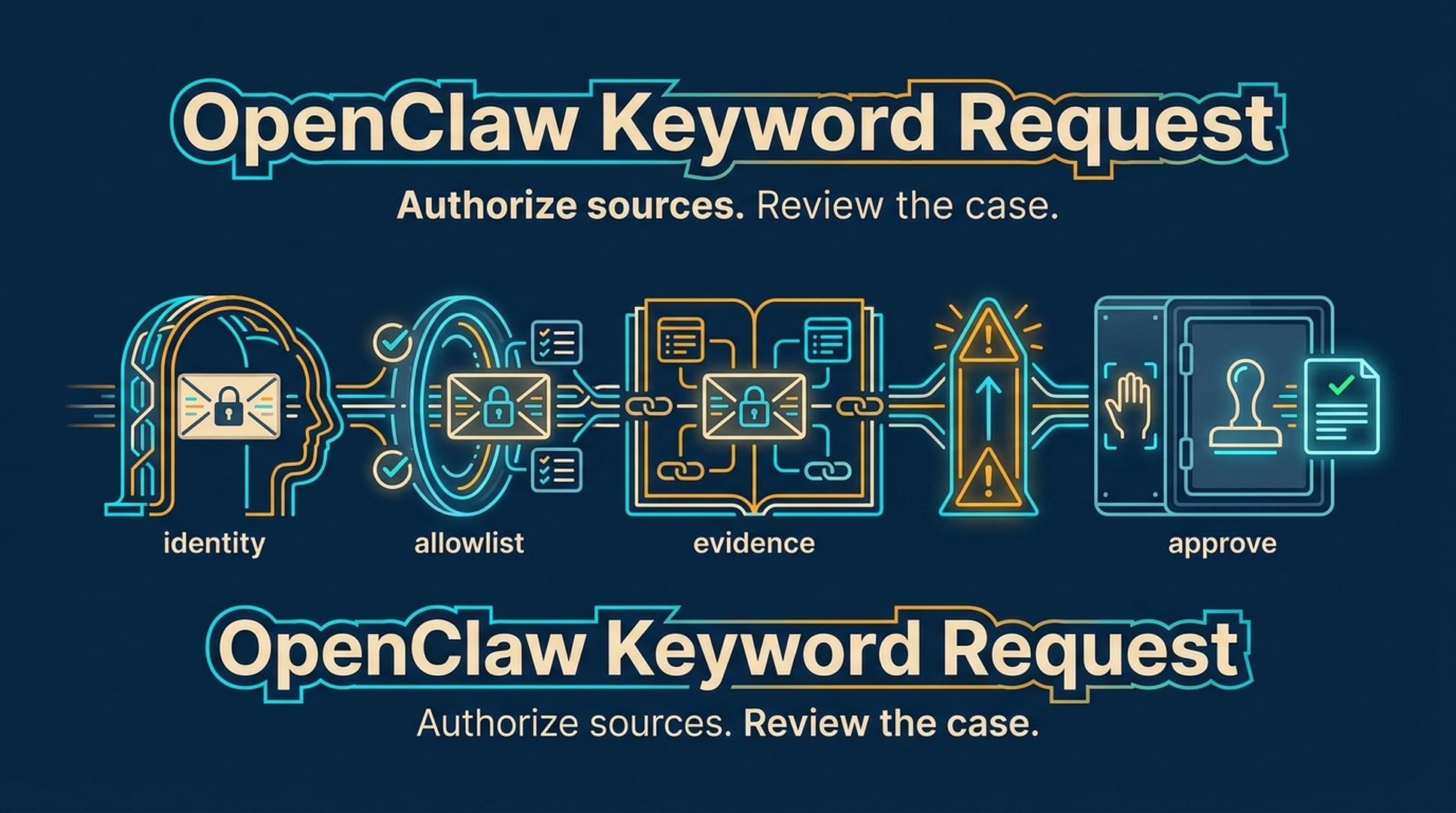
A keyword request is also an access request
OpenClaw can make keyword research feel deceptively simple: send a message, trigger an agent, receive a report. The harder question is who initiated the work, which sources the agent may use, and what it is allowed to do with the result.
That makes OpenClaw a good fit for a controlled keyword-research service. Treat each request as a small case file rather than a casual chat. The case file records the requester, allowed data sources, the one decision being made, the output location, and the actions that are explicitly prohibited.
Use this workflow if: keyword requests arrive through an OpenClaw channel or gateway and need an audit trail.
You will finish with: an authorized request, a source-bounded evidence log, a candidate recommendation, and a human-signed page decision.
You need: a named requester, a workspace with appropriate controls, approved source locations, a content owner, and a policy for handling sensitive data.
Done means: another reviewer can reconstruct what the agent was allowed to read and why the chosen keyword was approved.
Define the request envelope
The envelope is a compact policy attached to one task. Use it before handing the request to an agent.
Request ID: SEO-KW-2026-07-30-01
Requester: [named team or authorized role]
Decision: [refresh / new page / consolidate / no action]
Market and language: [market] / [language]
Allowed sources: [exact folders, exports, approved URLs, or integrations]
Prohibited sources: [private systems, customer records, unapproved web access]
Permitted actions: read, summarize, compare, draft report
Prohibited actions: edit CMS, change files, send messages, publish, install skills
Output location: [review folder or case system]
Approver: [content owner]
The model does not enforce every policy by itself. Your gateway, workspace configuration, and tool permissions should enforce the important boundaries. The envelope still matters because it makes intent visible to the requester and reviewer.
Quality check: the request contains exact sources, not vague phrases such as "our marketing data."
Recovery: if no one can name the source or approver, return a clarification request instead of starting research.
Authenticate the human purpose, not just the message
An agent can receive a plausible instruction from the wrong channel or an ambiguous person. Before processing an SEO request, validate the requester against the workspace's approved identity and channel policy.
This does not require exposing internal security details in the report. It means the case file should state whether the request passed the expected authorization check.
Use a human-readable acknowledgement:
Accepted for research only.
I will use the listed sources, prepare a keyword decision report,
and wait for the named approver. I will not edit, publish, contact,
or install anything.
If the request arrives from an unrecognized context, the correct outcome is PENDING AUTHORIZATION, not a best-effort keyword list.
Create a source allowlist and evidence ledger
The allowlist should be narrow enough that a reviewer can tell what supplied a claim. It might include a dated CSV export, a read-only search console report, a selected URL inventory, an approved public SERP review, and a brand-facts document.
For each observation, record:
Evidence ID | Source | What was read | Date | Handling rule |
|---|---|---|---|---|
K-01 | Approved export | Query and provider metric fields | export date | preserve labels |
K-02 | URL inventory | Existing owner pages | inventory date | no changes |
K-03 | SERP worksheet | Page types and features | observation date | human verified |
K-04 | Brand facts | Claims the business can support | review date | owner approved |
OpenClaw should not silently broaden the research to arbitrary web pages or connected systems. If a needed source is absent, it should request permission or mark the evidence as unavailable.
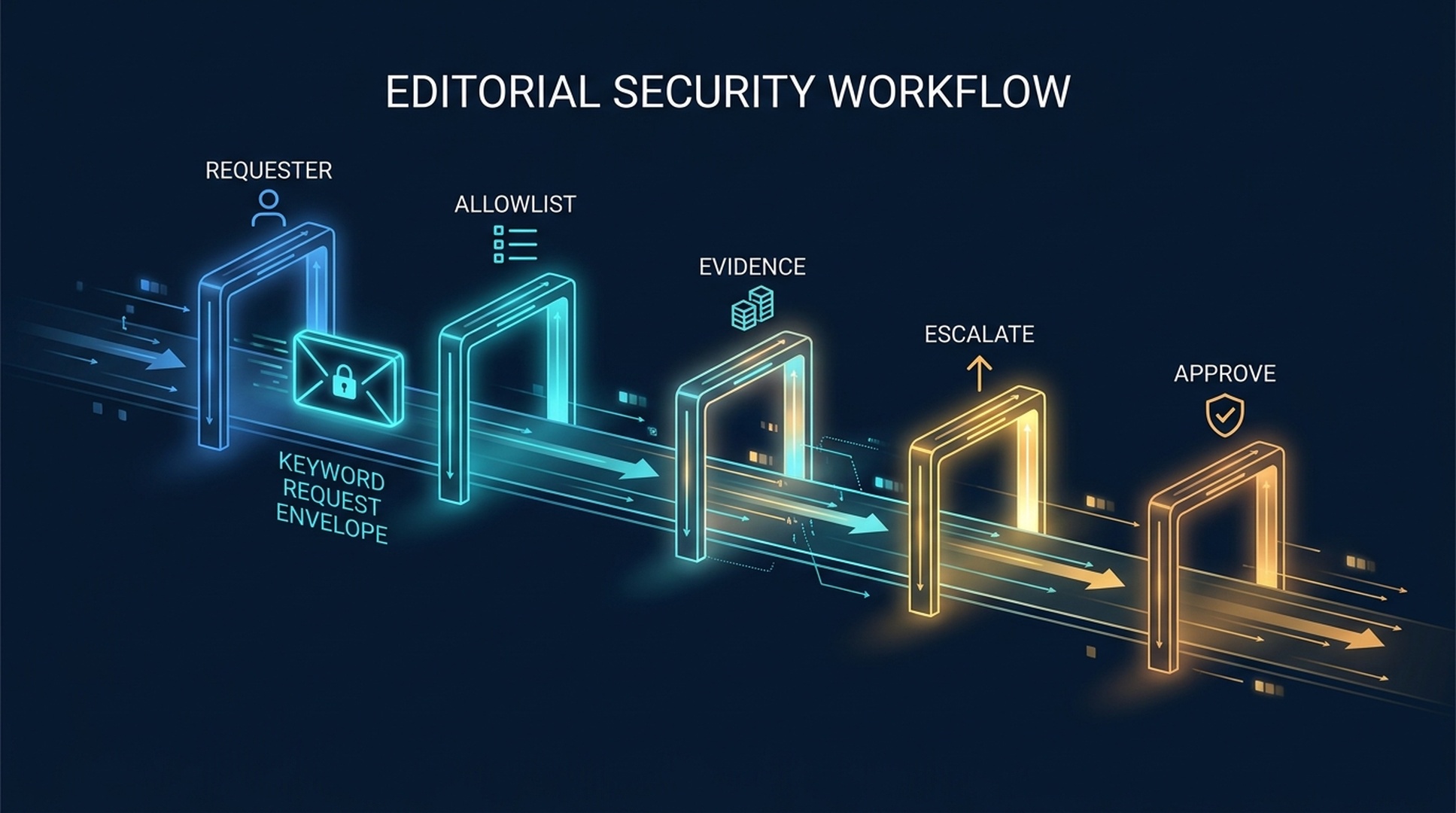
Caption: A useful audit trail begins before the agent reads the first keyword export.
Run the agent through three bounded passes
Do not use one giant prompt. Use three passes with a separate output for each.
Pass one: normalize supplied evidence
Ask the agent to preserve original columns, dates, markets, and unknowns. It may deduplicate obvious variants, but it should not make up intent classes or metrics.
Pass two: test page ownership
For each viable candidate, compare the searcher job against the URL inventory. Return one of five routes: refresh, expand, consolidate, create, or defer.
Pass three: state the decision case
The final report should recommend one candidate only when it can name the evidence, owner page, searcher job, SERP page type, conversion path, and open risk.
Keep the records distinct. A reviewer should be able to see whether an assertion came from the export, the content inventory, or an agent interpretation.
Escalate ambiguity instead of guessing
OpenClaw becomes risky when an agent treats missing permission as implied permission. Define escalation conditions up front:
- a source contains personal, customer, or regulated data;
- the current SERP cannot be checked from the approved environment;
- the existing-page owner is unclear;
- a proposed claim is not in the brand-facts file;
- the request asks for a CMS edit, outreach, or publication;
- the topic touches a regulated or high-stakes decision.
For each condition, the agent should stop at a concise clarification note. That is a successful output, not a failed one.
Review a decision record, not a chat summary
The content owner should receive a stable report with these fields:
Request and authorization status
Allowed sources consulted
Primary query and supporting wording
Searcher job and market
Observed SERP page type
Existing owner URL or proposed route
Evidence IDs
Business-fit statement
Open risks and UNKNOWN fields
Recommendation: approve / revise / defer / reject
Avoid letting the report become a general recommendation feed. One request should result in one clearly bounded decision. A second product line, market, or page type deserves another request envelope.
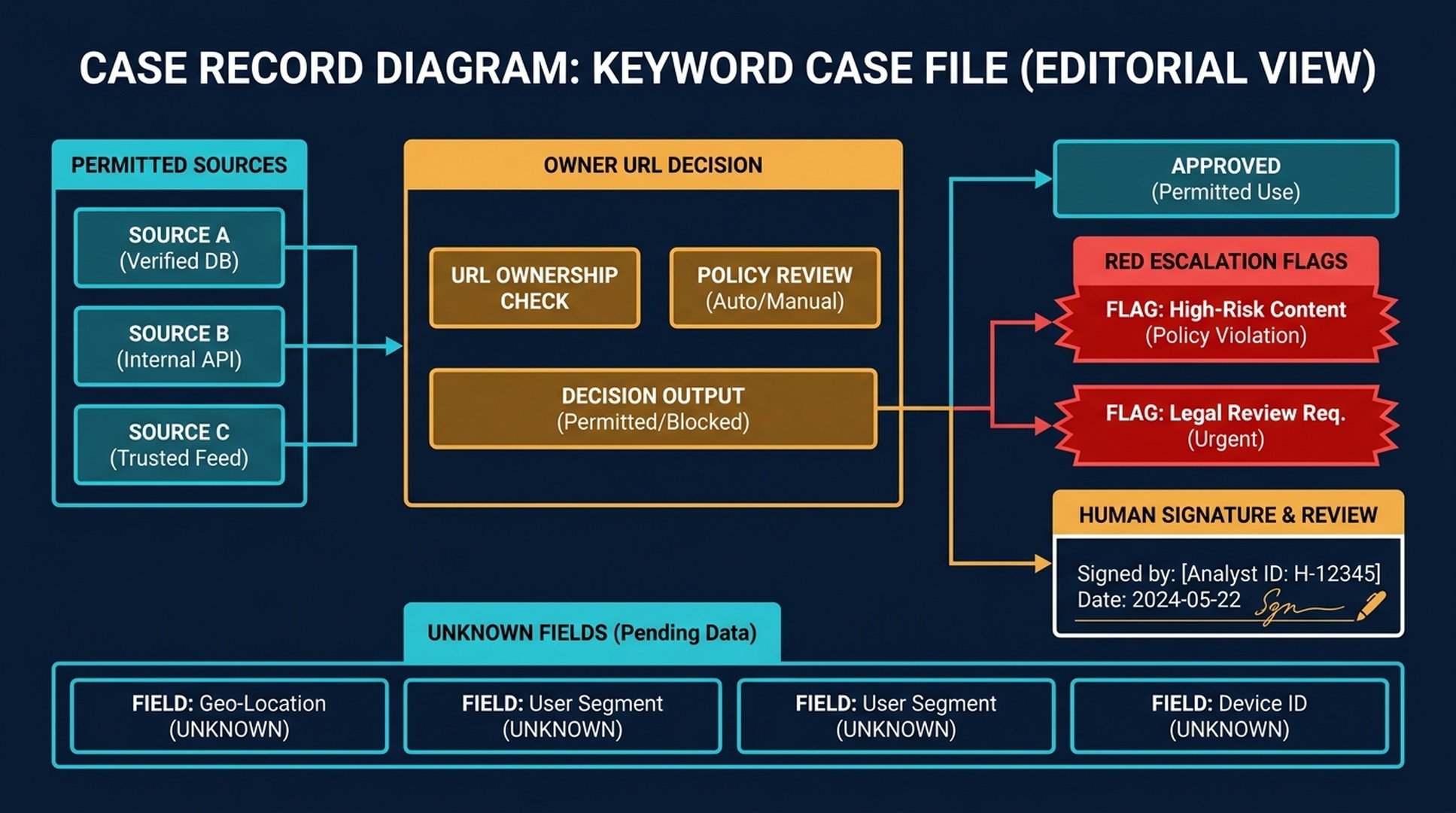
Caption: The approval record explains both the recommendation and the limits placed on the work.
Close the case and preserve only what is needed
After a decision, record the outcome and archive the minimal research artifacts required by your policy. Do not retain raw inputs indefinitely just because an agent used them. Link the approved writer brief or implementation ticket, but do not turn the original research agent into an unattended publisher.
For recurring requests, reuse the envelope template, not the prior conclusion. Fresh data, current page inventory, and a current SERP check still matter.
Verification checklist
- [ ] A recognized requester initiated the case.
- [ ] Allowed and prohibited sources are explicit.
- [ ] The report separates source facts from agent interpretation.
- [ ] Missing access produced an escalation, not an invented result.
- [ ] Exactly one owner URL or planned route is named.
- [ ] A human content owner made the final decision.
- [ ] No publishing or external action occurred during research.
FAQ
Can an OpenClaw agent browse the web for SERP research?
Only if that tool and destination are explicitly authorized in the request and workspace. A permitted connection is still not proof that any site may be accessed without review.
What should happen when a requester asks to publish immediately?
Return a decision report first. Publishing should require a separate, explicit approval path with a named owner.
Why keep the requester in the report?
It helps reviewers understand the business context and provides accountability when sources, markets, or priorities conflict.
Can the agent reuse a previous case file?
It can reuse the template, but not assume the prior evidence or decision remains current.
Author: Tessa Clarke, Content Governance Lead for 120+ Editorial Systems at Auspia. Tessa writes about review controls, permission boundaries, and reliable content operations.