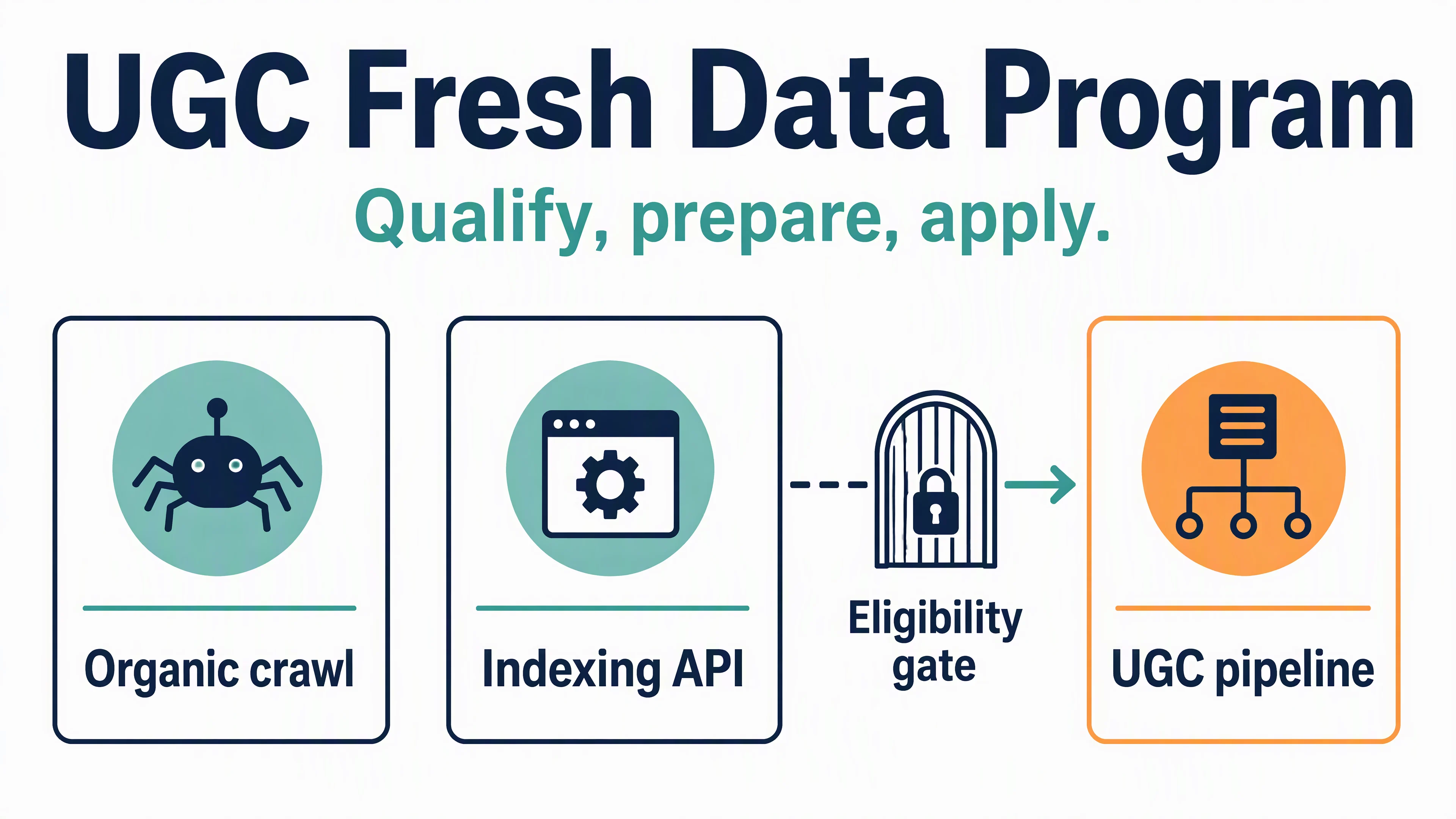
Google’s UGC Fresh Data Program is a separate submission channel for approved platforms that host large volumes of public, creator-attributed user-generated content. It is intended for fresh, trending social posts and forum discussions, not routine website pages. Google’s documentation says the program is independent of traditional organic crawling and the Indexing API, and participation does not guarantee that a page will appear in Search.
If you operate a forum, community, or social platform, use the checks below to decide whether an application is worth preparing. If you run a typical company blog or brochure site, focus on crawlability, internal links, and sitemaps instead.
First, choose the right Google pathway
These three mechanisms solve different problems. The UGC program is the one with a dedicated pipeline for qualifying platforms; the other two remain the usual routes for general web content and a narrow class of time-sensitive pages.
Path | Intended use | What it means for your team |
|---|---|---|
Organic crawling | Google discovers and crawls eligible web pages across the open web | Keep pages accessible and indexable; provide clear links and a sitemap. Discovery or indexing is never guaranteed. |
Indexing API | Pages that contain | Use it only for those supported page types. A notification prompts Google to schedule a crawl; it is not a general-purpose fast indexing API. |
UGC Fresh Data Program | Approved platforms with trending user-generated posts and interaction signals | Apply for access to a separate ingestion pipeline. Google provides integration details to selected platforms after acceptance. |
Google announced the documentation on October 8, 2026. The program is specifically described as separate from regular organic crawling and the Indexing API. That distinction matters: adding structured data or calling the Indexing API does not enroll a site in the UGC program.
Run the eligibility check before preparing an application
Treat this as a qualification gate, not a scorecard. Google publishes criteria but no numeric traffic, post-volume, or active-user threshold. Don’t invent one or assume that a large audience alone is enough.
1. Confirm that user posts are the product
The platform should primarily host content created independently by its users, such as social posts or forum discussions. A company blog with comments, a publisher’s editorial site, or a page that mostly republishes material from elsewhere is a weak fit.
Write down the platform’s main content types and who creates each one. Include a few representative URLs. The point is to show that UGC is central to the product, not an occasional feature.
2. Check the page shape and public access
Each post or discussion needs its own stable URL. A profile page or scrolling feed is not a substitute for a dedicated page for each item. The page must be publicly accessible to both users and Googlebot; content behind a login, paywall, or other access gate is ineligible under the published criteria.
Open sample URLs in a logged-out browser, then inspect whether Googlebot is blocked by robots rules or page-level directives. Check that the URL returns a successful page and that the post itself is visible without an account. If a post is only readable inside an app or a member session, resolve that before applying.
3. Verify attribution, moderation, and reporting
Every UGC item must be attributable to its creator, with a public profile. The platform also needs active moderation and a way for users to report content. Google excludes illegal content.
Document who handles reports, how users submit them, and what happens after a report. If the process exists only as an informal support inbox, make it clear and usable before you describe the platform as having a reporting mechanism.
4. Check structured data and authentication
Google expects valid Schema.org markup on the relevant URLs. Its examples include SocialMediaPosting and DiscussionForumPosting, with interactionStatistic for engagement information. Validate real post pages, not just a staging template, and make sure the markup describes what a user can see on the page.
The integration also requires secure OAuth 2.0 API authentication. Before applying, identify the team that can own authorization, data delivery, and access reviews. Google shares detailed developer documentation with platforms after acceptance, so don’t plan an integration against undocumented endpoints or infer a payload format.
5. Test whether your freshness operations are realistic
Google says new content should ideally be sent within minutes of creation. Engagement-counter updates should be sent regularly and within 72 hours of a post’s creation. These are operational expectations, so compare them with your actual publishing and event pipeline.
Measure your current delay from post creation to a reliably available event. Then check how likes, replies, or other interaction counts are updated. If data moves through a daily export, or counters routinely arrive several days late, name that gap and estimate the work to close it before you apply.
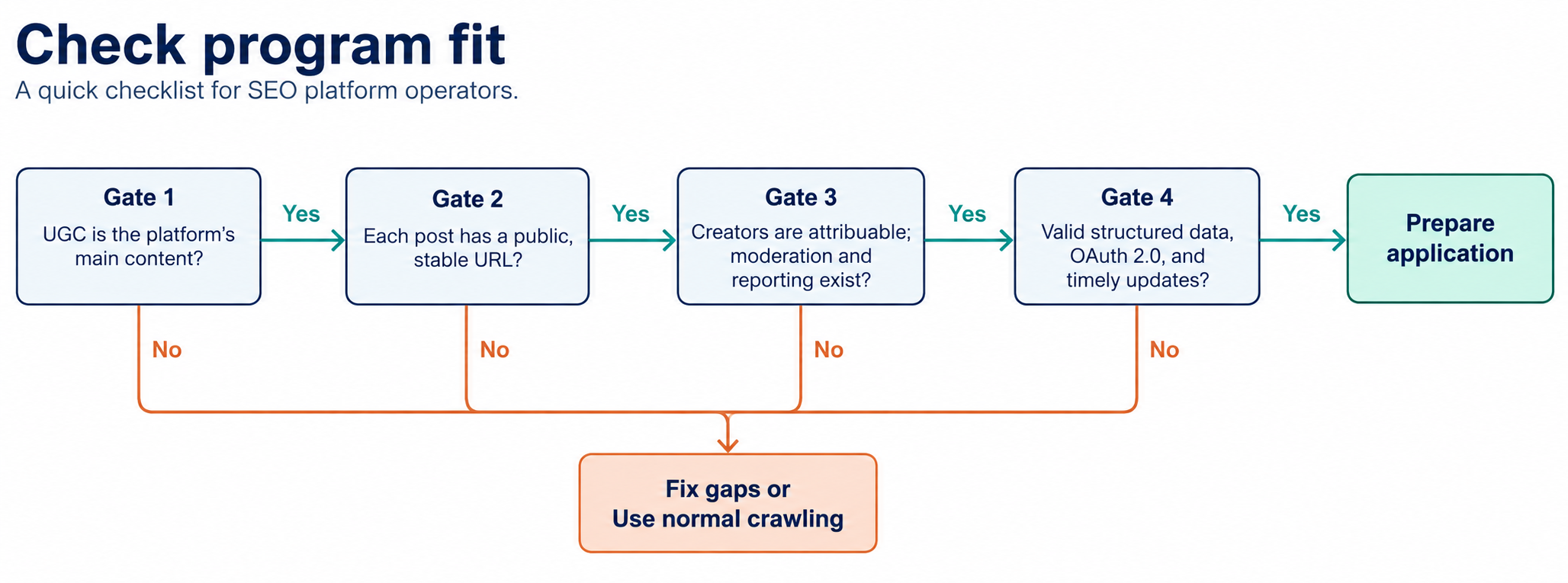
Use these four gates to decide whether to prepare an application, fix gaps, or rely on normal crawling.
Assemble a small readiness dossier
A focused evidence bundle makes the application easier to answer and exposes gaps early. Keep it factual and use public sample URLs wherever possible.
- Platform summary: what users publish, why it is UGC, and the approximate scale of active publishing and audience. Label internal estimates; Google has not published a minimum threshold.
- Sample pages: several stable URLs across the platform’s main UGC formats, checked while logged out.
- Access and attribution: notes on Googlebot access, public creator profiles, and how each post links to its creator.
- Safety operations: moderation ownership, user reporting path, and a concise description of how reports are handled.
- Technical evidence: representative rendered JSON-LD, validation results, and the team that will own OAuth 2.0 and integration security.
- Freshness evidence: observed time from creation to delivery, plus how often engagement counters are updated.
Do not send user-level personal data as a substitute for this summary. The public eligibility page describes the requirements; the detailed ingestion specifications are made available after acceptance.
Apply through Google’s official program page
Once the core checks pass, use the interest form linked from Google’s UGC Fresh Data Program documentation. Describe the platform plainly and map your evidence to the eligibility criteria. Avoid claims such as “all content is indexable” or “instant inclusion”; the program does not promise Search visibility.
Google says applicants should expect a response in six to eight weeks. If selected, the platform receives technical integration documentation and onboarding. Until then, continue supporting ordinary discovery and crawling for your pages. Applying is not a replacement for a sitemap or sound technical SEO.
Verify the decision and keep the fallback healthy
Before submitting, a second person should be able to review the dossier and answer “yes” to the published requirements: UGC is the platform’s main purpose; items have stable public URLs; creators are attributable; moderation and reporting exist; structured data is valid; OAuth 2.0 ownership is assigned; and the team can meet the freshness expectations.
If one of those conditions is missing, assign an owner and revisit the application when it is fixed. If the product is not a fit, use Google’s standard technical requirements: let Googlebot access the page, return a successful HTTP response, and make the content indexable. Provide discoverable links and a sitemap, then use Search Console’s URL Inspection and indexing reports to investigate individual URLs and broader coverage. These checks help diagnose eligibility; they do not guarantee indexing.
Questions platform teams ask
Does adding `DiscussionForumPosting` schema qualify my site? No. Valid structured data is one requirement among several. It does not grant access to the dedicated pipeline.
Can any website apply? The published criteria target platforms primarily hosting independently created UGC at scale, with dedicated public pages and the required safety and technical operations. Google does not publish a universal numeric cutoff.
Does acceptance guarantee indexing or rankings? No. Google explicitly says participation does not guarantee that content will appear in Search.
Should an ordinary blog use the Indexing API instead? Only if its pages meet the API’s supported JobPosting or livestream BroadcastEvent use cases. For other pages, maintain normal crawl access and sitemap coverage.
Martin Hayes builds step-by-step playbooks and operating checklists for SEO and growth teams.