Google Adds AI Overviews and Agentic Dashboards to Google Ads and Analytics
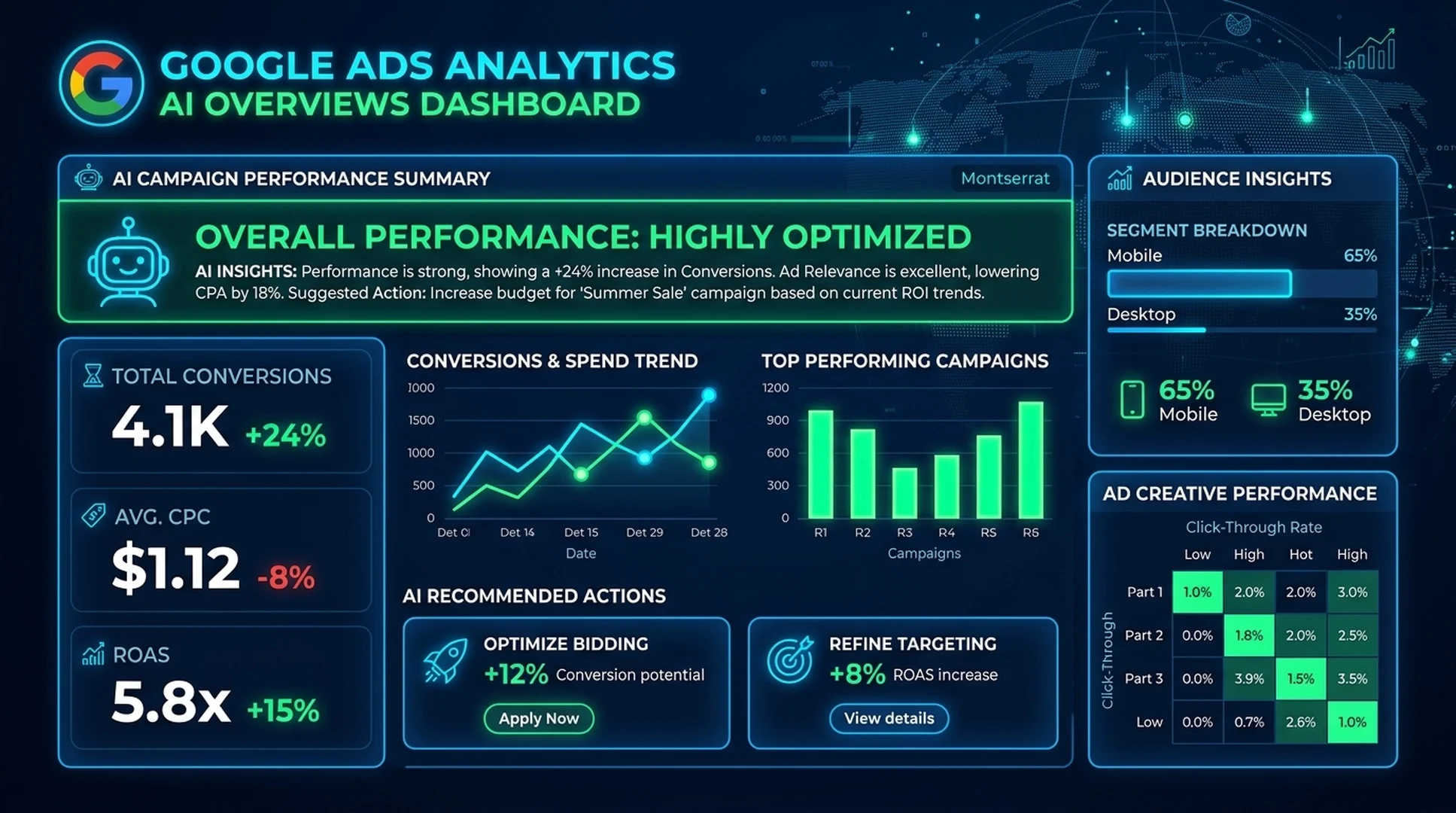
Google announced on August 10 that it is embedding AI Overviews and new agentic capabilities into Google Ads and Google Analytics, bringing generative AI summaries directly into the interfaces marketers use every day. The update, detailed in a blog post by Josh Moser, Senior Director of Product Management, introduces homepage AI summaries, text-prompt-driven reporting dashboards, and a competitive benchmarking tool — all built on Gemini.
The changes arrive as Google places AI agents inside more of its own products. Ask Advisor, the company's in-product AI assistant for marketing platforms, was introduced earlier this year and has since expanded across Google's advertising and analytics tools. This latest round gives Ask Advisor new data sources, new output formats, and a more prominent position in the user interface.
The details
The most visible change lands in Google Analytics, where AI Overviews now appear at the top of the homepage. When users log in, they see an instant summary of notable changes since their last visit — seasonal sales peaks, traffic shifts, or other performance anomalies. The format mirrors the AI Overviews that appear in Google Search results, though here they summarize account data rather than web content.
Each summary card links directly into Ask Advisor for deeper analysis. A marketer who notices a traffic drop in the overview can click through and ask the agent to investigate causes or suggest actions. Users can also opt into push or email notifications at a cadence they choose, so the summaries arrive whether or not someone opens the Analytics interface directly.
Google Ads gets a parallel treatment. The Ads homepage now surfaces AI-powered insight cards tailored to each advertiser's account. These cards surface time-sensitive information — competitor moves, emerging demand signals, or campaign opportunities. Above the cards sits a prompt box that lets users generate custom insights on demand. An advertiser could ask how competitors are affecting their impression share or which trends might improve their campaigns, and the system generates a response drawn from their account data.
The second major addition is a new Dashboards feature in Google Ads, with a Google Analytics rollout planned for later. Marketers can type plain-language prompts to convert raw data into visualizations. Instead of navigating nested menus to build a report, a user might type "show me branded vs. non-branded search traffic over the last quarter" and receive a formatted chart. Google says every report automatically generates a real-time summary explaining the reasoning behind the numbers, not just the numbers themselves. The company described this as transforming "raw data into clear visualizations with simple text prompts."
The third piece is a benchmarking tool inside Google Analytics' Ask Advisor. It compares a user's campaign performance against anonymized averages from similar businesses, giving marketers a reference point without needing to build their own competitive data sets. The tool addresses a long-standing pain point in digital marketing: knowing whether your metrics are good in absolute terms is less useful than knowing how they compare to peers in your category.
"Ask Advisor has become my go-to for a directional check on paid media performance," Kevin Marshall, Paid Media Director at home gardening company Gardyn, said in the announcement. "That speed matters because it gives me time to dig deeper and make shifts that improve performance sooner."
Google confirmed all the new features are built on Gemini, the same model family that powers AI Overviews in Search and the company's broader consumer AI products.
Some of the underlying technology appeared first in Google Merchant Center, where similar AI-driven reporting features began rolling out in recent weeks. The expansion to Ads and Analytics represents a broader deployment of the same approach.
Why this matters for SEO and AI visibility
The announcement confirms that Google views AI Overviews as a product pattern rather than a Search-specific experiment. The same summarization approach that answers user queries in Search now summarizes marketing data inside Google's own tools. For teams tracking how AI changes content visibility, the pattern is hard to ignore. Google is standardizing on the "AI Overview" format across surfaces.
That standardization has practical implications. The skills needed to earn citations in Search AI Overviews — structured data, clear entity signals, extractable content with direct answers — are the same skills that make content useful to any AI summarization system. As Google deploys these patterns across more products, the payoff for well-structured content compounds.
The benchmarking feature also raises questions that SEO and paid media teams should track. If Google is comparing advertiser performance against anonymized peer averages, the thresholds for what counts as strong performance may shift as more advertisers adopt AI-assisted optimization. Teams that understand how these benchmarks are calculated — and which peer group they fall into — will have an informational advantage.
What to watch next
Google said the Dashboards feature is coming soon to Google Analytics, though no specific date was given. The AI Overviews in Analytics and the insight cards in Google Ads are available now. The company's broader trajectory points toward deeper Ask Advisor integration across all Google marketing products, with the agent taking on more autonomous actions rather than just answering questions.
For SEO teams specifically, the question is whether Google's analytics AI will eventually surface organic search visibility data in the same summarized format — flagging AI Overview citation rates, for example, or comparing a site's AI search presence against category benchmarks.
Sources
- Google Ads & Commerce Blog — "Evolve your marketing with new AI tools" (August 10, 2026)
Author: Sophie Renard, AI Search Briefing Analyst at Auspia. Sophie tracks timely updates across 30+ platforms and distills them into concise briefs for search and AI visibility teams.