What you will have when you are done
A short, prioritized list of directories your company can join for free, ordered by what actually influences whether an AI assistant names you when a buyer asks for a recommendation. Not four hundred bookmarks. A set you can work through in an afternoon and then leave alone.
Who this is for: SaaS founders, B2B marketers, and anyone responsible for a company profile that a chatbot might describe.
Prerequisites: a working product page, a one-sentence description you are happy to see quoted, a company email address on your own domain, and a logo file.
Time: about three hours for the first pass across roughly twenty sites, plus review requests that run on their own schedule.
Done means: you can name the directories you are listed on, each listing carries the same company description and category, and at least three of them publish a list page in your category. You are not done when you have submitted. You are done when the listing is live and consistent.
Read this before you submit anything
A claim is circulating that directories now supply 41% of AI citations for B2B buyer queries, that G2, Capterra, and TrustRadius account for most of it, and that a company missing from those lists does not exist as far as AI is concerned.
The 41% is real, and it has a source. The rest of the claim has drifted.
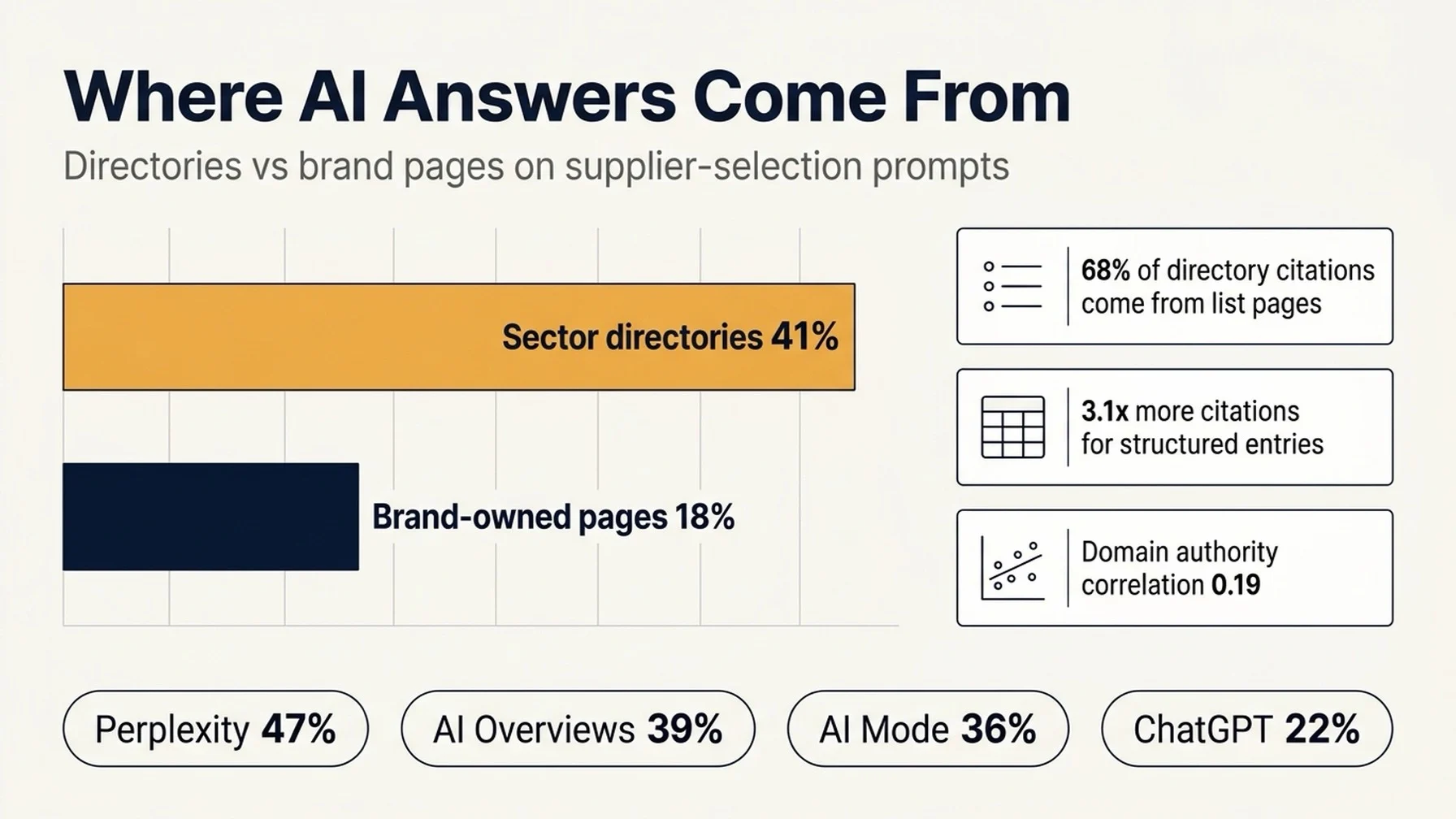
The number comes from a study published on 15 September 2026 by Citations.press, titled Sector Directories Are Driving AI Overview Citations. It ran 3,850 commercial prompts across ChatGPT, Google AI Mode, Perplexity, and Google AI Overviews between 10 June and 22 August 2026. Sector directories accounted for 41% of the citations behind AI-generated provider recommendations. Brand-owned pages accounted for 18%.
Four things the shareable version leaves out:
The 68% figure does not mean what it looks like. The study found that 68% of directory citations came from list pages rather than individual profile pages. In the version going around, that number has been reattached to G2, Capterra, and TrustRadius. Those platforms do appear in a different study, by Peec AI, which analyzed 30 million sources cited across five AI platforms and found that recommendation queries lean on third-party validation, with G2 landing in Perplexity's five most-cited domains. But that is a separate study measuring a separate thing, and it never produced a 68% figure about list pages. Two studies, two different measurements. If you build a plan around the merged version, you will spend money on the wrong thing.
The three platforms it names are not three platforms anymore. On 29 January 2026, G2 agreed to acquire Capterra, GetApp, and Software Advice from Gartner. That deal has closed. Gartner Digital Markets now redirects to G2 Digital Markets, and the copyright line on the new site reads G2.com, Inc. TrustRadius, the third name in the post, was acquired by HG Insights in June 2025 and operates as its subsidiary. So the claim lists three vendors. There are two corporate groups, and one of them now runs four of the largest review surfaces in the market. You did not need a further reason to check a claim before building a plan on it, but there is one.
The publisher operates the directories it tested. Citations.press describes itself as publishing research on how AI assistants select and cite sources, and it operates the sector directories used as the study's test set, including Engineering Panel, IT Suppliers, Partner Base, Agency Roster, Trainers List, and Secret Salons. The company also sells citation submission. That does not make the data wrong. The raw citation records, the full prompt set, and the classification rules are published alongside the study, which is more than most vendor research offers. It does mean you should read the conclusion as marketing for a product, and the measurements as the useful part.
I have read a lot of vendor research that hides its funding and its sample. This one publishes the full prompt set, the raw citation records, and the rules used to classify sources. That does not make the conclusion neutral. It makes the measurements checkable, which is the part worth your time.
It has not been replicated. The study says so directly. Its own listed limitations are worth knowing: responses are unstable across repeated runs, accounts, and regions; the prompt set is weighted toward the six sectors tested; source-type classification involves judgment; and the research measured citation frequency, not any effect on purchasing behavior.
Still, the finding is not isolated. DeltaV Digital tracked 21,075 AI engine responses and 25,337 citations across five engines over 90 days, and found that listicles made up 61% of the pages AI engines cited in B2B technical services. DeltaV discloses that it sells AI visibility work. Both studies point the same direction, and both were produced by companies selling the fix.
There is a third dataset worth more of your trust, because the company selling rank tracking has less reason to flatter directory submissions. SE Ranking classified 211,000 links across 30,000 commercial keywords and found that review platforms accounted for 8.5% of all links but appeared in 34.5% of Google AI Overviews. Five platforms took 88% of those citations: Gartner Peer Insights 26%, G2 23.1%, Capterra 17.8%, Software Advice 12.8%, TrustRadius 8.3%. The platforms were eight times more likely to appear in the source block than to be mentioned by name in the text.
And then the finding that reframes the question. Across 2024 and 2025, those same platforms lost most of their organic traffic. TrustRadius fell 92.2%. Capterra fell 89%, from roughly 1.63 million monthly visits to 179,000. GetApp fell 89%. G2 fell 84.5%, from 2.56 million to 397,000.
Put those two findings side by side. Organic traffic and AI citation have come apart. A platform can lose nearly all its human visitors while becoming a more important source for the answer a buyer reads. If your plan is built on traffic metrics, or on the domain-authority numbers that tend to track them, you are measuring a different thing than the one you care about. Directory work is not dead. The way most people sort directories is.
None of that is a reason to ignore the directories. It is a reason to read the finding rather than the headline: AI assistants lean on third-party lists, and the lists they lean on are the ones that resolve a category question completely.
The two findings that should reshape your list
Two numbers buried in the methodology matter more to your to-do list than the 41%.
Finding | What it measured | What it means for you |
|---|---|---|
Directories with one entity per entry and consistent attributes were cited 3.1× more often than directories with free-text listings | Compare a directory that stores each product in fixed fields against one where vendors paste arbitrary descriptions | Structure beats reach. A small directory with clean, comparable entries beats a large one where every listing is formatted differently |
Correlation between a directory's domain authority and how often it was cited was 0.19 (Spearman rank) | Domain authority is a weak predictor of AI citation inside this dataset | Stop sorting your to-do list by DR. It is close to noise here. Coverage depth inside your category was the stronger predictor |
That second row is the uncomfortable one. Most free directory lists, including the spreadsheets people trade, are sorted by domain rating, because DR is easy to measure and looks like a proxy for value. In this dataset it explains almost nothing. What predicted citation was whether a directory covered a stated category completely.
There is a second, harder implication. Directory citation rates on category prompts were not close to uniform: Perplexity 47%, Google AI Overviews 39%, Google AI Mode 36%, ChatGPT 22%. Overlap between the cited source sets across the four platforms was 31%. If you want to know whether a listing worked, you cannot check one chatbot and call it done.
A note from checking our own copy of "the list"
Free-directory spreadsheets circulate constantly, and they mostly descend from the same few sources. We took one of the larger ones and checked it at the submit page rather than at the marketing copy.
Of 549 directories, 79 held up: a real free path, no payment step, no condition requiring a link or badge on your own site. Sixty-one failed outright. The most common reasons were a free tier that had been withdrawn in favor of paid-only listing, and a "free" submission that turned out to require a reciprocal backlink. The remaining 409 could not be confirmed either way, usually because the submit page renders behind JavaScript or blocks automated checks.
Roughly one in seven survived. That ratio is the reason this article gives you a queue instead of a spreadsheet, and it is the reason Step 1 asks you to check coverage before you check a single directory.
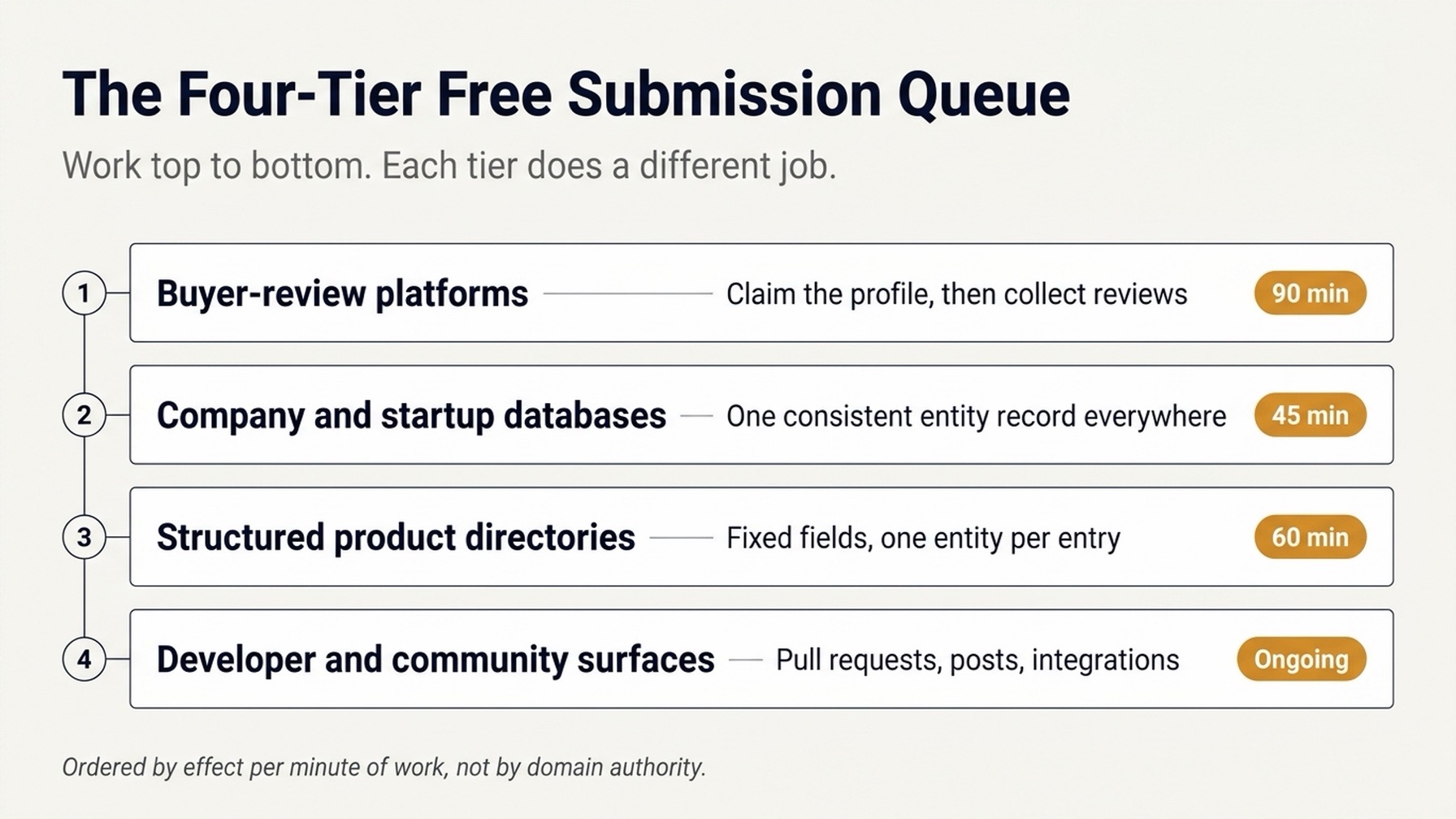
The queue is ordered by effect per minute of work, not by domain authority.
Step 1: Audit category coverage instead of directory count
Before you submit anywhere, answer one question: which directories publish a complete list for your category?
Open the four surfaces you care about and run a prompt that names your category but not your company. Something like "best [category] software for [use case]". Then look at where the answer points. You are looking for list pages, not brand pages.
Record what you find:
- Which directories appear across more than one prompt. Those are the ones covering your category thoroughly enough to be retrieved repeatedly.
- Which list pages rank products like yours. A directory that lists enterprise vendors only is not your target if you sell to small teams.
- Whether your competitors are already on those list pages. Competitor presence tells you the directory accepts companies at your stage.
- Which of the four surfaces surfaced them. Perplexity and AI Overviews cite directories far more aggressively than ChatGPT does. If Perplexity shows the list and ChatGPT does not, that is a platform gap, not a directory failure.
Quality check: you should end with three to six named directories. If your list has thirty names, you have collected directory homepages rather than category coverage. Go back and check which ones actually publish a list in your category.
If nothing appears: your category may be too narrow for a directory to cover, or your prompt may be too specific. Widen it once, then move on to Step 2 and let the listings themselves reveal the coverage.
Step 2: Claim the buyer-review platforms
These are the profiles that describe your company as an entity. Review platforms are the reference layer buyers check after an assistant names them.
Start here because it is the highest-value free work available: you are claiming an existing profile rather than asking a small directory to add you.
Platform | Domain | Free path | Watch for |
|---|---|---|---|
G2 | g2.com | Free vendor profile through the seller signup at g2.com. Verified 16 September 2026 | Paid placement exists but is not required to be listed. G2 now also operates Capterra, GetApp, and Software Advice |
Capterra | capterra.com | Free listing | Now part of G2, alongside GetApp and Software Advice. One seller account reaches four surfaces |
TrustRadius | trustradius.com | Free profile claim. Page says "Claim your free profile to get started" | Reviews are the entire point. An empty profile is close to worthless |
Trustpilot | business.trustpilot.com | Free account tier. "No credit card required"; 50 review invitations a month | One user login and 10 ecommerce integrations on the free tier, zero marketing integrations. Paid plans bill 12 months prepaid |
SourceForge | sourceforge.net | Free business listing via the vendor intake form; no payment field and no plan selection | The word "free" never appears on the form. Positions are set by plan price, and premium packages are pitched after you submit |
FeaturedCustomers | featuredcustomers.com | Free verified profile. Page says "Get verified for free" | The form is a contact modal, not an instant listing, and you will be quoted for adding customer references |
Product Hunt | producthunt.com | Free to launch. FAQ says "It's 100% free to use" | Company accounts are prohibited, so you launch as an individual. Login required |
SoftwareSuggest | softwaresuggest.com | Free vendor listing | Checked live 16 September 2026 |
SaaSHub | saashub.com | Free registration, then list | Checked live 16 September 2026. Also publishes alternatives-style comparison pages |
Crozdesk | crozdesk.com | Free vendor signup | Business email required |
FinancesOnline | financesonline.com | Free product submission | Expect a paid review pitch after you submit |
Clutch | clutch.co | Free vendor profile | The onboarding form is long and the links are nofollow. Worth it for the brand profile, not for link equity |
G2, Capterra, and TrustRadius are the three the circulated claim names, and between them they now cover four of the platforms in this table. They matter, but not for the reason the post gives. Their value is that they hold structured, comparable, review-backed entries in a category, which is exactly the shape of source the study found being cited. You do not need to pay any of them to be listed, and one G2 seller account reaches four surfaces.
One calibration note before you spend a morning here. PeerSpot is a platform you will see described as free on a lot of directory blogs. Its own vendor pages do not say that. Every route on its site is a contact form or a demo booking, and the only "free" it advertises belongs to a separate content product. I left it off the table rather than repeat what third parties claim about it.
In the SE Ranking dataset, AlternativeTo, SaaSHub, and FinancesOnline were not cited at all. That is one study, on one surface, in one snapshot, so it is not a verdict. But if a platform is described as free only by other people, or never appears in your own Step 1 coverage audit, believe the audit over any list, including this one.
Quality check: the description you write should match your website's meta description word for word where possible. Inconsistent company descriptions across platforms are one of the most common reasons an assistant describes a company vaguely.
Recovery path: if a platform asks for a business email and you use a personal domain, most accept a support request with proof of company control. If a platform requires you to prove you are a vendor representative and you are not, hand the claim to whoever owns the company email on that domain and come back.
Step 3: Fill the company and startup databases
These listings carry your name, category, founding year, location, and one-liner. Individually they look like nothing. Together they are the consistent entity record that decides whether an assistant can describe you at all.
Directory | Domain | Notes |
|---|---|---|
F6S | f6s.com | Broad startup database, free product or service listing. Fronted by a bot check, so expect a browser pause |
Built In | builtin.com | Company profile you create yourself. Your email domain should match the company domain |
Wellfound | wellfound.com | Free company profile tier. Blocks automated checks, so verify the current terms in the dashboard |
Startup Stash | startupstash.com | Alive and free. The submission path has moved, so navigate from the site footer rather than a bookmarked URL |
SideProjectors | sideprojectors.com | Free submission; doubles as a marketplace if you ever sell the project |
PitchWall | pitchwall.co | Free startup listing. This is what BetaPage became; betapage.co now redirects to pitchwall.co |
FoundersBeta | foundersbeta.com | Free submission at foundersbeta.com/submit |
Acquire.com | acquire.com | Free company profile. Useful as an entity record even if you never intend to sell |
Callupcontact | callupcontact.com | Free listing form at callupcontact.com/add-listing |
Brownbook | brownbook.net | Free business listing database |
On Top List | ontoplist.com | Alive and free. The submission path has moved, so start from the homepage |
Viesearch | viesearch.com | Alive and free. The submission path has moved, so start from the homepage |
SubmitMySaaS | submitmysaas.com | Free submission. Advertises paid placement beside it, so pick the free lane deliberately |
StartupBase | startupbase.io | Free submission, account required |
Every domain in the table above returned a live page on 16 September 2026. Where a submission URL I expected came back missing, I have said so and pointed you at the site itself rather than hand you a link that will 404. Directory owners rearrange their submit pages constantly, which is the same reason Step 7 asks you to verify rather than trust.
Quality check: open every listing side by side and confirm four fields match exactly: company name, category, one-liner, and website URL. Then check that your one-liner ends with a period and reads as a sentence, because that is how a model will quote it.
Step 4: Pick structured product directories
This is where the 3.1× finding earns its place. You are looking for directories that store each product in fixed fields: name, category, pricing model, platform, tags. Skip anything where you paste free text into a single box.
Every domain below was checked live on 16 September 2026 and returned a working free submission page. They skew toward software and AI tools, because that is where structured fields are most common. If your product sits outside that space, use the field test above to find your own equivalents rather than forcing yourself into a directory whose categories do not fit.
Directory | Domain | Free submission path | What structure it gives you |
|---|---|---|---|
SimilarLabs | similarlabs.com | similarlabs.com/submit | Category, pricing model, and platform captured as separate fields |
Future Tools | futuretools.io | futuretools.io/submit-a-tool/ | Fixed taxonomy plus a media field, so entries stay visually comparable |
AI Collection | thataicollection.com | thataicollection.com/submit/ | Category and use-case tags as structured selectors |
AITrendyTools | aitrendytools.com | Navigate from the homepage | Category fields; the submit path has moved since last check |
ReviewAI | reviewai.net | Navigate from the homepage | Category and pricing fields; the submit path has moved since last check |
Woy AI | woy.ai | woy.ai/submit | Category and pricing structured separately |
Gets.Tools | gets.tools | Navigate from the homepage | Category, open-source, and affiliate flags as separate attributes |
AIStart | aistart.ai | aistart.ai/submit | Launch-date and category fields, which makes recency filterable |
DetectorTools | detectortools.ai | detectortools.ai/submit-tool/ | Narrow category taxonomy, which is the coverage-depth case in miniature |
LLM Relevance | llmrelevance.com | llmrelevance.com/submit | Category and pricing fields, plus a launch surface |
AI Hustle | aihustle.tools | aihustle.tools/submit/ | Category and pricing fields |
Rank My AI | rankmyai.com | Navigate from the homepage | Ranking and category structure |
AI138 | ai138.com | ai138.com/submit | Chinese-language directory with category fields |
AI 导航网 | ainav.cn | Navigate from the homepage | Chinese-language directory with category fields |
Two of these, ReviewAI and AITrendyTools, no longer serve the submission path I had recorded. I left them in with a note rather than deleting them, because a moved submit page is not the same as a withdrawn free tier, and the distinction matters when you are deciding what to cross off your list.
Quality check: view a live listing on the directory before you submit. If the published entries are inconsistent in length, missing categories, or dominated by thin descriptions, the directory is unlikely to be the source a model retrieves.
Step 5: Cover developer and community surfaces
If your product has an API, an open-source component, an integration, or a technical audience, these surfaces are covered by other directories that general marketing lists never mention.
Surface | Domain | How you get in |
|---|---|---|
Zapier App Directory | zapier.com/apps | Free listing through the developer platform once you publish an integration. Only applies if you actually have one |
RapidAPI Hub | rapidapi.com | Free API listing. Requires a real, documented API |
AlternativeTo | alternativeto.net | Free submission, but an account is required: alternativeto.net/software/new redirects to a login. Strongest for products with clear competitors |
Console.dev | console.dev | Free weekly devtools newsletter and directory. Curated, so pitching matters more than submitting |
free-for.dev | free-for.dev | Free-tier listings for developer services. Requires a genuine free tier |
Open Source Alternatives | opensourcealternative.to | Only if your product is open source |
DEV Community | dev.to | Sign up and publish. Profile and posts both count |
Hashnode | hashnode.com | Developer blogging platform with a public profile |
Hacker News | news.ycombinator.com/submit | Submit page is free; the audience decides whether it stays visible |
Devpost | devpost.com/software | Software project showcase |
GitHub curated lists | github.com | Via pull request to a curated list. Free, and the maintainers are strict |
Worth knowing before you spend a Saturday on this tier: several directories in the developer-tools space have died or gone dark recently. MCP Hunt, mkinf, and MCP.ing were all checked on 16 September 2026 and none resolve. Meanwhile LobeHub still lists and accepts servers, but its only claim path asks for read and write access to all your public and private repositories, gists, workflows, and organization settings. A listing is not worth that. Where a directory asks for more access than the listing is worth, walk away.
Recovery path: if a curated list rejects your pull request, read the contribution guidelines before resubmitting. Most rejections are formatting, not quality, and a second attempt that follows the template usually succeeds.
Step 6: Write the entry so a model can extract it
The study found that directories with consistent attributes were cited 3.1 times more often. Your submission is only half of that. The other half is whether the entry you write is comparable to the ones beside it.
Keep these five fields identical everywhere:
- Company name exactly as it appears in your logo and on your homepage. No taglines, no punctuation variations.
- Category using the directory's own taxonomy. Pick the narrowest accurate option, not the broadest.
- One-sentence description under 160 characters, written as a full sentence that names what the product does and who it is for.
- Pricing model as a word, not a range. "Free tier", "Subscription", "Usage-based".
- Website URL, the canonical one, without tracking parameters.
Then use the directory's own structured fields wherever they exist. If it offers tag fields, fill them. If it offers a pros and cons field, write both. Empty structured fields are a retrieval disadvantage you chose.
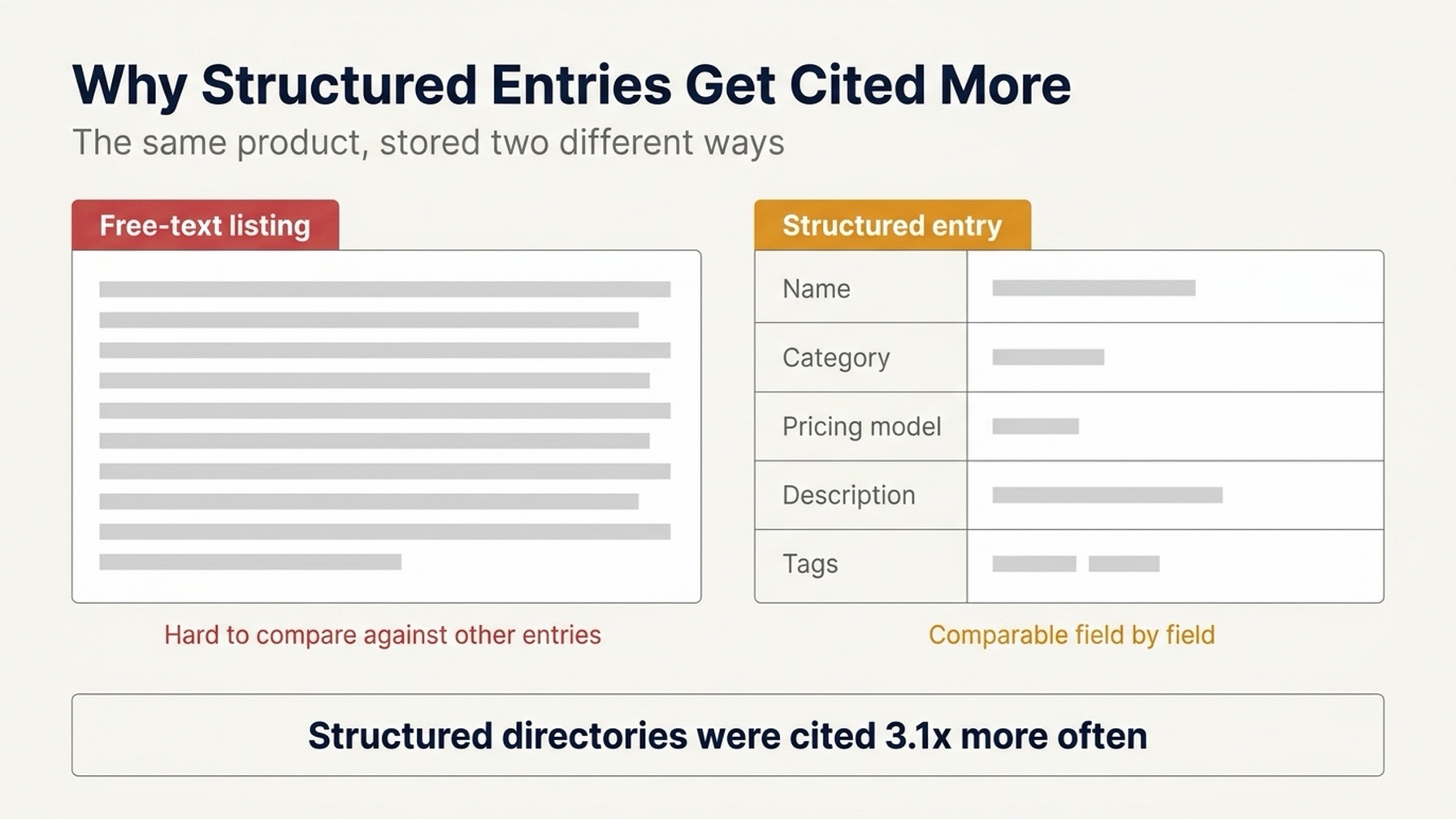
The same product, stored two ways. The structured version is the one a model can compare against its neighbors.
Quality check: read your description out loud as an answer to "what is [your company]?" If it does not work as a spoken answer, it will not work as a cited one.
Step 7: Verify the submission, then verify the citation
Two verifications, and they are different jobs.
Verify the listing is live. Wait for the directory's stated queue, then check the public URL, not the dashboard. Confirm your name, category, and URL are correct, and that the page is indexable rather than sitting behind a login or marked noindex.
If a check fails, be careful what you conclude from it. A URL that 404s usually means the directory moved its submit page, not that it withdrew its free tier. A request that returns 403 usually means the site blocks automated clients, not that the site is gone. Both mistakes lead you to cross a usable directory off your list. Load it in a real browser before you decide, and be aware that a corporate proxy or VPN can return a page that is not the page you asked for. Check where you actually landed.
Verify the citation. Give the directories two to four weeks, then run the same category prompt you used in Step 1 across all four surfaces. You are checking one thing: does a directory list page now appear where it did not before, and does your name appear on it.
Run every check across Perplexity, Google AI Overviews, Google AI Mode, and ChatGPT. The same directory that shows up on nearly half of Perplexity's category answers shows up on roughly a fifth of ChatGPT's, so a single-platform check tells you very little.
If you want a faster read on whether your citation footprint changed across surfaces without setting up a spreadsheet, Auspia's one-page GEO citation audit checks a single page against AI answer surfaces in one pass.
If nothing changes after six weeks: the problem is usually the description, not the directory. Rewrite the one-liner so it names the category and the buyer explicitly, then update it everywhere at once.
Failure modes that waste the most time
Reciprocal backlinks dressed up as free listings. A number of directories offer free submission on the condition that you place their link or badge on your own homepage. That is not free, it is a trade, and in 2026 it is a poor one. Some of these state the requirement plainly; others bury it in an FAQ while the submission page says "no backlink required", which applies only to a paid tier. Read the FAQ, not the submit button.
The free tier that exists but is unusable. A free tier with a three-month queue, nofollow links, and a listing the directory never promotes is technically free. It is also close to worthless. Several directories pair exactly that with an instant paid option. Decide in advance whether you will accept a long queue, because you will be asked repeatedly.
Submitting to everything. The domain-authority correlation of 0.19 cuts both ways. If authority barely predicts citation, then adding fifty low-coverage directories does not compound into visibility. It produces fifty inconsistent descriptions of your company, which is worse than twenty consistent ones.
Paying for a placement before you have reviews. A paid listing on a review platform with an empty profile is a paid empty profile. Collect reviews first. Review density is the signal that makes the profile worth citing.
Chasing the number in the headline. The 41% describes supplier-selection prompts in six sectors over one summer, in a first-party study that has not been replicated. It is a strong signal about where to spend attention. It is not a guarantee, and no vendor can promise you a citation.
What to re-check each quarter
Directory lists rot faster than almost any other asset in a growth plan. Set a quarterly reminder and check four things:
- Is the listing still live and still accurate? Products get delisted, categories get rewritten, and descriptions drift.
- Has the submission policy changed? Free tiers get withdrawn. At least one directory in the AI-tools space has already discontinued free submissions outright and moved to a paid-only model.
- Does the directory still appear on category prompts? Coverage changes. A directory that led last quarter may have stopped publishing in your category.
- Have you added reviews? Review count on your existing listings is the lever that keeps working after the submission is done.
FAQ
The study was published by a company that runs directories. Does that invalidate it? No, but it changes what you should take from it. The measurements are usable because the prompt set, raw citation records, and classification rules are published. And the pattern is not unique to this publisher: DeltaV Digital found it in B2B technical services, SE Ranking found it across 30,000 commercial keywords, and Peec AI found it across 30 million cited sources. The framing is promotional and the specific 41% figure has not been replicated. Take the finding, leave the sales pitch.
Is a directory listing a backlink? Sometimes, but treat it as a separate question. Many free directories publish links as nofollow, and the study's own finding is that domain authority barely predicts citation. The listing's job is to make your company describable and comparable, not to move link equity.
How many directories should we be on? Enough to cover your category completely across the surfaces your buyers use. For most B2B companies that lands somewhere between fifteen and thirty, weighted toward the platforms where buyers actually read reviews.
Do we need reviews to make this work? Yes. A profile with no reviews gives an assistant a name and a category and nothing else. Review platforms without reviews are the weakest version of this exercise, and they are also the ones that matter most when they are populated.
Should we pay for any of these? Not in the first pass. Every platform in this list has a free path. Paying for placement before you have reviews, consistent descriptions, and category coverage is paying to skip the part that works.
How long until we see anything? Give it four to eight weeks before checking citation behavior, and expect the updates to be uneven across platforms. Response instability across repeated runs is one of the limitations the study itself names, so a single check that shows nothing is not evidence of failure.
Does this work for non-English markets? Partly. Regional directories exist and are worth adding, but the coverage-depth finding is the one that travels: a directory that lists your category completely in your language matters more than a global directory where your entry is one line in a list of thousands.
Author: Isabel Grant, Researcher of 2,000+ AI Citation Patterns at Auspia. Isabel writes about citation earning, source quality, and how retrieval systems choose what to quote.