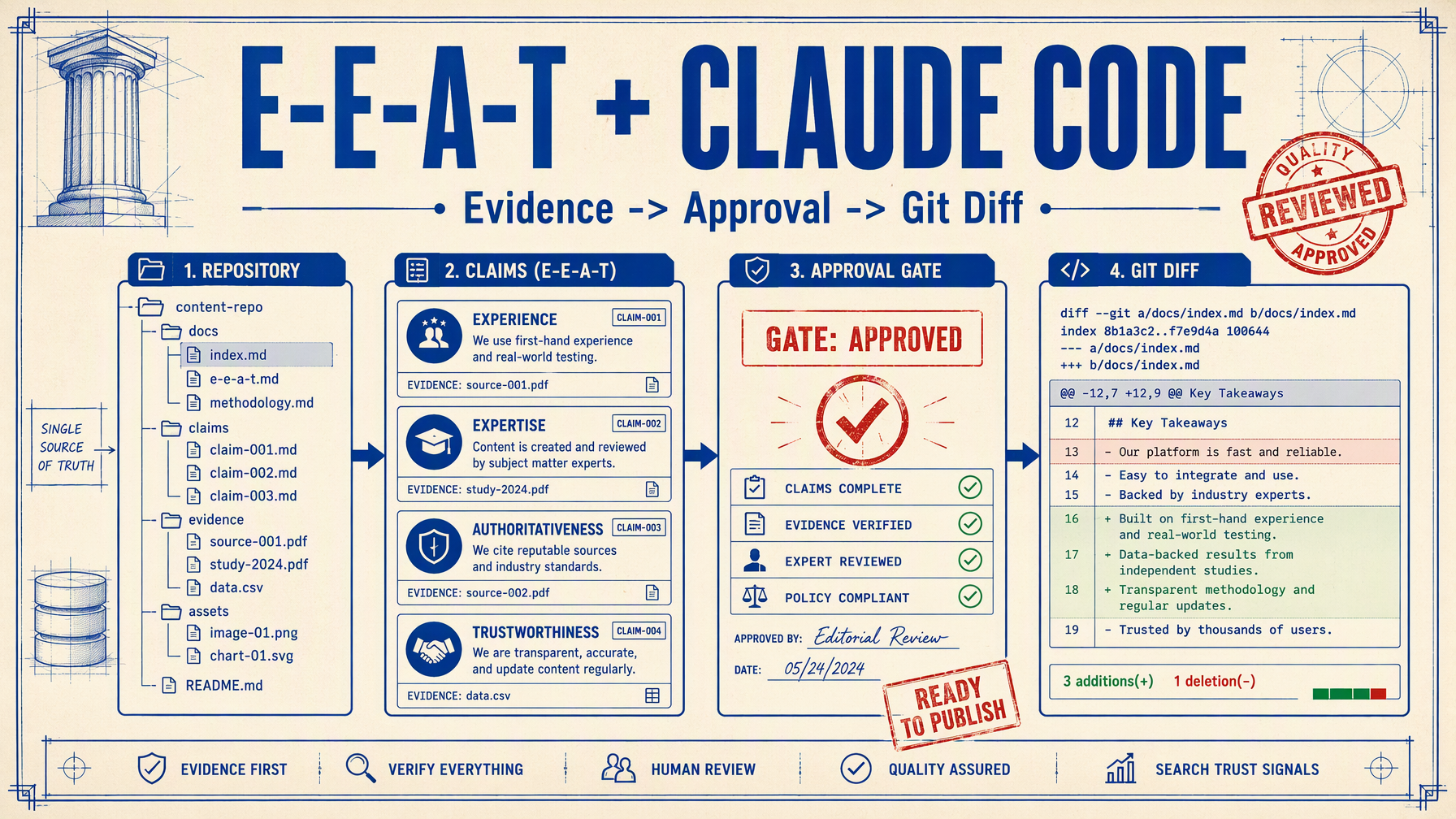
Claude Code is most useful for E-E-A-T work when the page, its supporting files, and its change history live in a repository. Anthropic's Claude Code overview describes a tool that can work across a codebase and run tasks; in this workflow, that access is limited to tracing claims to local evidence, preparing an audit report, and proposing a narrow diff. It cannot confirm that an author has experience, that a testimonial is genuine, or that a source supports a claim unless a person provides verifiable proof.
This workflow deliberately separates the audit from the edit. Claude Code first builds an evidence packet. A human reviews the packet. Only then does it prepare a small change that can be inspected, tested, and rolled back.
What you will finish with
Item | Result |
|---|---|
Best for | A content or development team whose website copy is stored in Git |
Starting input | One page file, its public URL, and any approved source or author files |
Audit output | A claim inventory, unknowns log, and evidence-to-file map |
Implementation output | One reviewed Git diff limited to approved claims |
Definition of done | Every changed factual statement points to visible or owner-approved evidence, and the rendered page matches the approved diff |
Do not begin with a request such as "improve our E-E-A-T." That gives the agent no reliable stopping point. Begin with one page and one visitor task, such as helping a UK small-business owner compare bookkeeping services before contacting a provider.
Put the evidence beside the page
A repository-backed audit works better when Claude Code can distinguish publishable evidence from working notes. The exact folder names can differ, but the boundary should be obvious.
content/
  guides/choosing-a-bookkeeper.md
evidence/
  choosing-a-bookkeeper/
    sources.md
    approved-author-facts.md
    method-notes.md
    unknowns.md
reports/
  eeat-audit/
The sources.md file should record the source title, URL, retrieval date, and the claim it supports. approved-author-facts.md should contain only wording the named person or responsible editor has approved. method-notes.md can describe what was actually tested or reviewed. If a fact is missing, put the question in unknowns.md rather than filling the gap with plausible copy.
Never add customer exports, account tokens, private analytics, unapproved testimonials, or personal data to make the folder look complete. A small evidence set with honest gaps is better than a rich folder with unclear permission.
Give Claude Code a project rule before the audit
Add the following policy to the relevant project guidance file, such as CLAUDE.md. Adjust paths to fit the repository.
## E-E-A-T evidence review policy

- Treat website files, public pages, and owner-approved evidence as separate inputs.
- Build a claim inventory before proposing copy changes.
- Label every material claim as visible, owner_supplied, needs_human_verification, or not_provided.
- Do not invent experience, qualifications, reviews, customers, awards, sources, test results, policies, dates, or performance outcomes.
- Do not edit content, Schema, author data, or templates until a human approves the claim inventory and exact change list.
- Keep changes limited to the named page and its directly related tests.
- Show the diff and verification results before requesting approval to merge or publish.
This is a safety policy, not evidence. It tells Claude Code how to handle the material it receives; it does not make any claim more trustworthy.
Build a claim inventory before touching the copy
Ask Claude Code to inspect the target file, the rendered public page when available, and the evidence folder. The output should stay factual and easy to challenge.
Audit one page for evidence-backed E-E-A-T.

Target file: [PATH]
Public URL: [URL OR "not published"]
Audience: [AUDIENCE]
Visitor task: [DECISION OR ACTION]
Evidence folder: [PATH]

Read only during this phase. Do not edit files, Schema, tests, or configuration.

Create reports/eeat-audit/claim-inventory.md with:
1. each material factual or credibility claim;
2. the exact file and line or rendered-page location;
3. the evidence location;
4. status: visible, owner_supplied, needs_human_verification, or not_provided;
5. the relevant Experience, Expertise, Authoritativeness, or Trust lens;
6. the safest next action.

Also create unknowns.md and list no more than five recommended changes. Do not assign an E-E-A-T score or predict rankings, traffic, rich results, AI citations, or conversions.
A good inventory might flag that a service page says "trusted by 2,000 companies" while no approved source in the repository supports the number. It should not suggest changing the number to a softer phrase. The safe actions are to obtain proof, narrow the statement to a supported fact, or remove it.
Review the packet as a content owner, not as a model user
The human reviewer should be able to reject one claim without rejecting the whole audit. Use a simple decision table.
Claim | Evidence | Decision | Owner | Notes |
|---|---|---|---|---|
The author performed the test | Dated method notes and approved author confirmation | Approve, revise, or reject | Named author | Confirm scope and date |
A product feature is available | Current vendor documentation | Approve or narrow | Product owner | Check plan and market limits |
A customer result is publishable | Written approval and source record | Approve or remove | Legal or customer owner | Do not infer consent |
A policy applies to the page | Current public policy | Approve or correct | Responsible team | Check URL and effective date |
Claude Code can organize this review, but it should not decide whether private evidence is legally or ethically publishable.
Turn only approved findings into a small diff
After the inventory is approved, give Claude Code the exact accepted claim IDs and allowed files. Require a plan before editing.
Use only the approved items in reports/eeat-audit/approvals.md.

Allowed files:
- [TARGET PAGE]
- [DIRECTLY RELATED VISIBLE AUTHOR OR SOURCE COMPONENT, IF APPROVED]
- [RELEVANT TEST FILE]

First show a change plan that maps each proposed sentence to an approved evidence item. Wait for approval. Then make the smallest useful edit, run the existing checks, and return the Git diff plus test results.

Do not add new claims, author credentials, testimonials, review markup, dates, or Schema fields that are absent from the approval file.
This is where Claude Code differs from a conversational audit. The final recommendation is not merely prose. It becomes a visible, bounded change in the same review system the team already uses for code and content.
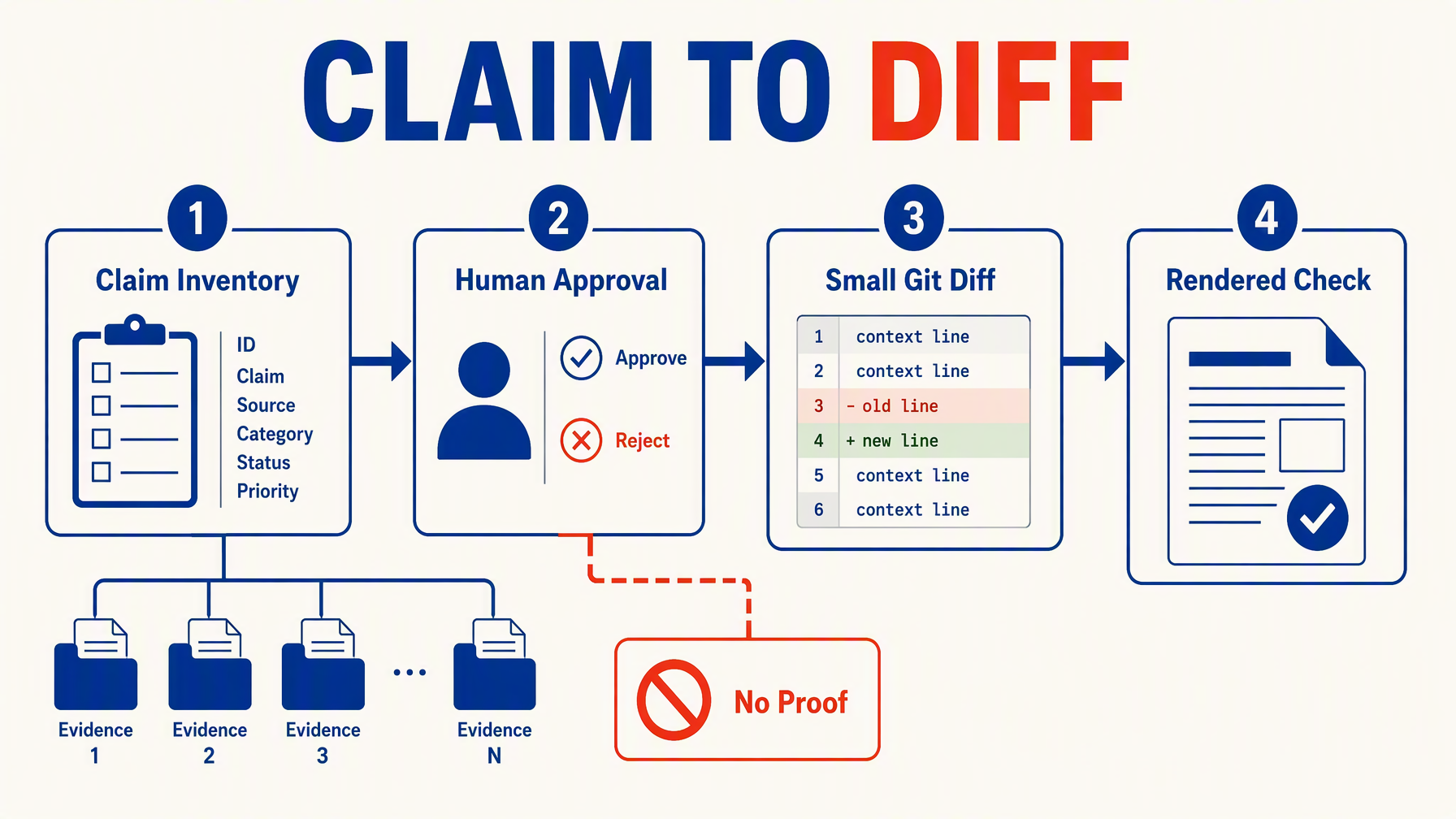
Illustrative workflow: a claim without proof stops before the implementation diff.
Check the rendered page against the evidence map
Passing a test does not prove that a claim is true. It only shows that the implementation met the test's conditions. Finish with two kinds of verification.
First, run the repository's existing build, lint, link, or content tests. Second, inspect the rendered page and compare it with the approval record.
- Every changed claim uses the approved wording or a narrower version.
- Source links open and support the nearby statement.
- The author description matches the approved facts.
- Visible content and structured data agree.
- No rejected claim remains in another component, metadata field, or reusable block.
- The diff contains no unrelated cleanup.
If the change fails a build, fix only the implementation problem. If the evidence fails review, stop the claim. Do not rewrite around the missing proof.
A practical example
Suppose a comparison page says, "We tested all major email platforms for six months." The repository contains screenshots from two tools, a four-week test note, and no list defining "all major platforms."
Claude Code should record the mismatch. A human might approve this narrower statement: "Our team ran a four-week workflow test using Platform A and Platform B." The diff can then update the sentence, add an approved method note, and adjust any matching Schema or metadata. It should not extend the duration, name additional platforms, or imply that the test represents the whole market.
That less dramatic sentence is more useful. A reader can see what happened and where the limits are.
Where this workflow should stop
Do not let the repository become a shortcut around human responsibility. Stop before:
- publishing biographical facts the named person has not approved;
- exposing private supporting material on a public page;
- adding Review, Person, Organization, or other Schema fields that exceed visible facts;
- treating a clean Git history as proof of expertise;
- merging or deploying simply because the diff is small.
Claude Code gives you a strong chain from evidence to implementation. The chain still needs a human owner at every factual handoff.
Frequently asked questions
Can Claude Code calculate an E-E-A-T score?
It can create an internal checklist, but Google does not provide a public page-level E-E-A-T score. A made-up number can hide the more useful question: which important claims are supported, uncertain, or contradicted?
Should the evidence folder be published?
Usually not. Publish only the sources, methods, author facts, and policies that are appropriate for visitors. Keep private approvals and working records out of the public site.
Can this workflow update Schema automatically?
Only after a human approves the visible fact and the exact Schema change. Structured data should describe the rendered page, not create authority that the page does not show.
Does a reviewed diff improve rankings?
It can make the page more accurate, transparent, and maintainable. It does not guarantee a ranking, traffic, rich-result, or AI-citation change.
Author: Julian Mercer, 14-Year Technical SEO Practitioner at Auspia. Julian writes about crawlability, structured data, rendering, and reviewable website changes.