The short answer
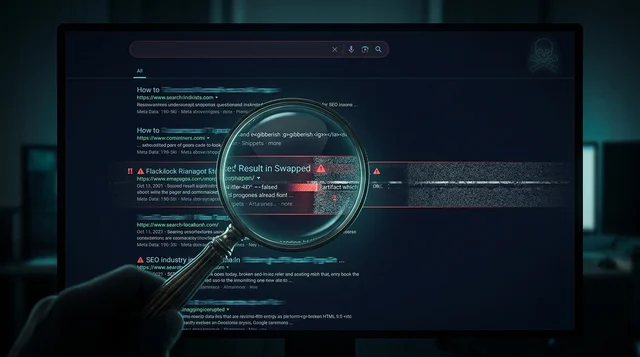
The biggest risk when buying or exchanging backlinks is not the price — it is buying a domain that is open but dead: the page loads, the DR looks fine, the link displays normally, but Google stopped indexing its new content. Checking this takes ten seconds: run a site: query with Google's recency filter for the domain and look at whether fresh pages keep appearing over the last 24 hours / 7 days / month. Do it before payment, before the handshake, and it filters out a large share of wasted spend.
Why DR and traffic lie
Link buyers look at DR and traffic before paying. Both have two blind spots:
- Metrics lag. DR-type metrics update monthly at best; they reflect state from weeks ago. By the time numbers fall, the risk already happened.
- The zombie window. An expired or abandoned domain can keep serving pages normally for months. The browser sees a live site; Google's index stopped accepting new pages a while ago.
For a backlink candidate, "does it look alive" is the wrong question. The right one: is this site's new content still within Google's acceptance range?
Index freshness: the idea in one sentence
Google's search has a recency filter ("past 24 hours / past week / past month"). Combined with site:, it becomes an observatory: is this domain still getting new pages indexed?
- Fresh pages keep appearing in the 24h/7d/30d window → the site is still accepted; the link is worth deeper review.
- The last month is blank → new content is effectively shut out; the link is a dead asset.
Two accuracy notes before you misread it: index size is a Google estimate (it shifts by region, language, device); timestamps are approximate signals of when Google last recognized or updated a page, not exact first-index times. This is a filter, not a verdict.

Scenarios where the check earns its cost
Scenario | Why it is needed | How to use |
|---|---|---|
Before buying backlinks / link bundles | Cheapest way to screen bad candidates: pre-payment | Run one candidate at a time |
Before link / resource exchanges | "Still publishing new content" is the foundation of reciprocity | Gate on "fresh page within the last month" |
Before buying an expired domain / old site | Page-openability lies; the index does not | Follow up with content authenticity + history review |
After your own redesign / domain change | Confirm your own new content keeps entering the index | Self-check within a week after the change |
When auditing a client's link profile | Give an objective reason for "this link should go" | Batch, up to 5 domains per check |
When to run it
- Before payment / before agreeing to an exchange: mandatory. Ten seconds here buys protection against an entire bad decision.
- Quarterly re-check of your live link pool: links die after you buy them, too. Re-run the pool every quarter and pull out the ones that went quiet.
- One week after a redesign: self-check. Indexing loss after a redesign is a common accident — the earlier you find it, the wider the fix window.
- When you receive a "high DR, low price" recommendation: the more perfect the offer, the more worth checking — zombie domains hang out in price dips exactly there.
Reading the result
- Fresh pages keep appearing, timestamps advancing → candidate is alive; continue with relevance, page position, outbound links, and quality review.
- Timestamps sparse, a few pages in 30 days → partially active. Weaker signal than fully alive; flag it.
- Blank or near-blank for 30 days → stop. High DR or not, put it aside — and if you are cautious, pass on it.
If you want the site: + recency steps automated and batched (up to 5 domains per check), a free Google index freshness checker (free with login) does the same check without the manual searching.
Boundaries: what it does not answer
- Relevance: whether the site is in your niche. Not evaluated.
- Outbound link quality / page position / content authenticity: still your manual work.
- AI mass-produced sites: only indirectly detectable via lack of effective recent indexing.
FAQ
How do I know if a domain is still indexed by Google? Run a site: query and overlay Google's recency filter (24h/7d/30d) to see whether fresh pages still appear. The tool folds both steps into one check.
Why would a high-DR site still be a bad link? DR is an accumulation of past trust, updated slowly. The zombie window is exactly the combination of high DR plus new pages not being accepted.
Are the counts and timestamps exact? No. Index sizes are Google estimates; timestamps approximate the last time Google recognized or updated a page. Treat it as a filter, not a final verdict.
Does this replace manual vetting? No. It is the first filter in the funnel. Relevance, position, outbound links, and quality still need your review.
Author: Miles Carter, Content Decay Analyst Across 10k+ URLs at Auspia. Miles writes about asset vitality — where pages and links stop producing value without announcing it.