

At-a-Glance: Which Tool for Which Situation
Before the deep reviews, here is the short answer for every common scenario:
- Deepest, freshest backlink data: Ahrefs
- All-in-one SEO + backlinks + toxic link detection: Semrush
- Best under $50/month: SE Ranking or Linkody
- Free — and still essential: Google Search Console
- Link quality over link quantity: Majestic
- Client-ready metrics everyone recognizes: Moz Pro
- AI citation tracking + backlinks in one tool: Respona
- Solo SEO on a tight budget: LinkMiner (Mangools)
There is no single "best" tool. The right choice depends on whether you need competitor analysis, how fresh you need the data, and whether you are monitoring your own site or prospecting for new links.
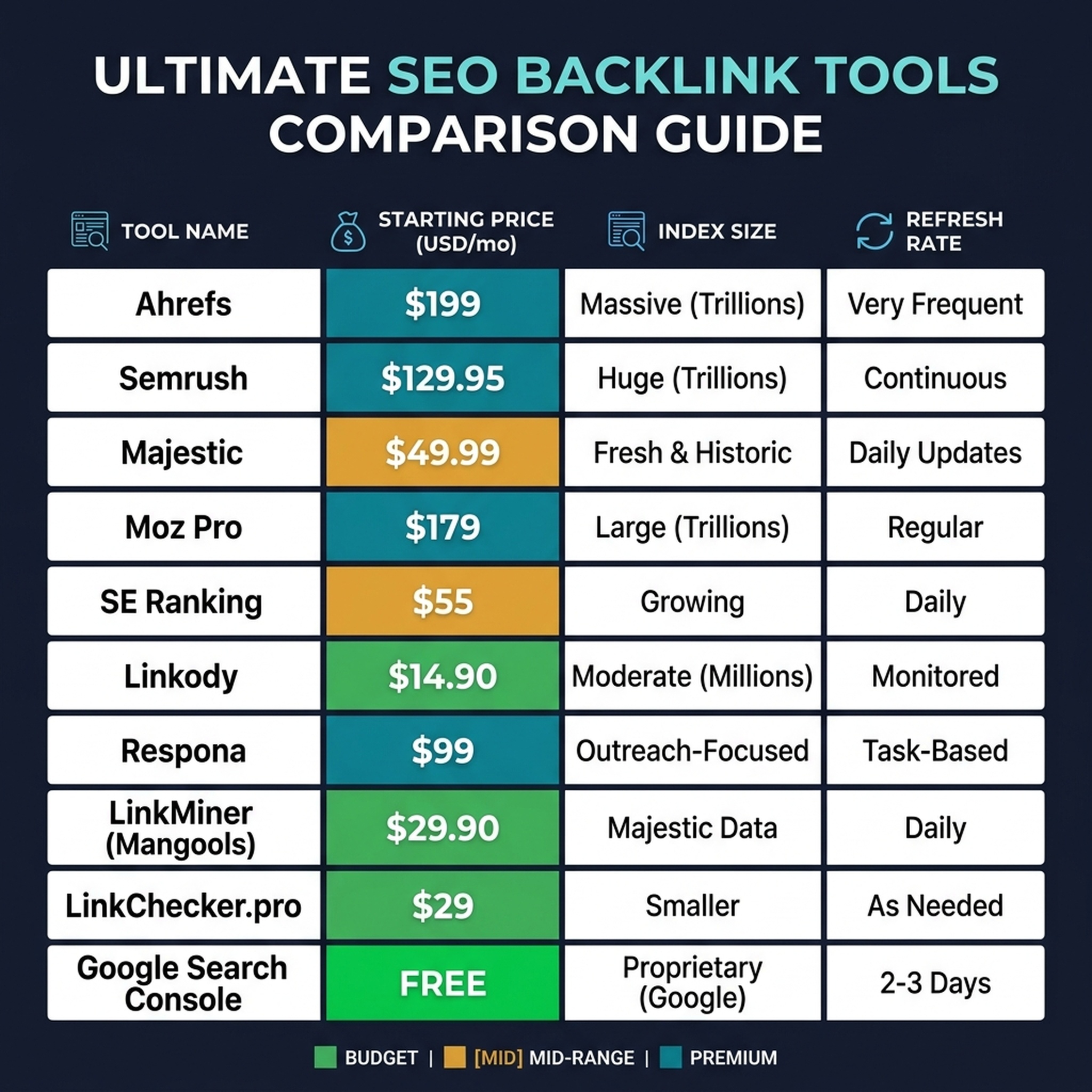
Quick Comparison Table
Tool | Starting Price (Monthly) | Backlink Index Size | Data Refresh | Standout Feature |
|---|---|---|---|---|
Ahrefs | $129 ($108 annual) | 35T+ links, 500M+ domains | 15–30 min | Site Explorer + Backlink Gap |
Semrush | $139.95 ($117.33 annual) | 43T links, 390M domains | ~15 min | Toxic link scoring (50+ params) |
Majestic | $49.99 ($41.67 annual) | Fresh + Historic Index | Daily | Trust Flow / Topical Trust Flow |
Moz Pro | $49 | 44T links, 700M+ domains | Weekly | Domain Authority + Spam Score |
SE Ranking | $52 | ~3T links | Every 3 days | White-label reports at low price |
Linkody | $14.90 | N/A (monitoring only) | Every 24 hours | Dedicated link tracker, no bloat |
Respona | Pay-per-placement | N/A (AI citation focus) | Real-time alerts | AI search visibility + backlinks |
LinkMiner (Mangools) | $29.90 | Limited but fresh | Near real-time | Link Strength metric |
LinkChecker.pro | $25 | N/A (verification focus) | On-demand | Google indexing verification |
Google Search Console | Free | Google's own data | 2–3 day delay | Official Google data, no speculation |
How We Tested
We evaluated each tool on six criteria, with the heaviest weight on data freshness and competitor analysis capability — the two things that make or break a backlink monitoring workflow in 2026:
- Data freshness and index depth — How often is the index updated? How many links does it actually find compared to Google Search Console?
- Competitor analysis — Can you compare your backlink profile against competitors? How many at once?
- Alerting and monitoring — Does it notify you of new and lost links? Via email, Slack, or API?
- Link quality assessment — Are there trust/authority/spam metrics? Can you identify toxic links?
- Usability and reporting — How steep is the learning curve? Can you generate client-facing reports?
- Pricing vs. value — What do you actually get at each price tier? Are there hidden add-on costs?
Tool-by-Tool Reviews
Ahrefs
Ahrefs is the tool most SEOs name when you ask which backlink index they trust. Its index covers 35 trillion links across 500 million domains, refreshed every 15 to 30 minutes — the fastest in the industry.
Standout feature: Site Explorer lets you see every backlink, the referring page's DR, estimated traffic to that page, anchor text, and link type (dofollow/nofollow/UGC/sponsored) in one view. The Backlink Gap tool compares your profile against up to 10 competitors and surfaces pages linking to them but not you — this is the single most useful prospecting feature in any backlink tool.
Where it falls short: The $29 Starter plan is too limited for serious backlink work. You need at least the $129 Lite plan for competitor research. There is no free trial on paid plans — only the free Ahrefs Webmaster Tools for verified domains.
Pricing: Lite $129/mo ($108 annual) → Standard $249/mo → Advanced $449/mo → Enterprise custom.
Verdict: Best overall if you can afford it. The combination of index freshness, competitor comparison depth, and analysis granularity has not been matched.
Semrush
Semrush competes head-to-head with Ahrefs on backlink data while bundling keyword research, rank tracking, content tools, and paid-search analysis into one platform. If you already use Semrush for other SEO work, its backlink tools are strong enough that you probably do not need a second tool.
Standout feature: The Backlink Audit tool scores every link on 50+ toxicity parameters and generates a ready-to-upload disavow file. No other all-in-one platform does toxic-link detection this thoroughly. The Backlink Gap tool compares up to 5 competitors and highlights domains with the highest Authority Score.
Where it falls short: Pricing escalates fast. The Pro plan ($139.95/mo) limits you to 3,000 backlink audits per month. Guru ($249.95/mo) unlocks more. Add-ons for extra seats, branded reports, and API access push costs higher. The backlink index, while enormous (43T links), is slightly less exhaustive than Ahrefs for very small sites.
Pricing: Pro $139.95/mo ($117.33 annual) → Guru $249.95/mo → Business $499.95/mo. Free tier: 10 backlink checks/day.
Verdict: The best option if you want backlinks, keywords, content, and PPC in one login. The toxic-link audit alone justifies the price for agencies managing multiple client sites.
Majestic
Majestic does one thing — backlinks — and has done it longer than anyone. It is the only tool with a split index: a daily-updated Fresh Index for recent links and a Historic Index going back years. Its proprietary metrics — Trust Flow (link quality), Citation Flow (link volume), and Topical Trust Flow (topic-level relevance) — are used by SEOs who need to go deeper than domain-level authority scores.
Standout feature: Topical Trust Flow categorizes every linking domain into 800+ topic categories, so you can see not just how authoritative a link is, but whether it is topically relevant to your site. No other tool does this at the same granularity.
Where it falls short: Majestic is backlinks-only. No keyword research, no rank tracking, no site audits. The interface is dated compared to Ahrefs and Semrush. And the Fresh Index, while updated daily, does not match the 15-minute refresh cycles of the top two tools.
Pricing: Lite $49.99/mo ($41.67 annual) → Pro $99.99/mo → API $399.99/mo.
Verdict: The specialist's choice. If you audit link profiles for quality and topical relevance, Majestic's Trust Flow metrics are worth the separate subscription. Pair it with Google Search Console for a complete picture.
Moz Pro
Moz invented Domain Authority (DA), and that metric still carries weight — especially in client conversations where "what's our DA?" is a question you will hear. Moz's Link Explorer covers 44 trillion links across 700 million domains. Its Link Intersect tool finds sites linking to competitors but not you, similar to Ahrefs' Backlink Gap but with a simpler interface.
Standout feature: DA and Spam Score are the most widely recognized third-party authority metrics. Clients and stakeholders who have never logged into an SEO tool have heard of Domain Authority. For reporting and stakeholder communication, this matters.
Where it falls short: The backlink index is updated weekly, not daily or hourly. This is a meaningful disadvantage if you are monitoring for new or lost links — by the time Moz picks up a new link, it could be a week old. The toolset is broad (rank tracking, site audits, on-page optimization) but shallower than Semrush in most categories.
Pricing: Starter $49/mo → Standard $99/mo → Medium $179/mo → Large $299/mo. 30-day free trial available.
Verdict: Good for small teams who need recognizable metrics for client reporting and do not require real-time link monitoring. The weekly index refresh is the main limitation to be aware of.
SE Ranking
SE Ranking is the best value option for agencies and freelancers who need backlink monitoring alongside rank tracking, site audits, and white-label reporting — all at roughly half the price of Ahrefs or Semrush.
Standout feature: White-label reports at a price point where competitors charge extra. If you run an agency and need to send branded backlink reports to clients without paying enterprise rates, SE Ranking is hard to beat. The backlink gap tool, while less sophisticated than Ahrefs, covers the essentials.
Where it falls short: The backlink index is smaller (~3 trillion links) and updated less frequently (every 3 days) than the top-tier tools. For large sites or competitive niches, it may miss links that Ahrefs or Semrush would catch. The interface can feel cluttered when managing multiple projects.
Pricing: Essential $52/mo → Pro $103.20/mo → Business custom. Annual billing saves 20%.
Verdict: The best price-to-feature ratio for agencies. Accept the smaller index as a tradeoff for getting rank tracking, audits, and white-label reporting included at no extra cost.
Linkody
Linkody is a dedicated backlink monitor — no keyword research, no rank tracking, no audits. It connects to your Google Search Console, pulls in your known backlinks, and checks their status every 24 hours. When a link goes down, changes from dofollow to nofollow, or a new link appears, you get an alert.
Standout feature: Pure monitoring focus. Linkody does not try to be an all-in-one platform. It tracks whether your links are live, what anchor text they use, and whether they have changed — and sends you clean, minimal reports. The Link Visualizer shows your backlink network as an interactive graph.
Where it falls short: Linkody does not have its own backlink discovery index. It relies on GSC + Moz's index for link data. If you need to prospect for new link opportunities or analyze competitors' full backlink profiles, you need another tool.
Pricing: Webmaster $14.90/mo → Advanced $24.90/mo → Agency $45.90/mo. 10-day free trial.
Verdict: The cheapest way to get automated backlink monitoring with alerts. Best paired with GSC and a paid index-based tool for discovery.
Respona
Respona is a 2026 entrant that combines traditional backlink monitoring with AI search visibility tracking — it watches your brand mentions and citations across ChatGPT, Perplexity, Google AI Overviews, Gemini, Claude, and Copilot. It then generates prioritized link-building action plans based on gaps it identifies.
Standout feature: AI citation monitoring alongside backlinks. In 2026, knowing who links to you is only half the picture — knowing who cites you in AI answers is the other half. Respona is the only tool in this roundup that does both.
Where it falls short: Pay-per-placement pricing ($100–$500 per link placement, based on publisher DR) means costs scale with outreach volume. No monthly subscription option for teams that prefer predictable costs. The tool is newer and has less community documentation than established players.
Pricing: Pay-per-placement, typically $100–$500 per link. Free backlink checker available.
Verdict: Worth adding to your stack if AI search visibility is a priority and you are actively doing link outreach. Not a replacement for a traditional backlink index tool — treat it as a complementary layer.
LinkMiner (Mangools)
LinkMiner is part of the Mangools suite — a clean, affordable toolset that includes KWFinder, SERPChecker, and SiteProfiler. The backlink tool is lightweight but well-designed, with a unique Link Strength metric that combines multiple signals into one easy-to-compare number.
Standout feature: Link Strength simplifies backlink evaluation. Instead of cross-referencing DR, traffic, and relevance separately, Link Strength gives you a single score that is surprisingly good at surfacing high-value links. The interface is the cleanest of any tool tested.
Where it falls short: The backlink index is limited in size compared to Ahrefs or Semrush. Near-real-time fresh-backlink alerts are useful for monitoring but the discovery depth is not competitive for large-scale competitor analysis.
Pricing: Mangools Entry $29.90/mo → Basic $44.90/mo → Premium $89.90/mo → Agency $129.90/mo. 10-day free trial.
Verdict: The best choice for solo SEOs and small teams who want a clean, fast tool without paying for data depth they do not need.
LinkChecker.pro
LinkChecker.pro focuses on one specific problem: verifying that your backlinks are actually indexed by Google. Many tools report a link as "live" if the page exists, but if Google has not indexed that page, the link is invisible to search. LinkChecker.pro catches this.
Standout feature: Google indexing verification. It checks whether each backlink's page is in Google's index — not just whether the URL resolves. It also tracks brand mentions (unlinked) so you can convert them into links.
Where it falls short: Narrow scope. No backlink discovery index, no competitor analysis, no rank tracking. You need another tool for prospecting and comprehensive competitor research.
Pricing: From $25/mo. Team plans with multi-user support available.
Verdict: A useful specialist tool for link-building teams that need to verify indexing at scale. Not a standalone backlink monitoring solution.
Google Search Console
Google Search Console is free, and it shows you exactly which links Google has counted for your site — no third-party index, no estimation. This is ground truth.
Standout feature: It is Google's own data. The Links report shows your top linking sites, top linked pages, and anchor text distribution — all from Google's perspective. No other tool, paid or free, gives you the link data that Google actually uses for ranking.
Where it falls short: No competitor analysis. No alerts for new or lost links. No authority metrics. The data is sampled (not every link is shown) and delayed by 2–3 days. The export is limited to 1,000 rows. And you can only access data for sites you have verified ownership of.
Pricing: Free.
Verdict: Every site owner should have GSC connected. It is the essential baseline. But it is not a replacement for a paid backlink monitoring tool — it answers "what does Google see?" but not "what should I do about it?"
Backlink Monitoring in the AI Era
Backlink monitoring in 2026 is not just about tracking blue links. Three shifts are changing what you need from a monitoring tool:
1. AI citations are the new backlinks. When ChatGPT or Perplexity cites your brand in an answer, that citation functions like a backlink — it drives referral traffic and builds authority signals. Tools like Respona are the first generation to track these alongside traditional links.
2. Link quality matters more as AI content saturates the web. With 74% of new web content estimated to be AI-generated, the pool of potential backlinks is growing faster than ever — but most of it is low quality. Tools that surface link quality signals (Majestic's Trust Flow, Semrush's toxicity scoring, Moz's Spam Score) are more valuable than tools that just count links.
3. Google's index IS the index that matters. A tool can report a link as live, but if Google has not indexed the linking page, that link contributes nothing. LinkChecker.pro and the index-verification workflow it enables are becoming a standard part of link-building QA.
Which Tool Should You Choose?
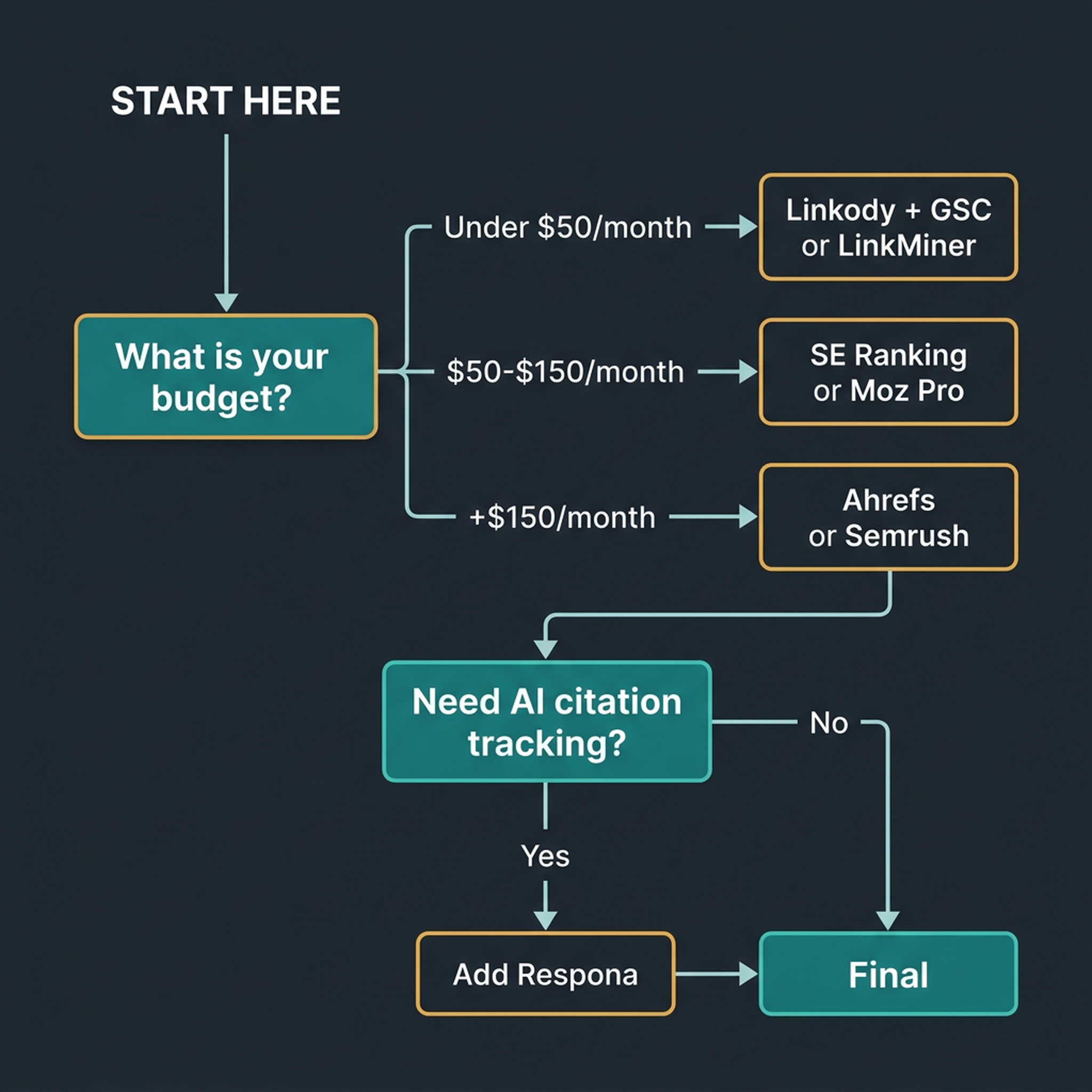
Use this decision path instead of a one-size-fits-all recommendation:
- You have no backlink tool today: Start with Google Search Console (free) + Linkody ($14.90/mo) for monitoring. Add Ahrefs or Semrush when budget allows.
- You need one tool that does everything: Semrush if you also need keyword research, rank tracking, and content tools. Ahrefs if backlinks are your primary workflow.
- You run an agency with multiple clients: SE Ranking for white-label reports at agency-friendly pricing. Add Majestic if link-quality audits are part of your retainer.
- Your budget is under $30/month: Linkody + GSC, or LinkMiner (Mangools) if you want a full SEO suite at entry-level pricing.
- You care about AI search visibility: Add Respona to your existing stack. It does not replace a traditional backlink tool — it adds a layer on top.
FAQ
How often should I monitor my backlinks?
At minimum, weekly. For sites actively building links or in competitive niches, daily monitoring with automated alerts is better. Most paid tools can email or Slack you when links are gained or lost.
Can I monitor competitor backlinks with these tools?
Yes — all tools in this roundup except Google Search Console, Linkody, and LinkChecker.pro offer competitor backlink analysis. Ahrefs (up to 10 competitors at once) and Semrush (up to 5) have the strongest competitor gap features.
What should I do when a backlink is lost?
First, verify whether the linking page itself is gone (404) or whether your link was removed. If the page 404'd, check the Wayback Machine and reach out to the site owner — they may have moved the content. If your link was removed, analyze what replaced it and decide whether a reclamation email is worth sending. Lost links from high-DR sites are worth pursuing; links from low-quality pages are usually not.
Do I need more than one backlink tool?
For most teams, one paid tool plus Google Search Console is the right setup. Agencies doing link-quality audits may benefit from adding Majestic (for Trust Flow metrics) to their primary tool. Teams focused on AI search visibility should consider Respona as a complementary layer.
Are free backlink checkers enough?
Free checkers (Ahrefs Free Backlink Checker, Semrush free tier, Ubersuggest) are useful for one-off competitor lookups. They are not sufficient for ongoing monitoring because they lack automated alerts, historical tracking, and comprehensive index coverage.
Author: Marcus Ellery, Growth Experimenter Behind 150+ SEO Tests at Auspia. Marcus writes about SEO tools, benchmarks, and evidence-led workflows that help growth teams pick the right stack and skip the rest.