The answer depends on the recommendation
AI-generated SEO recommendations can be accurate and useful when the task has clear inputs: finding missing title tags, clustering similar queries, summarizing crawl issues, spotting repeated content themes, or drafting a refresh checklist. They are much less dependable when the task requires judgment about search intent, factual accuracy, brand positioning, causality, or whether a page deserves to exist.
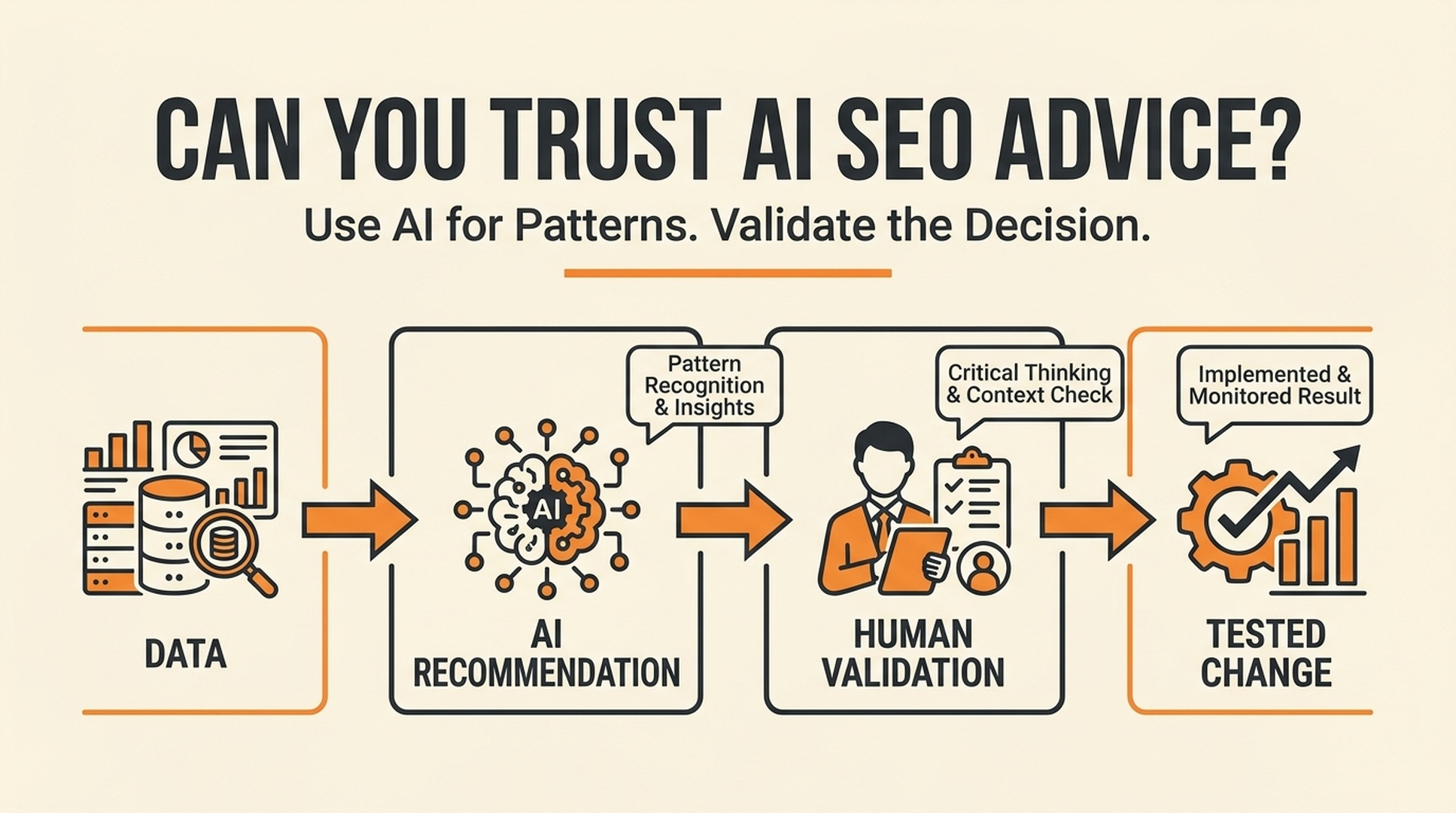
Manual optimization is not automatically better. A human can overfit to one keyword, miss a pattern in thousands of URLs, or make changes without checking data. The strongest approach is a division of labor: let AI surface candidates and explain the first pass, then require a person to validate the recommendation against the SERP, the site, the customer, and the business goal.
What AI is usually good at
AI tools handle large amounts of structured or semi-structured information well. Give a model a crawl export, search-query list, content inventory, or set of customer questions, and it can turn the material into categories much faster than an individual analyst.
Recommendation type | Typical AI value | What to verify manually |
|---|---|---|
Query clustering | Groups similar wording and recurring themes | Whether the group truly shares one search intent |
Metadata gaps | Finds missing, duplicated, or overly long fields | Whether the proposed title is accurate and compelling |
Content coverage | Identifies entities and questions common in ranking pages | Whether each topic helps the intended reader |
Internal-link candidates | Finds semantically related pages | Whether the link makes contextual sense and supports architecture |
Technical issue summaries | Translates crawl data into a priority list | Root cause, severity, and the correct implementation |
Reporting summaries | Highlights trend changes and outliers | Attribution, seasonality, tracking changes, and next action |
The common theme is scale. AI is a capable assistant for pattern detection and first drafts. It is not a reliable witness to what happened on your website or in your market unless the evidence is supplied and checked.
Why a polished recommendation can still be wrong
Language models are designed to produce plausible language. That makes them especially persuasive when they lack information. A recommendation may sound specific while relying on an outdated page, an incomplete crawl, a search result from another market, or a generic assumption about how users behave.
There are four regular failure modes.
It confuses correlation with a fix
If top-ranking pages use a comparison table, an AI tool may recommend adding one. That does not prove the table caused their rankings. It may be useful because the query is comparison-led, or it may be decorative. Check the intent as well as the shared feature.
It copies the current SERP too literally
Search results are evidence of what Google currently returns, not a template to clone. A page that repeats every heading and term used by competitors can become interchangeable. Look for a better explanation, a firsthand example, a clearer decision framework, or information competitors leave out.
It cannot validate business facts
Models do not know your shipping limits, implementation process, pricing policy, customer objections, or roadmap unless you provide that information. Any advice that relies on those facts needs a source owner.
It can miss technical context
An AI summary may notice that a page has low traffic and recommend a rewrite, while the real problem is noindex, a canonical conflict, rendering failure, migration error, or changing demand. Technical diagnosis still starts with inspection.
A four-question validation test
Before actioning any recommendation, ask:
- What data or evidence produced this suggestion?
- Does it match the live search result and the user's task?
- Would the change make the page more useful even if rankings did not move?
- How will we know whether the change helped?
If the tool cannot answer the first question, treat its output as an idea, not analysis. If the answer to the third is no, do not make the change merely to improve a score.
Manual optimization still has a job
Human specialists are best placed to make the judgment calls that differentiate a helpful page from a complete-looking one. They can interview sales or support teams, recognize legal and reputational risks, reconcile conflicting data, inspect code and rendering, decide whether pages should merge, and use experience to interpret a volatile result set.
This does not mean every adjustment needs a long meeting. It means the reviewer owns the decision. A competent workflow lets the reviewer accept, reject, or modify an AI suggestion with a reason attached. Over time, those reasons become the team's own optimization rules.
A test design that produces learning
Do not judge AI recommendations by whether they sound right. Run a controlled operating test on a defined group of pages.
Step | Action |
|---|---|
1 | Choose 10 to 20 comparable pages with enough existing search data |
2 | Record baseline impressions, clicks, query mix, technical state, and conversions |
3 | Have AI propose changes, then document which were accepted, rejected, or edited |
4 | Apply only changes that pass the four-question validation test |
5 | Wait for enough data, then compare trends with a similar untouched group where possible |
6 | Record what the team learned, including recommendations that were wrong |
SEO is noisy, so no small test proves a universal rule. It can still tell you whether a particular tool improves your team's research speed, catches defects, or creates a review burden that outweighs its value.
Where Auspia's approach belongs
For teams extending SEO into AI-search visibility, the same validation principle applies. A report that says a brand is absent from an answer is a starting point. The next step is to inspect the prompt, the competing sources, the page evidence, technical access, and the claim being asked of the system.
Auspia's AI Search Visibility Checker is useful as a measurement input in that loop. It can help a team establish repeatable prompt checks, but the team still needs to decide which sources to improve and whether the resulting content is genuinely better for readers.
The practical standard: assisted, accountable optimization
Use AI recommendations to widen your field of view and shorten repetitive analysis. Keep humans accountable for the meaning of a page, the truth of its claims, the technical diagnosis, and the value of the next action. That is a more accurate description of modern SEO than either extreme: "AI replaces experts" or "AI is useless."
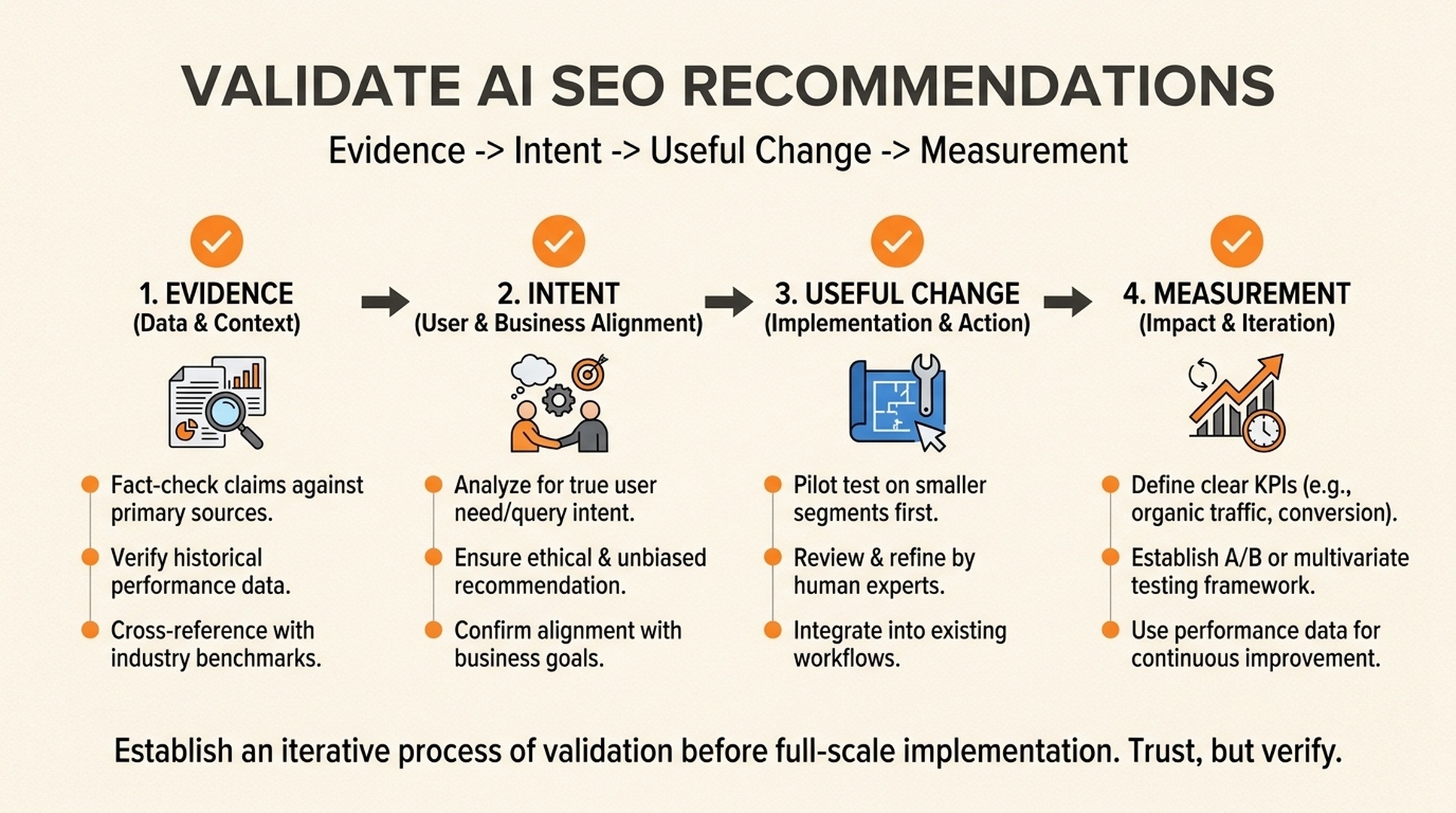
Validation workflow for AI-generated SEO recommendations
FAQ
Can AI tools audit a website accurately?
They can accurately identify many detectable issues if they receive a complete crawl and valid data. They cannot reliably determine business priority or every technical root cause without human inspection.
Should writers follow AI content scores?
Use scores as diagnostic prompts. Do not force in words or sections that do not serve the reader, and do not publish a page solely because it crosses a numeric threshold.
How often should a team review AI SEO recommendations?
Review high-impact recommendations before implementation and regularly audit a sample of lower-risk changes. The right frequency depends on site size, publishing volume, and the risk of incorrect claims.
What official principles should guide AI-assisted SEO?
Google's people-first content guidance and AI content guidance are useful baselines: create helpful content and avoid scaled, low-value output.
Author: Felix Ward, SEO Experiment Analyst Across 180+ Controlled Tests at Auspia. Felix writes about validation, measurement design, and what growth teams can learn from imperfect SEO experiments.