The dashboard problem
Your analytics show AI referral traffic. Maybe it is up. Maybe it is a rounding error. Either way, you are looking at the wrong number, and agentic commerce is about to make that obvious.
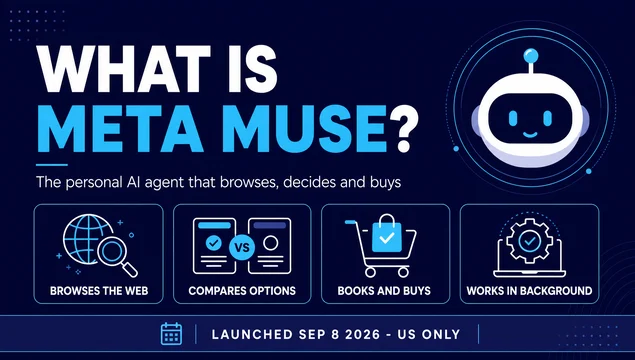
Here is the mechanism. When a person uses ChatGPT or Perplexity, they usually click through to a source, and that click shows up in your analytics. When a person uses Muse, the agent may research ten sites, compare them, recommend one, and complete the purchase without ever sending a click to nine of them. The tenth might get a checkout, not a pageview.
If your only AI metric is referral sessions, you will see a flat line while your category share quietly moves. That is the failure mode this article is about.
Why referral traffic breaks as a signal
Three things changed at once.
The click became optional. Muse completes tasks in its own browser session. A purchase can happen without a visit to your site in any meaningful sense.
The decision moved earlier. The agent filters against the buyer's constraints before the buyer sees anything. Being in the final set matters more than being clicked.
Attribution got thinner. Some agent orders are tagged at the platform level, some arrive as ordinary transactions, and some are invisible. Referral traffic was never a perfect metric, but it was at least a consistent one. That consistency is gone.
None of this means analytics are useless. It means the metric that was doing the most work in your AI reporting is no longer measuring the thing you care about.
The replacement: recommendation share
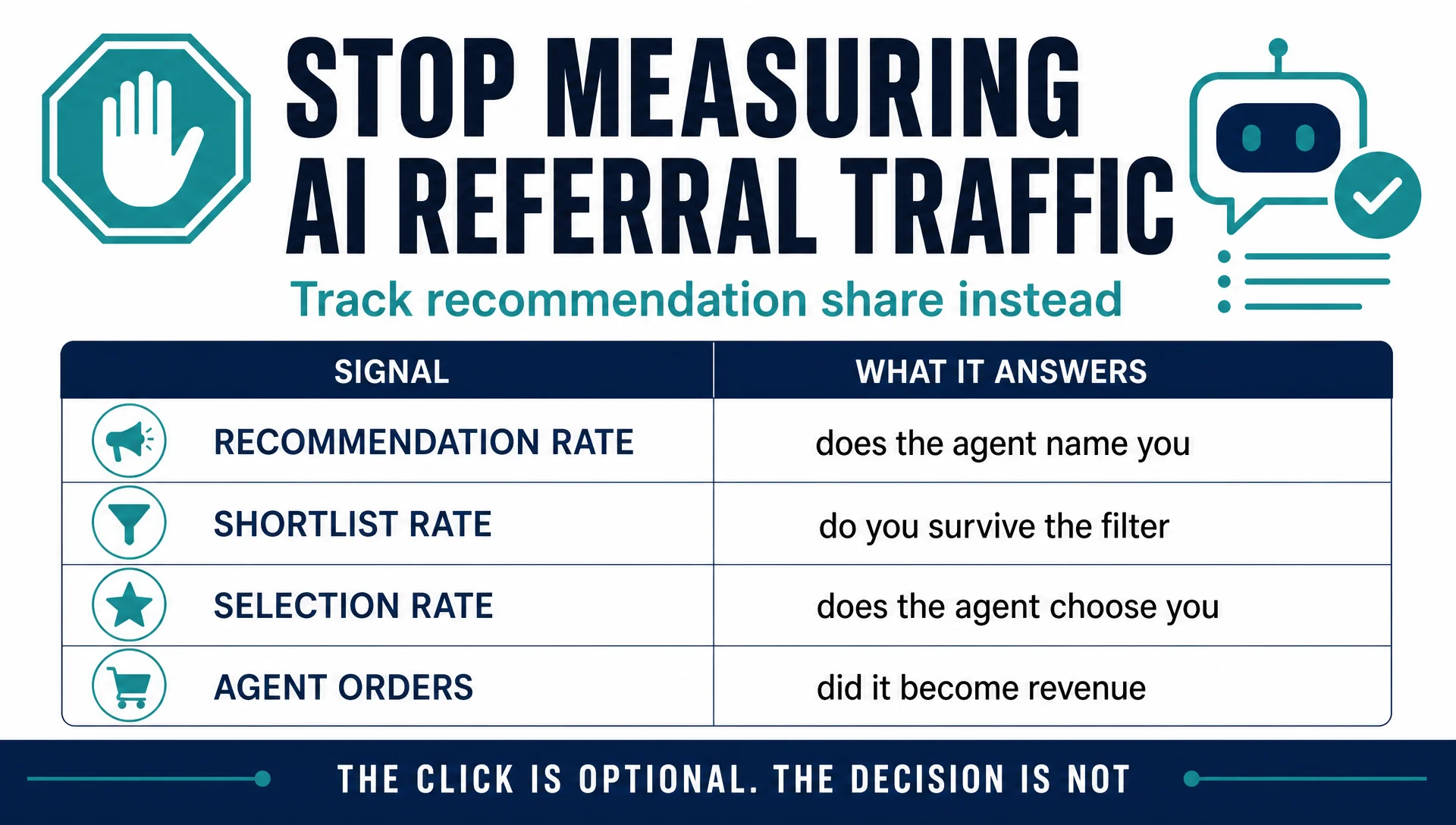
Track whether you were in the consideration set, not just whether someone clicked.
Four signals, in order of how directly they map to revenue:
Signal | What it answers | How to get it |
|---|---|---|
Recommendation rate | How often does the agent name you? | Run your category's buyer prompts against the agent on a fixed schedule |
Shortlist rate | How often do you survive the first filter? | Same prompt set, record whether you appear in the narrowed options |
Selection rate | How often does the agent choose you? | Where observable, track whether your product is the one presented for approval |
Completed agent orders | How often did it become revenue? | Platform tagging where available, payment reports otherwise |
The first three are things you can measure today with a prompt set. The fourth depends on platform reporting that is still thin.
Building the prompt set
This is the part most teams skip, and it is the part that makes the rest work.
Do not test your brand name. Test the buyer's question.
Build 20 to 40 prompts that mirror how someone would actually ask for your category. For a luggage brand, that is not "best luggage." It is "find me a carry-on that fits under an airline seat, has a laptop compartment, and does not look like hiking gear."
Then:
- Group prompts by intent. Gift, replacement, upgrade, comparison, budget-constrained.
- Include the constraints that matter. Price ceilings, sizes, compatibility, deadlines.
- Run the same set on a fixed cadence. Weekly if you are actively optimizing, monthly if you are monitoring.
- Record the raw output. Do not just note whether you appeared. Save what the agent said, so you can see how it described you.
The output is a recommendation rate per prompt group. That number moves for reasons you can act on, which is more than can be said for most AI traffic dashboards.
What the platform data already shows
Shopify's Q1 2026 results are the clearest public evidence that this channel is real, and they are worth reading carefully because they are platform-reported, not vendor marketing.
- AI-driven traffic to Shopify stores grew 8x year over year
- Orders originating from AI-powered searches grew nearly 13x
- New buyers arriving through AI channels placed orders at roughly twice the rate of other channels
The gap between the traffic multiple and the order multiple is the interesting part. Orders grew faster than traffic, which suggests AI-referred visitors arrive with more intent. That is consistent with what an agent does: it filters before it sends anyone.
Treat these as Shopify's numbers for Shopify stores. They are not a forecast for your site.
A scorecard you can run this month
Metric | Baseline | Target | Cadence |
|---|---|---|---|
Recommendation rate (all prompts) | Measure now | Track trend, not a fixed goal | Weekly |
Recommendation rate (high-intent prompts) | Measure now | Outperform your category average | Weekly |
Shortlist rate | Measure now | Improve after each data fix | Monthly |
Completed agent orders | Log from zero | Establish a baseline | Monthly |
Product data completeness | Audit now | 100% of shortlist | Quarterly |
Checkout reachability | Binary check | At least one agent-capable rail | Quarterly |
Notice that only one row is a revenue number. The rest are leading indicators. In a channel this young, the leading indicators are what you can actually influence.
Where this breaks
Three honest caveats.
You cannot see inside the agent. You are inferring recommendation behavior from outputs. Treat it as directional, not precise.
Prompt sets drift. As agents change, the same prompt can produce different behavior. Version your prompt set and note when you change it.
Small numbers are noisy. If you are getting three agent orders a month, do not build a strategy on week-over-week movement. Track the trend over a quarter.
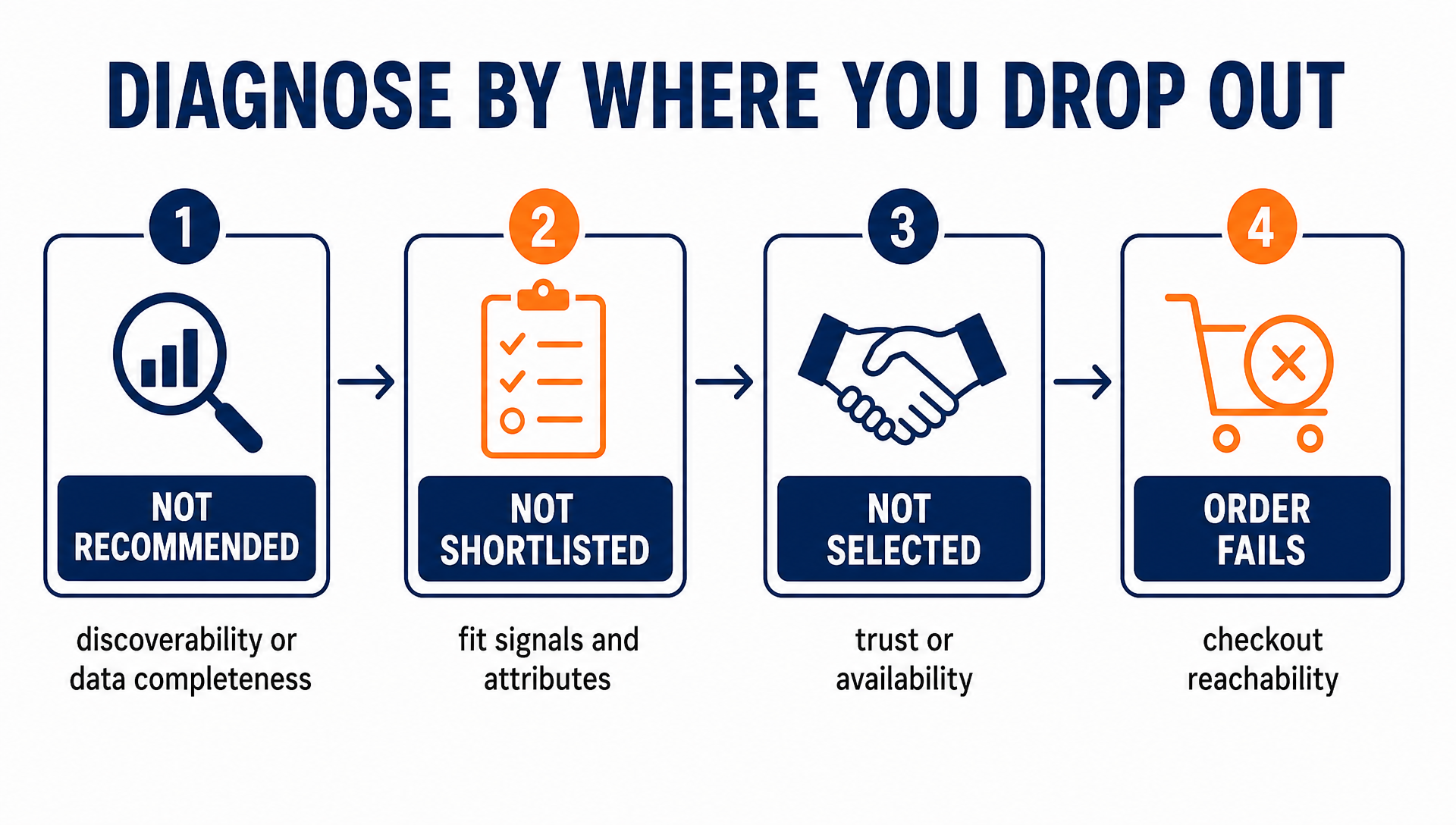
Where you drop out tells you what to fix. Each stage has a different cause and a different remedy.
What to do with the numbers
Once you have a recommendation rate, the work becomes specific.
If you are not recommended at all, the problem is usually discoverability or data completeness. Check whether the agent can find and parse your product.
If you are recommended but not shortlisted, the problem is usually fit signals. Your attributes may not match the constraints buyers state.
If you are shortlisted but not selected, the problem is usually trust or availability. Look at corroborating evidence and whether your stock and price are current.
If you are selected but the order fails, the problem is checkout reachability. Fix the payment path before optimizing anything else.
FAQ
Can I still use referral traffic as a metric? Yes, as one input. It is no longer sufficient on its own, and for agentic channels it undercounts the influence you actually had.
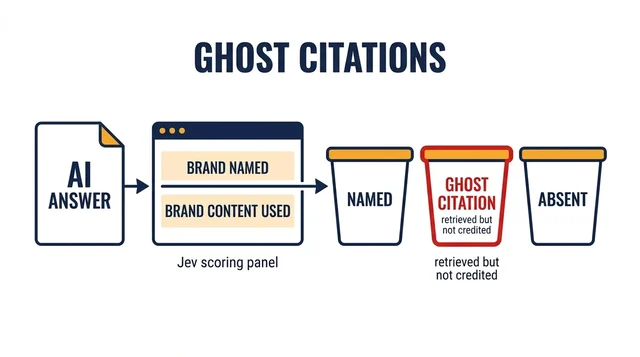
How is this different from tracking AI citations? Citations measure whether a source was referenced in an answer. This measures whether a brand was recommended and selected in a decision. A brand can be cited and never chosen.
Do I need paid tools? No. A spreadsheet and a consistent prompt set will get you a usable baseline. Tools help with scale and history, not with the core method.
How many prompts do I need? Twenty is enough to start. Forty gives you better coverage across intent groups. More than that is only worth it if you can run them consistently.
What if my category has no agent coverage yet? Then your baseline is zero, and that is useful information. Build the prompt set now so you can see the shift when it arrives.
Auspia's view
The teams that handle this well will not be the ones with the most sophisticated dashboards. They will be the ones who started measuring recommendation share before it was fashionable, kept a clean prompt set, and used it to drive specific fixes rather than general anxiety.
Referral traffic told you what happened after someone found you. Recommendation share tells you whether you were in the room. In an agent-mediated buying process, the room is the whole game.
Author: Ethan Marlowe, GEO Measurement Lead Across 500+ Prompts at Auspia. Ethan writes about prompt tracking, citation reporting, visibility dashboards, and AI answer quality checks.