What you will finish with
This workflow is for a content lead or product marketer who owns a "best X", "X vs Y", or alternatives page. When you finish, you will know which of three specific problems your page has, and you will have applied the fix that matches it.
- Outcome: your page is rewritten so the AI answer for the same buyer question can name your brand, and you have a checked comparison showing the change.
- Time: 40-60 minutes for the first run, about 15 minutes a month after that.
- Prerequisites: an Auspia account (the check runs in a logged-in tool), your domain, and the query your buyer actually types.
- Definition of done: you have run the check, your page's brands and the AI-named brands are on the same table, and you know which diagnosis applies (or you know that no owned comparison page exists yet).
Three things this workflow is not: it is not a full-site audit, it is not long-term monitoring, and it does not promise you a ranking or a citation.
Before you start: find the query your buyer actually asks
Your article title is not the query. The buyer asks "best crm tools"; your article may answer "best crm tools for small businesses". Start from the buyer:
- Open Search Console and filter queries for your category patterns: "best", "vs", "alternatives", "which". The queries with impressions but weak clicks are the ones people type while comparing.
- If you have no data yet, take the obvious head term for your category and its "-for" variations.
- Pick one query for this run. The check compares one query against one domain at a time.
Decide what your comparison page is: a best-of list, a product comparison, an alternatives post, or a price comparison all count. If you have no owned page for the query at all, stop here. The check will tell you, and the fix is a new article.
Step 1: Run the check
Open the Best Tools List Debiaser (in the free-tools section of the Auspia site) and enter:
- The Best X keyword: the buyer's query, e.g.
best crm tools. - Your product domain: your domain, e.g.
yourdomain.com. - Choose the market your buyers are in (the default is United States / English).
Then run it. The check does four deterministic things: it reads the live Google SERP for the keyword including the AI Overview sources, it looks at the ranked pages under your domain, it selects the one article that matches a comparison/most-commonly-listed intent, and it extracts the brands named in that article. Then it places two lists side by side: the brands your article names and the brands AI names for the same question, with a flag for your domain.
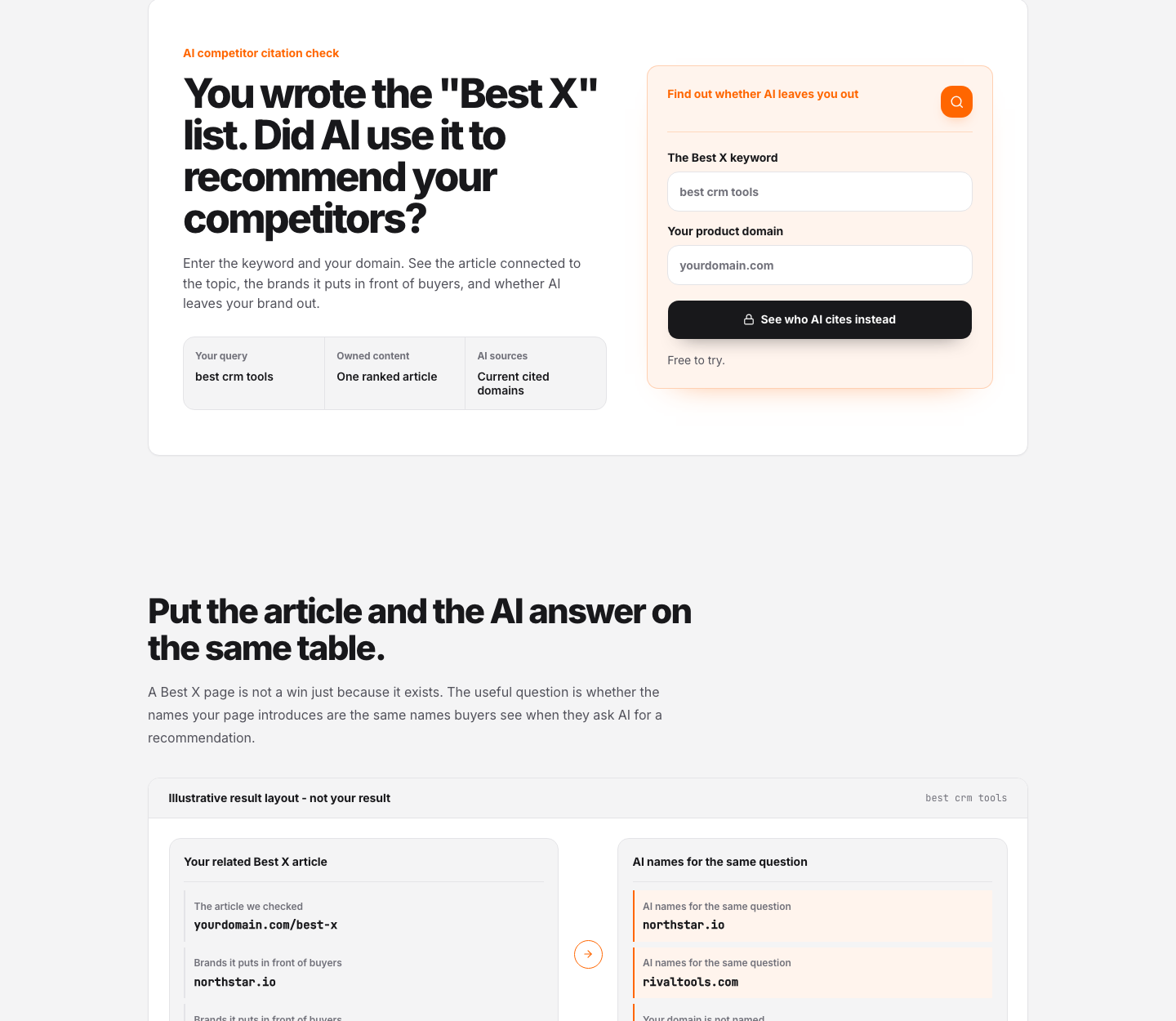
The check runs on one query and one domain at a time.
Expected output: a table like this (values from our own run and the tool's sample; the structure is what matters):
Your article names | AI names for the same question | Your domain |
|---|---|---|
Northstar | Northstar, Rival, Atlas | Not named |
Rival | Rival | Not named |
Atlas | Atlas | Not named |
Quality check: the table has content in all three columns and your domain appears somewhere in either list. If it does not, your input is wrong, not the page.
If the tool reports no matching article: check the domain spelling and whether this comparison lives under a subfolder (for example blog/). If both are right and no article was found, you are at the "build it" branch: this is a content gap question, not a citation question, and the rest of this workflow does not apply to a page that does not exist.
Step 2: Read the diagnosis
Three diagnoses cover almost every mismatch. You can end up in more than one; pick the dominant. The tool names them plainly.
Diagnosis | What it means | What the evidence looks like |
|---|---|---|
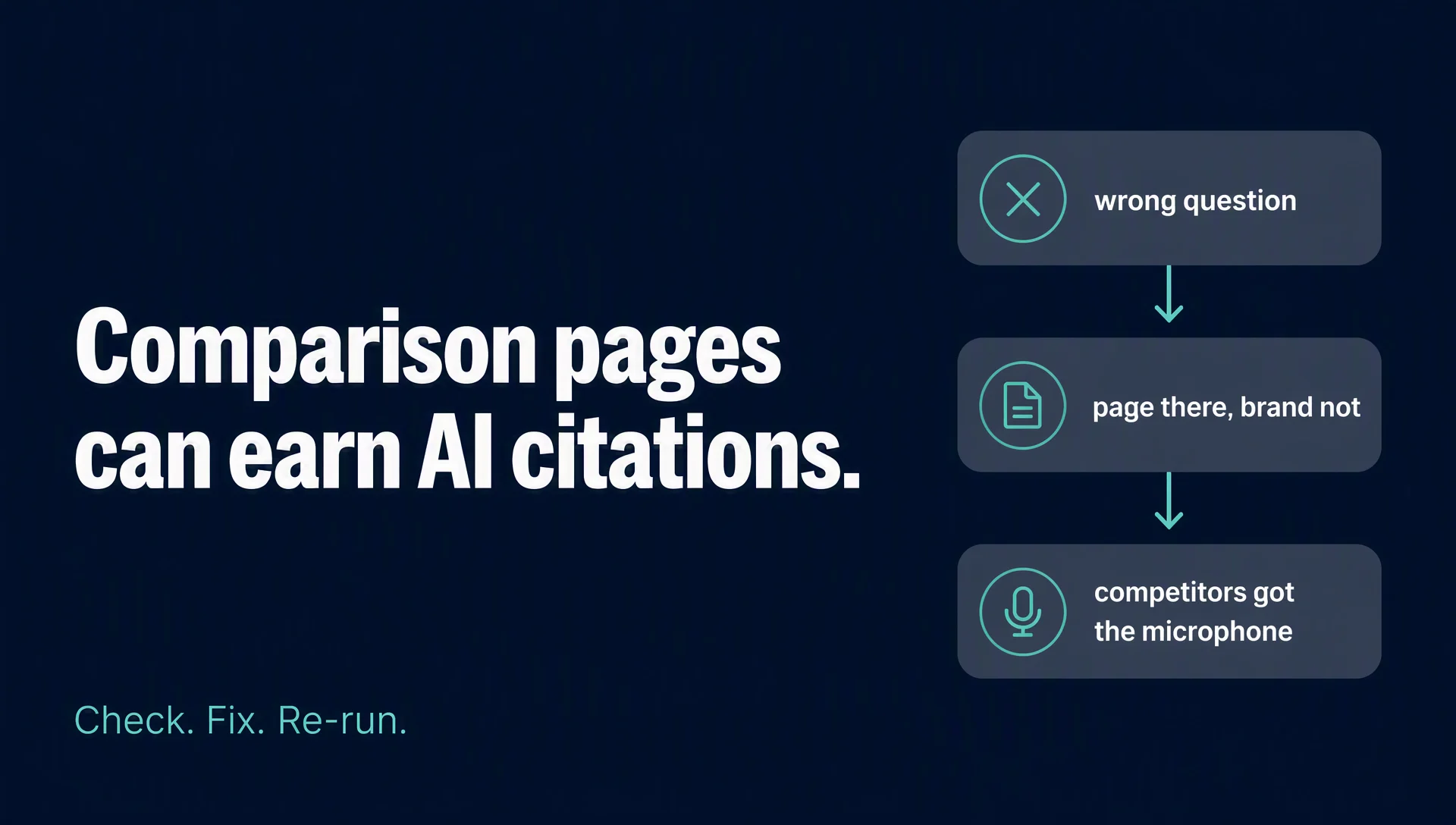
You solved the wrong version of the question | Your article answers a narrower use case than the buyer's query | A "for small business" article is on the page for "best crm tools"; your domain is not named in the AI answer |
Your page is there. Your brand is not. | You have a close-match page, but AI cites other sources for the same question | Your domain is absent from the AI-named set and none of its brands dominate either |
Your list gives competitors the microphone | The brands in your article appear in the AI answer while you are absent | Heavy overlap between your article's brands and the AI-named brands, side by side |
One caution before you change anything: AI answers move. Running the same check on the same term two weeks apart on our side returned different cited sources. A single run is a data point, not a trend. If the gap is small, run the check again after two weeks before rewriting anything, and if it is still there, come back to Step 3.
Step 3: Fix per diagnosis
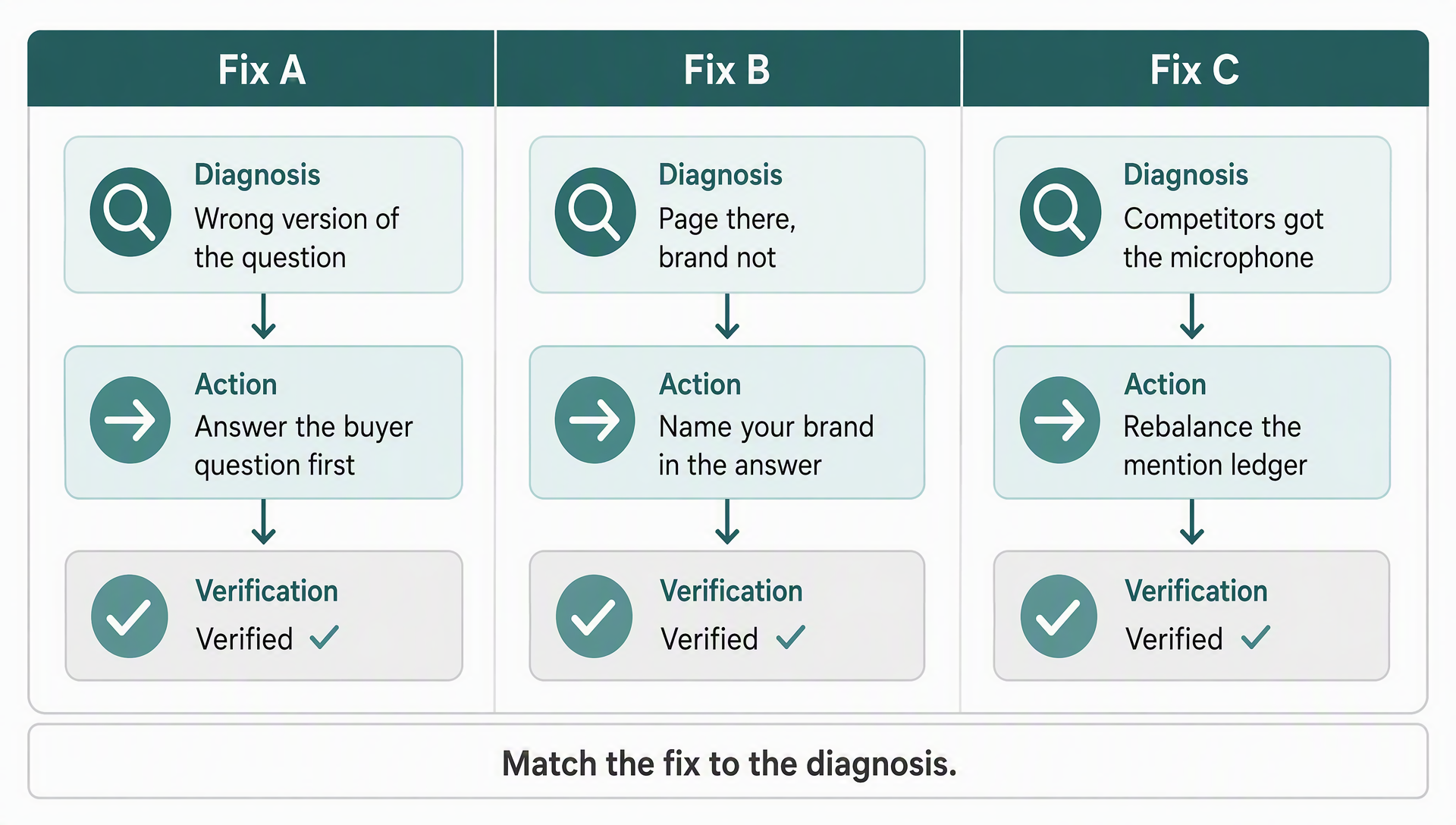
Match the fix to the diagnosis.
Fix A: you solved the wrong version of the question.
- Action: rewrite the title and the opening answer block to answer the buyer's phrasing first, then move the niche context (your narrower angle) below it. The page now answers the head question on the first screen.
- Expected output: after the rewrite, the first three sentences answer the query as asked, before any segment framing.
- Quality check: read it cold like the buyer. In three seconds, can you tell what question it answers? If the answer is no, the title is still yours, not the buyer's.
- Recovery: if the mismatch is deeper than the title, if the whole asset is about a different use case, do not force it here. Keep that page for its own query and put the answer to the buyer's question into the strongest competing page you have, or plan the new one.
Fix B: your page is there, your brand is not.
- Action: make the answer block quote-names you. Two to three sentences at the top that name your product as the default candidate and the condition under which it wins, then your evidence immediately after: one measured number, one live screenshot, one test result. Then make sure the brand entity is unmissable: product name in the first paragraph, product name in image alt text, product name in the first FAQ answer.
- Expected output: the page, read cold, names your product as the default candidate, with evidence nearby.
- Quality check: re-run the check. If your domain still is not named, verify the page itself is the one being selected, not an older sibling. If your page simply is not retrieved at all, the problem moved upstream (indexing, ranking, topic match), and the citation formula is not where the work is.
- Recovery: when the gap persists after two re-runs and a real rewrite, your page is retrieved but the answer engine prefers another source on this question. That often points to the query or the evidence, not the copy: weak, generic evidence cannot be fixed by adjectives (see Fix C).
Fix C: your list gives competitors the microphone.
- Action: rebalance the ledger. Your product keeps one entry, but it is now the same size as a competitor entry: a "best for" line, a measured number, a row in every comparison table. Competitors are demoted: two to three entries each, framed as "when to choose them instead of us". Where a competitor genuinely wins an axis, say it, and say the constraint. Unhedged "we are better at everything" is exactly what models mention least.
- Expected output: a comparison matrix with your product measured on every axis, with numbers, not checkmarks.
- Quality check: count the mentions in the rendered page. Your product should be mentioned at least as often as each competitor, and appear in every table.
- Recovery: if you cannot produce one honest, measurable advantage, no rebalancing will help. This is a product or positioning problem. Fix the evidence first, then the copy. No correction of the article should pretend otherwise: the check reports a visibility gap, not proof that AI started recommending you.
Step 4: Re-run and verify
Run the check again with the same query and domain after your revision.
- If your domain appears in the AI-named set, or the overlap between your article's brands and the AI-named brands has shrunk, the page changed behavior. Note the date and conditions in your report.
- If nothing changed, do not spiral. Run it again after two weeks (AI citation sets move on their own; our own check on "best crm tools" changed cited sources between an August 13 run and an August 28 run, and the head term volume dropped 31% over that period). If after two honest runs nothing moved, revisit the query, not the page.
- One warning: a single "your domain appears" does not prove the AI answer changed because of your page. Use the trend across two runs, and keep the wording in your report honest.
Step 5: Keep the check current
The monthly version takes fifteen minutes:
- Re-run and save the table (date, brands, whether your domain was named).
- Collect three months of rows before treating a pattern as a trend.
- Watch Search Console for AI-driven queries: those are the impressions nobody clicks but the answer engine reads.
- Two useful term-level signals from our running check: "best crm tools" volume was down 31% over three months, and the top long-tail opportunity ("best crm tools for small business", 2,900 monthly, KD 36) still has a Reddit thread as its number one result. When the term is declining or unanswered, a flat page is the wrong page for the question.
Common ways this goes wrong
- Checking the query you invented instead of the query buyers type.
- Copy-led fixes when the evidence is missing. The rewrite is easy; the number is the work.
- Panicking after a single run. One check is a snapshot; AI answers change between runs.
- Promising a citation. The check shows a gap to investigate. It does not force an answer engine to name you.
FAQ
Is naming competitors in a comparison page a bad idea? No. Comparisons without alternatives lose credibility, and credibility is what earns the citation. The shift is in emphasis and evidence: your product gets the default position and the measured proof; competitors get the honest "when to choose them" entries.
Should I delete my "best X" listicle and start over? Rarely. The ranking page is the asset. Rewrite it through Fix A, B, or C, keep the URL, and keep the evidence in the tables. A new list with the same structure inherits the same ledger problem.
How often do AI answers change? Often enough that one run is never a verdict. On our own check of "best crm tools", the cited sources changed between two runs two weeks apart. Two runs a month apart is the shortest horizon worth a conclusion.
Author: Martin Hayes, GEO Playbook Builder for 200+ Execution Checklists at Auspia. Martin writes step-by-step workflows for AI search visibility, citation-first content operations, and repeatable GEO checklists.