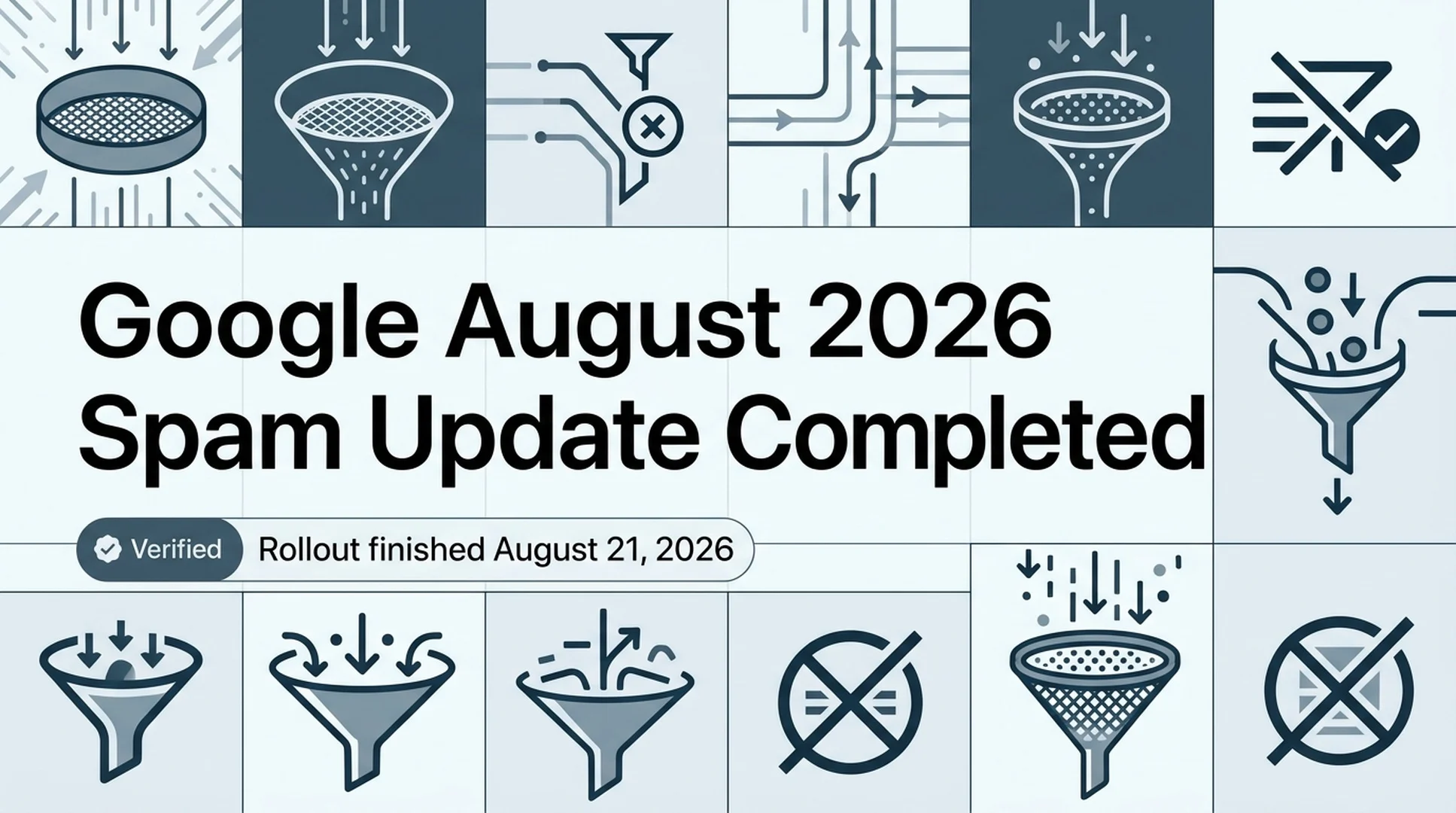
Google's August 2026 spam update completed its rollout on August 21, 2026, the company confirmed on its Search Status Dashboard. The update began on August 18 at approximately 12:30 p.m. ET and finished at around 4:50 a.m. ET on August 21, running for roughly two days and sixteen hours.
What was announced
Google published the update on its Search Status Dashboard and on LinkedIn, describing it as a normal spam update that applies globally to all languages and locations. The company linked to its spam policies documentation for details on which practices the update targets.
Details and availability
The update targets sites that violate specific Google search spam policies. According to Google, it does not target link spam and does not target the site reputation abuse policy. The spam policies documentation covers practices including cloaking, doorway abuse, expired domain abuse, hacked content, hidden text and link abuse, keyword stuffing, scraped content, sneaky redirects, and user-generated spam.
Google said the rollout would take a few days to complete, and the actual duration matched that estimate. The company did not disclose what percentage of searches or queries were affected by the update.
Google also confirmed it will run periodic refreshes of this spam update. Recovery for sites affected by the update can take many months, according to Google's guidance.
Context
Google runs named spam updates on a regular cadence alongside its broader core updates. The previous spam update was the June 2026 spam update, which rolled out over approximately two days and one hour starting June 24. Before that, the March 2026 spam update completed in roughly nineteen and a half hours.
Spam updates target specific policy-violating techniques rather than the broad quality signals that core updates evaluate. Google has historically distinguished between the two: core updates reassess the overall quality of content and pages, while spam updates specifically enforce violations of documented spam policies.
Google's John Mueller addressed community observations that ranking volatility appeared before the official announcement, saying the earlier fluctuations were not related to this spam update.
What has not been confirmed
Google did not specify which spam policy categories were most responsible for rankings changes in this rollout. The company did not provide data on how many sites or queries were affected. There is no public information on whether this update introduced new detection capabilities or simply applied existing systems more broadly.