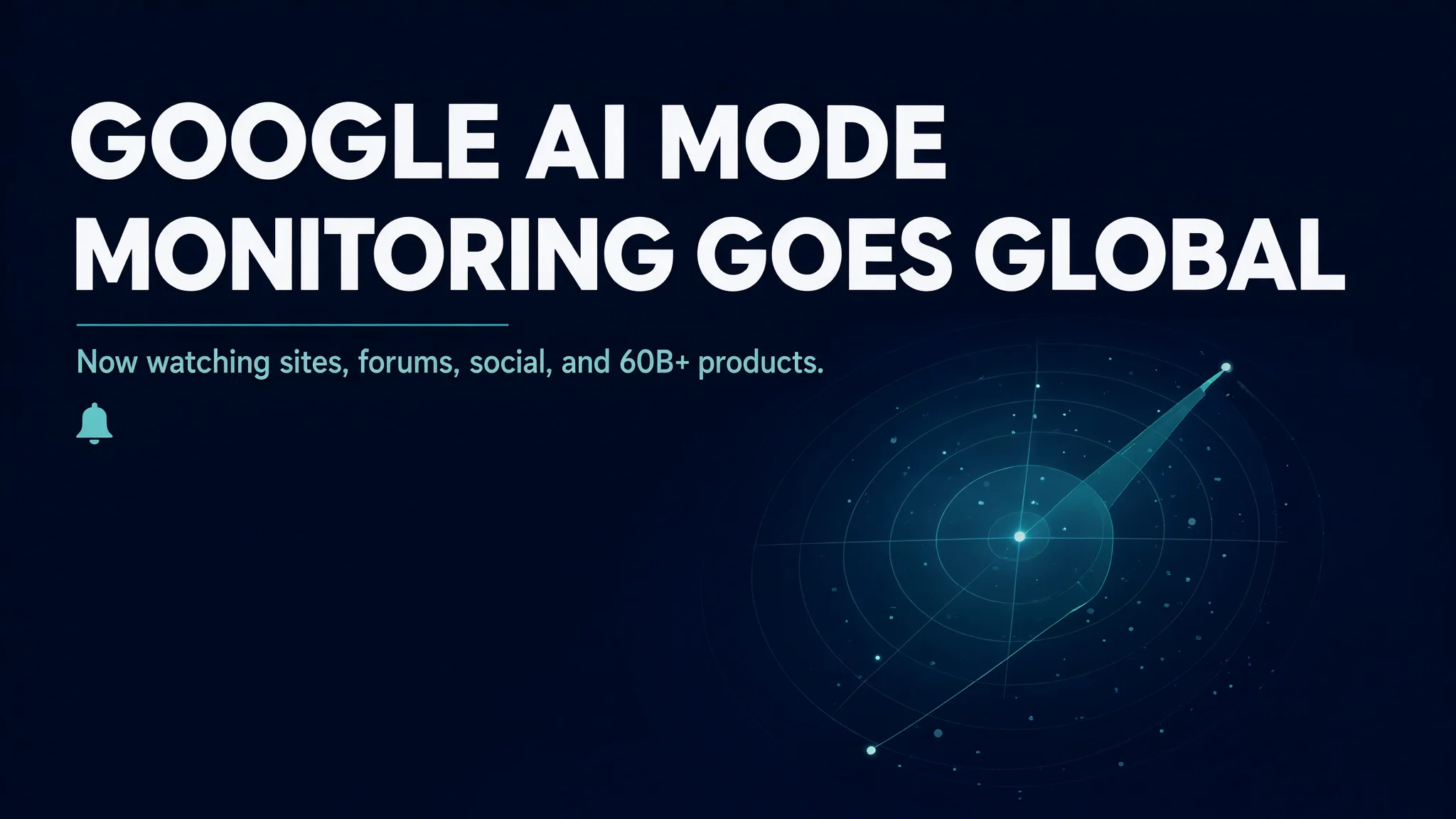
On September 28, 2026, Google began rolling out information monitoring in AI Mode to everyone globally. The feature had been limited to Ultra and Pro paid subscribers. Robby Stein, Google's Vice President of Product in Search, announced the change on X, and Search Engine Roundtable and Search Engine Journal covered it the same day.
The practical change is small to describe and large in effect. A user tells AI Mode what to watch, and Search keeps checking for changes across websites, forums, social posts, Google's real-time data sources, and the Shopping Graph of more than 60 billion products. When something relevant changes, Google alerts the user through the app. AI Mode also suggests monitoring tasks as people search.
Search just became a standing agent that keeps watching after the query ends. For anyone responsible for how a brand shows up in AI answers, that is a new surface to think about.
What changed
The feature itself is not new; the audience is. Monitoring in AI Mode existed for paying subscribers first. The September 28 update opens it to all Google users globally, which turns a niche capability into a default part of how people use Search.
Here is what AI Mode monitors, per Google's description:
Source AI Mode watches | Why it matters for a brand |
|---|---|
Websites | Your own pages and competitors' pages, including pages you may not have updated in months |
Forums | Community threads where your product, pricing, or reputation gets discussed without you |
Social posts | Public posts and announcements that shape what an agent believes about you |
Google's real-time data sources | Live information Google already tracks, which can override a stale page |
Shopping Graph (60B+ products) | Product, price, and availability data for anything a user is tracking |
Google's example use cases are consumer-flavored: new restaurants opening nearby, local holiday activities, and back-in-stock or price-drop alerts. But the mechanism is general. Anything a user asks AI Mode to track becomes something AI Mode keeps re-checking, and the sources it checks are the same sources that shape what AI answers say about a brand.
What the evidence shows
Three facts are solid from the announcement, and they are worth holding separately from interpretation.
The rollout is global and open to all users. Stein's announcement and both industry write-ups describe the same scope: previously paid-subscriber-only, now everyone. This is not a limited test.
The monitored sources are named. Google lists sites, forums, social posts, real-time data sources, and the Shopping Graph. That is a concrete list, not a vague promise, and it tells you where an agent's attention goes.
The alerting runs through the Google app. Monitoring is not a one-time answer; it produces ongoing notifications and suggested tasks. The interaction model is a subscription, not a search.
Why this matters for visibility
Most brand visibility work assumes a moment of search: a user asks, an answer appears, the interaction ends. AI Mode monitoring breaks that assumption. When a user subscribes to a topic, the agent keeps evaluating sources over time, and the brand's standing in those sources is re-checked continuously.
That changes what "being visible" requires. A page that was accurate six months ago can now feed a stale belief into an ongoing monitor. A forum thread with an outdated price can become the fact an agent repeats in an alert. A social post that contradicts your website creates the kind of inconsistency an agent resolves by hedging, or by trusting the source it can verify.
In other words, monitoring raises the cost of inconsistency and the value of freshness. The brand that keeps every monitored source aligned and current wins the alert; the brand that leaves contradictions around loses it quietly, without ever seeing a ranking drop.
What is still uncertain
Do not read more into the launch than Google stated.
Google has not published how often it re-checks each source, how it weighs a forum thread against an official page, or how it decides which change is worth an alert. Those ranking-style details are exactly the ones that would let a team optimize precisely, and they are not available.
It is also unclear how monitoring interacts with AI Mode's existing answers over time. A monitor may surface a fact that never appears in a normal answer, or it may reinforce one that does. Until there is public data, treat any claim about "monitoring rankings" as speculation.
Finally, availability is rolling out, so not every user sees it yet. That makes early measurement noisy.
What teams should do this week
The useful work is straightforward and does not depend on the unknowns.
List the sources an agent would check about you. Start with your own site, then add the industry forums, review sites, social accounts, and product feeds where your brand is discussed. That list is the surface AI Mode monitoring draws from.
Check each source for stale or contradictory facts. Look specifically at price, availability, features, and claims. Where a source disagrees with your official page, fix it or update the official page. Consistency beats volume.
Keep your product data current. If you sell anything, the Shopping Graph is in scope. Price and availability that lag reality are the fastest way to feed a wrong alert.
Use monitoring on yourself. Turn the feature around and have AI Mode watch your brand and your competitors. It is a free, native way to see what an agent notices changing, which is close to what your customers' agents will notice too.
Write facts, not just persuasion. Pages that state a clear, current fact in plain language are easier for an agent to monitor and repeat accurately than pages that imply the fact across three paragraphs of copy.
Metrics to watch
Track whether your brand facts stay consistent across the sources on your list, and how often a source goes stale. Watch branded search volume and direct traffic for signs that monitoring-driven alerts are sending people to you. And keep an eye on the gap between what your official pages say and what forums or social posts say, because that gap is where an agent's belief about you gets decided.
For the wider picture, this connects to how AI search citation sources differ by industry and to the four factors that decide whether AI search cites you.
Auspia view
Google did not ship a new ranking factor; it shipped a new attention pattern. AI Mode now watches the web on a user's behalf, and the sources it watches are the ones that already decide what AI answers say about a brand. The teams that treat every monitored source as a place where their facts must stay current will hold their position. The teams that only optimize their own pages will slowly lose the alert to whoever stays consistent.
FAQ
Is AI Mode monitoring free now?
Yes. Google opened the feature to all users globally on September 28, 2026, after an initial period limited to Ultra and Pro subscribers.
What sources does AI Mode monitor?
Google lists websites, forums, social posts, its real-time data sources, and the Shopping Graph of more than 60 billion products.
Does monitoring change how AI Mode ranks or cites pages?
Google has not published how monitoring weighs sources or how it interacts with normal AI Mode answers. Any claim about a "monitoring ranking" is speculation until Google shares details.
What is the fastest thing a brand can do?
Make sure the facts about your brand are consistent and current across every source an agent would check — your site, forums, social, and product feeds. Inconsistency is the clearest way to lose an agent's trust.
Author: Jasper Quinn, AI Search Product Researcher Tracking 60+ Feature Changes at Auspia. Jasper writes about search product updates, AI platform changes, and what they mean for how brands get found.