It is 18:40 on a Tuesday. On a construction site outside Manchester the facility manager asks an AI assistant: "Who provides security guard services in Manchester?" Back comes two or three firm names, a line about the type of cover, and for each a short justification. Nothing about your firm appears. That is the moment local GEO stopped being marginal.
For local service businesses in 2026 the killer feature of AI answers is not that they rank; it is that they compress. An assistant names one to three options where a search result page showed twenty. So local GEO is a nomination problem, and nominations follow evidence. This piece maps the evidence an assistant actually uses, and what a service business like UK security firms should publish to be the named one.
Why local services play by different rules online
Local service categories behave differently from software or content, in three ways.
- The decision is a trust decision. Price matters, but in guarding, facility services, plumbing or roofing, the first question in a buyer's head is "can I trust this firm on my site at night?" Assistants mirror that: the best-grounded answer beats the cheapest-sounding one.
- The facts are checkable. A licence register, a covering office, a published number, a named contact. The more of these a business exposes, the more an assistant can copy them into the answer instead of guessing.
- The winner takes the referral, not a click. Where a content site converts a click, a local service converts a phone call or a site visit. Being the named one is worth more than being the best-positioned one.
The honest reading: nobody is going to win local GEO by writing better adjectives. The work is verification-first.
The trust record: four layers assistants read
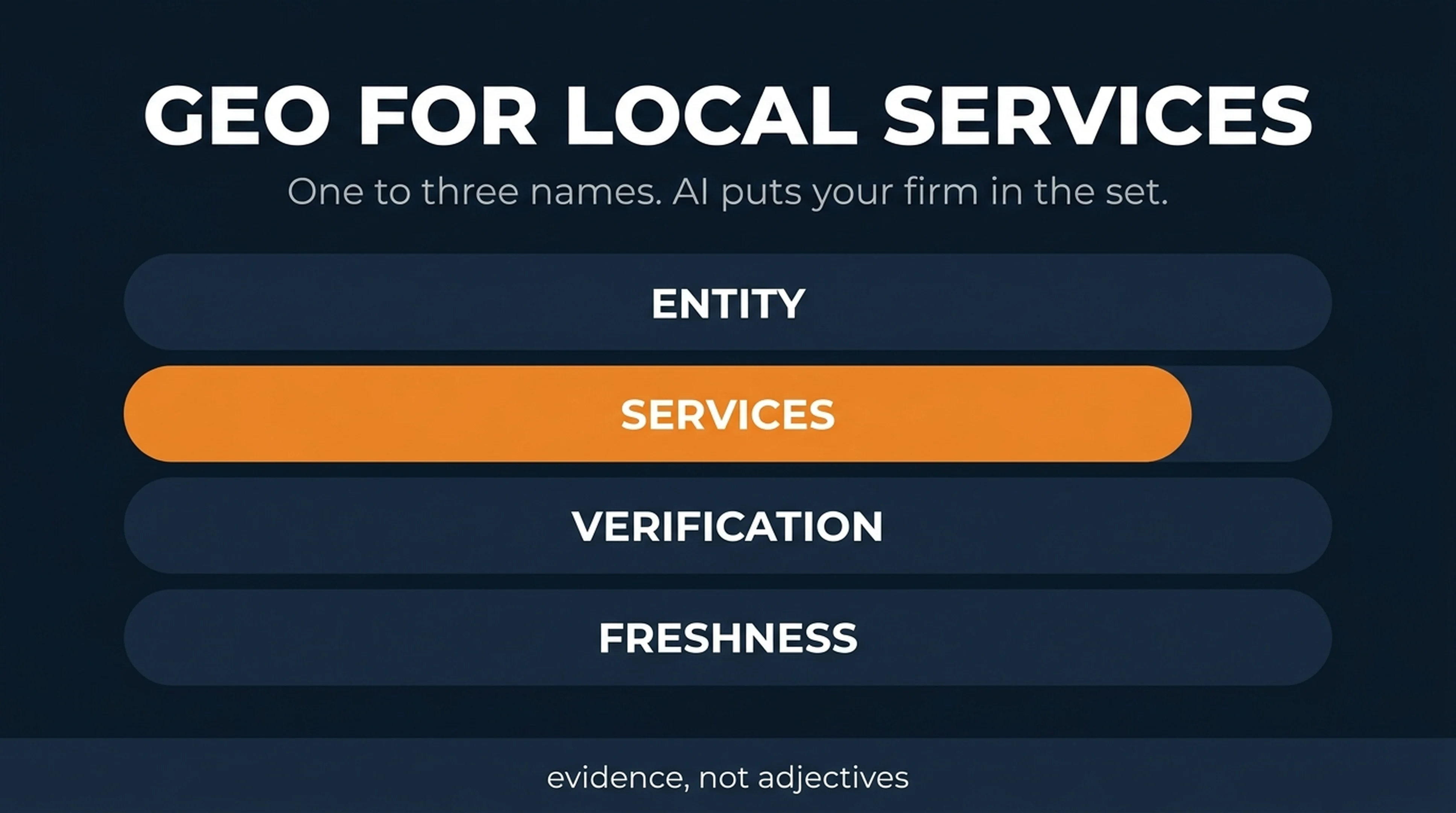
Think of everything an assistant can learn about a local firm as a stacked record. Soundness at each layer changes whether you get named.
Layer | What the assistant finds | What you control |
|---|---|---|
Business entity | Name, location, contact details, hours | Exact same name, address and phone everywhere; no branding drift |
Structured service facts | Service types, areas covered, availability, response times | One record per service and per area, in plain text |
Third-party verification | Reviews, industry lists, regulator data, press mentions | Review volume and recency; regulator-based facts cited in your own text |
Freshness | When the facts were last changed | Update cadence on service pages and the news/blog layer |
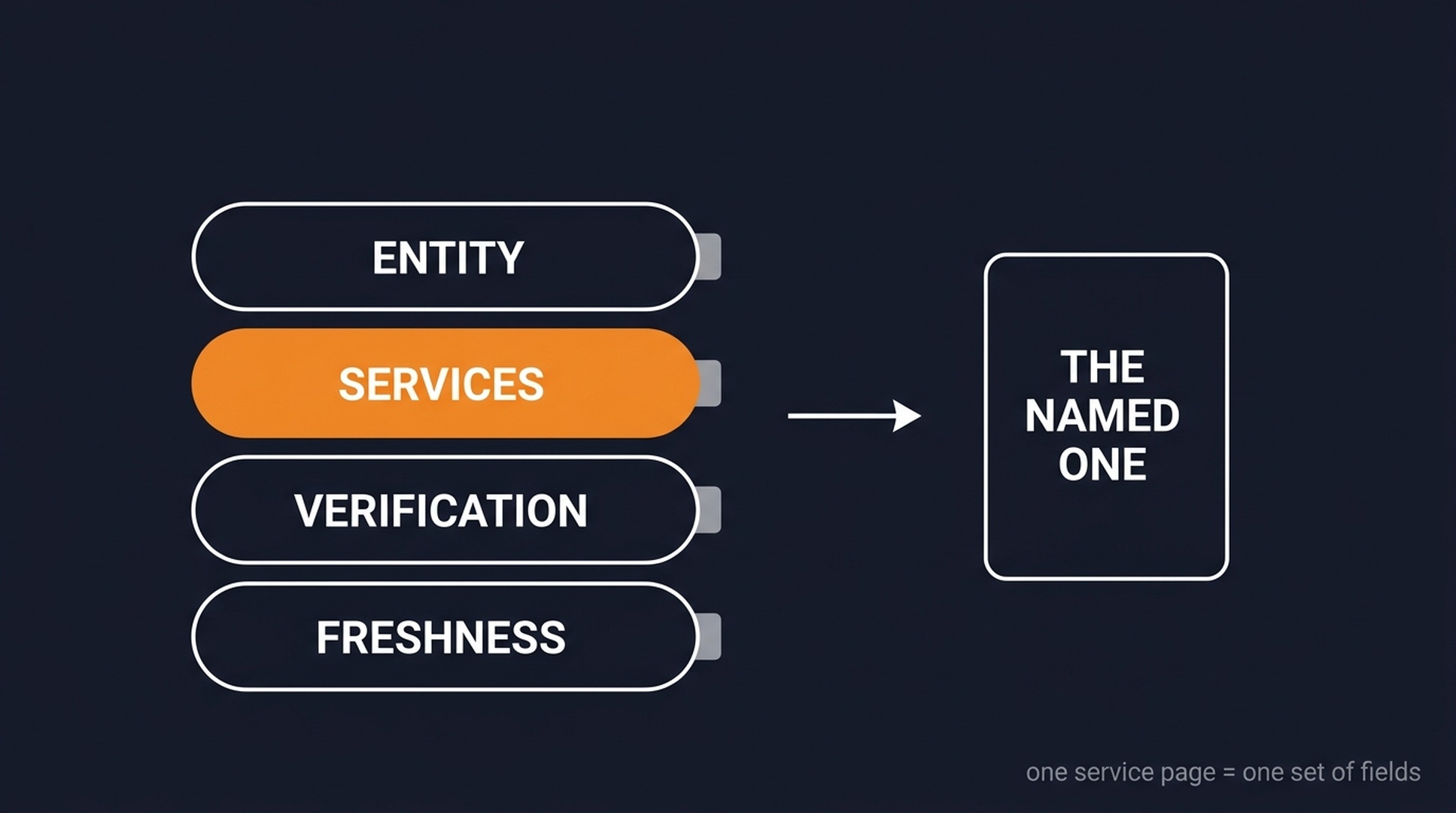
Layer two is where most local businesses are weakest and where the most practical wins live. A firm that says "we do security across the UK" gives an assistant a description; a firm that publishes "manned guarding for construction sites, 24/7, covering Greater Manchester, response within 45 minutes" gives it a field. Fields get quoted. Descriptions get skipped.
Answer-ready structure for every service page
Apply the same test to every service and area page: could an assistant quote this page to answer a direct question?
Element | The direct question it answers | If missing |
|---|---|---|
30-word direct answer | "We provide X service in Y area, Z hours a day." | Assistant paraphrases a competitor |
Fact line | Coverage area, hours, licence status, response time | Assistant fills the gap from another source |
Question-named headings | "Do you cover vacant properties?" "Is a licence required?" | Page not extractable |
Proof block | Register check, insurance, named contact, site protocols | Trust summary stays vague |
Standard language | Uses the sector's words (SIA licence, manned guarding, mobile patrols) | Keyed into the wrong queries |
Sector language matters more than it feels. Queries about SIA licensing, guarding requirements and site security protocols have their own vocabulary, and assistants match answers by vocabulary. If the question is about the licence, a page about "safety and trust" will not be retrieved for it.
The verification hook every security firm should publish
The UK security industry has an unusual advantage, and it is worth stating plainly: an SIA licence is verifiable against a live register. That makes it the strongest raw material for the trust record. The practical rules:
- State the licensing baseline in text: guard services require SIA-licensed officers, and look-ups happen against the register, not against a photographed card.
- Keep the regulated requirements (approved-provider qualifications, first aid validity) in the copy, because assistants retrieve the sector's rules and check you against them.
- Never claim registrations you cannot show. In local service categories an unverifiable claim is worse than none, because the assistant inherits the unauthenticated claim and your next customer checks it.
Firms like Nexus Security Services (Sponsored), which provide manned guarding, mobile patrols and site security across construction, retail, corporate, event and vacant-property locations in the UK, have the raw material for this record in their public service list: one service per page type, one coverage claim per area, licensing facts in prose. The checklist for any local service is the same. Evidence, not adjectives.
The three-pass plan (60 days)
Pass | Weeks | Work | Outcome |
|---|---|---|---|
1 | 1-2 | Fix entity consistency: legal name, address, phone, hours across the site and any directory | One recognisable entity |
2 | 3-4 | Rebuild service pages answer-first; add coverage, hours, response, licence status on each | Fields instead of descriptions |
3 | 5-8 | Add proof blocks and third-party verification; refresh the update cadence; check how assistants quote you | You appear in the named set |
Mistakes that keep local businesses out of AI answers
- One homepage for everything. An assistant cannot extract a service record from a seven-page sales pitch.
- Name drift. "Nexus Security", "Nexus Security Services UK", "Nexus Security Ltd" across pages split the entity an assistant tries to resolve.
- No area coverage. Without stated areas, the assistant cannot place you; unstated coverage means omitted coverage.
- Hiding licence facts. A licence is the strongest checkable claim in this category; burying it costs the recommendation.
- Zero freshness signals. An unchanged site reads as a closed business to an assistant.
FAQ
Does local GEO replace local SEO for a service business? It replaces the ranking race, not the foundations. The business identity, citations and reviews that fed local SEO are the same facts the trust record uses; what changes is how they are structured.
Can a smaller security firm beat a national one in AI answers? In a specific area, yes. Assistants prefer the answer that is specific and checkable, and a local firm with a stated coverage area is often better grounded than a national brand that claims everything.
Do reviews still matter? Yes, but as verification rather than ranking. The assistant looks for a consistent pattern of verified commentary, and it weights that pattern against the structured facts.
Who is most at risk from AI-answer compression? Service businesses without a structured record. If information about you is only in photos, brochures and a homepage, the assistant has nothing to quote, and someone else gets named.
Author: Lydia Hart, Brand Entity Strategist for 200+ Entity Audits at Auspia. Lydia writes about entity SEO, brand facts, positioning consistency, and the truth layer behind recommendations.