Everyone in this series gets the same promise. Let's make it concrete for this one: after you finish this article, you can type one command in Codex, wait about fifteen seconds, and get back a nine-category technical SEO audit of any URL. Score included, reading list included, and a "how would we know this failed" check on every finding.
I built this skill because the audit part of technical SEO is where the real time goes. Crawlability, indexability, security headers, mobile, Core Web Vitals, structured data, rendering. Nine areas, each with thresholds that matter, each with a pile of tools that need a credit card. This version runs on nothing but python3, and its thresholds match Google's published documentation, not some random "SEO score" site.
The outcome
Who this is for | Anyone with a website and |
What you get | A scan of nine technical SEO categories with pass/warn/fail status per category, a 0-100 technical score, and a Critical/High/Medium/Low action plan |
Time | 15 seconds to scan. Write-up with me: about 30 minutes. Manual audits of the same scope: four hours at minimum |
Definition of done | Output has the score, the failing checks named with evidence, and every recommendation clearly states what to fix and how to verify it worked |
Here is the tool running on my own site, auspia.ai, right after I wrote the scanner. Real output, not a mockup:
technical_scan https://auspia.ai
  final status: 200  (redirects: 0)  size: 410.9kB
  security headers: Strict-Transport-Security
  - Info: no CSP header
  - Warn: missing X-Content-Type-Options
  robots.txt: http 200  sitemaps declared: ['https://auspia.ai/sitemap.xml']
  sitemap url_count: 966
  title(46): Auspia - AI-powered SEO automation growth tool
  h1 x1, h2 x9, imgs 15 (missing alt 0), scripts 57
  schema: [['Organization'], ['WebSite']]
Within that block we already know: HTTPS enforced, robots.txt present and pointing at a real sitemap with 966 URLs, one H1, all images have alt, and two valid JSON-LD blocks. We also see two things to improve. The scanner does the boring work; you read it against the judgment table later in this article.
Why technical SEO still matters in 2026
Ranking requires indexing. Googlebot only crawls what it can reach, can only read the first 2MB of an HTML page, skips JavaScript on non-200 responses, and saves a page in a duplicate cluster for up to two weeks after you fix its canonical tag. None of that changes because search got more AI. If anything, the stakes grew: Google's new status for AI crawlers (GPTBot, ClaudeBot, PerplexityBot, the user-triggered agents you cannot even block) means your robots.txt decisions now affect both search ranking and AI visibility. The site that does not control its robots file is making a half-hidden choice about whether an AI company gets to train on its content.
Practical payoffs, in order of size: crawl budget efficiency (Google does not waste time on pages you told it to skip), removal of indexing blockers (the single biggest cause of "I wrote it and it never ranked"), and trust signals (security headers are thin ranking factors, but missing HSTS when you sell things online is a bad look and a tiny negative). Technical SEO won't rescue weak content, but it will stop your best pages from being invisible.
The nine categories at a glance
# | Category | What the scanner checks automatically | What still needs your eyes |
|---|---|---|---|
1 | Crawlability | robots.txt status, sitemap declarations, total page size (2MB limit) | AI-crawler strategy, crawl budget for 10k+ page sites |
2 | Indexability | canonical presence, robots meta, word count, hreflang links | Duplicate-page campaigns, intentional vs accidental noindex |
3 | Security | HTTPS enforcement, redirect chain, HSTS/CSP/X-Frame-Options/X-CTO/Referrer headers | HSTS preload, mixed content |
4 | URL structure | Redirect hops, URL length signals | Slug naming, trailing slash consistency |
5 | Mobile | Viewport + lang presence, image/text ratios | Touch targets, interstitial checks, desktop/mobile parity |
6 | Core Web Vitals | Lab CWV via free PSI API ( | Threshold interpretation (75th percentile) |
7 | Structured data | JSON-LD blocks, | Schema design (next article in this series) |
8 | JS rendering | Word count vs script count (CSR-shell detection) | Browser verification if the shell is real |
9 | IndexNow | Recommendations only | Config changes on the server or CMS |
The scanner covers what one fetcher can see. The table above marks what needs a browser or a human decision, and the skill tells you to say so instead of guessing.
Install the skill
Two files, same as every article in this series. First, the folder:
mkdir -p ~/.codex/skills/codex-seo-technical/scriptsSave this as ~/.codex/skills/codex-seo-technical/SKILL.md:
---
name: codex-seo-technical
description: Use when the user asks for a technical SEO check of any website or URL - crawl problems, robots.txt, XML sitemap, canonical conflicts, duplicate content, noindex tags, security headers, HTTPS, mobile questions, Core Web Vitals, structured data presence, or JavaScript rendering concerns. Triggers on "technical SEO", "crawl issues", "robots.txt check", "why is my page not indexing", "site speed", "security headers".
---
# Technical SEO Audit

Run the scanner first, then evaluate the nine categories against this
checklist. Every recommendation carries an explicit "how would we know this
failed" check, so the audit is falsifiable rather than decorative.

## Run

```bash
python3 ~/.codex/skills/codex-seo-technical/scripts/technical_scan.py <url> [--json] [--psi]
```

- Without flags: human-readable summary.
- `--json`: machine-readable full report (use this when writing your findings).
- `--psi`: also queries the free PageSpeed Insights API for real lab + field
  data (no API key needed). It rate-limits without a key (HTTP 429); report
  "live CWV unavailable, low-traffic sites are common" and continue instead of
  treating it as a failure.

## The nine categories

### 1. Crawlability

| Check | Fail means | Fix |
|-------|-----------|-----|
| robots.txt | 404 or unreachable | Create one via a CMS or static file; keep mobile/non-search user agents in mind |
| Sitemap declared + reachable | No `Sitemap:` line, or declared URL 404s | Point at a real XML sitemap; check it after every deploy |
| Noindex tags | Robots meta or X-Robots-Tag on a page you want indexed | Remove the directive on canonical pages only; keep it on thin/gated pages |
| Crawl budget | Site >10k pages, many near-duplicate URLs | Canonicalize, block parameter URLs in robots.txt, trim dead pages |

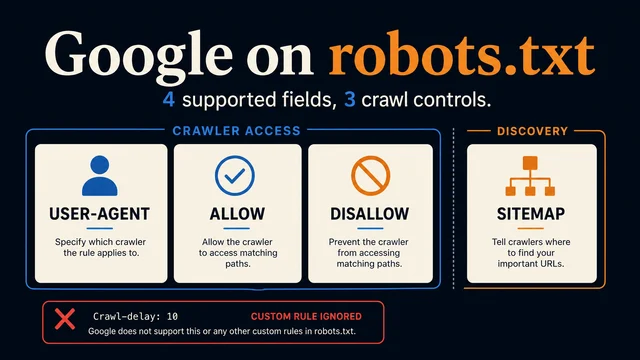
AI crawler handling (robots.txt tokens): `GPTBot` (OpenAI training),
`ChatGPT-User` (OpenAI live browsing), `ClaudeBot` (Anthropic training),
`PerplexityBot` (Perplexity search + training), `Bytespider` (ByteDance),
`Google-Extended` (Gemini training only, not Google Search), `CCBot` (Common
Crawl). Blocking `Google-Extended` does not affect Google Search indexing or AI
Overviews. User-triggered fetchers - `Google-Agent`, `Google-NotebookLM`,
`Google Messages` - ignore robots.txt by design; block those server-side.

Hard facts to keep in audits: Googlebot reads only the first **2MB of HTML**
(and 64MB of a PDF), so keep critical content and JSON-LD in the opening
payload. Crawl rate auto-adjusts; there is no manual crawl-rate setting (the
legacy Search Console control was removed in January 2024). AMP gets no
ranking advantage since 2026 and Google sends users to publisher-hosted AMP
URLs; do not recommend AMP Cache unless the site already has it.

### 2. Indexability

| Check | Fail means | Fix |
|-------|-----------|-----|
| Canonical | Missing, not self-referencing, or points at a redirected URL | Self-referencing canonical on every page |
| Canonical vs noindex conflict | Canonical exists but robots says `noindex` | Either index it or point the canonical at the indexed twin |
| Thin content | <300 words on a page you want ranking | Expand or fix the intent match; thin pages have no ranking potential |
| Duplicate content | Same content at www/non-www, http/https, trailing-slash variants | One version per URL set; 301 the variants |
| Hreflang | `hreflang` links exist but pairs are wrong for your language set | Use bidirectional pairs, one canonical each |

Do not interpret an unchanged canonical immediately after a fix as failure:
Google may keep corrected pages in a duplicate cluster for up to two weeks,
then re-evaluate.

### 3. Security

Check headers in the scanner output: `Strict-Transport-Security`,
`Content-Security-Policy`, `X-Frame-Options`, `X-Content-Type-Options`,
`Referrer-Policy`. Missing HSTS and X-Content-Type-Options are warns; CSP
missing is information (not all sites need one).

**Critical:** back-button hijacking via `history.pushState`/`replaceState` (a
Google spam-policy violation, enforcement live since 2026-06-15); third-party
ad scripts doing it still counts.

### 4. URL structure

- Redirect chains: max one hop; 301 for permanent moves (never 302).
- Long query strings on content pages: flag >100-character URLs.
- Descriptive, hyphenated slugs; consistent trailing slashes.

### 5. Mobile and page experience

- Viewport meta present; no horizontal scroll (mobile).
- Mobile-first indexing: Googlebot Smartphone is the primary crawler. A mobile
  version is strongly recommended, not required; the real risk is content and
  parity loss, not de-indexing.
- Content parity (highest-value check): same primary content, matching robots
  meta, matching titles, equivalent structured data, crawlable resources.
- Interstitials: flag full-page popovers, consent-redirect pages, persistent
  blocking dialogs; allow small banners and standard CMS/legal dialogs.
- Keep key content visible on load - not behind tabs or accordions.

Page experience is guidance, not one ranking system. Only Core Web Vitals feed
ranking directly; HTTPS is a confirmed but lightweight signal.

### 6. Core Web Vitals

| Metric | Threshold (75th percentile) |
|--------|----------------------------|
| LCP | <=2.5s |
| INP | <=200ms |
| CLS | <=0.1 |

INP replaced FID in March 2024 - never report FID. Field data comes from CrUX
via `--psi`; when the API rate-limits, say so explicitly instead of inventing
lab numbers.

### 7. Structured data

Scanner reports JSON-LD blocks and their `@type`; flag invalid JSON (it is
invisible to Google). Full analysis = the codex-seo-schema skill; here, just
note presence and validity. Prefer JSON-LD over Microdata/RDFa.

### 8. JavaScript rendering

Signals from the scan: very low word count + high script count points to a
client-side-rendered shell. If so:

1. Check if canonical/robots/title appear in the raw HTML source (curl the
   URL). December 2025 Google guidance: a canonical injected only by JS may
   conflict, and Google MAY still honor a `noindex` that raw HTML served even
   if JS removes it.
2. Google doesn't render any page with a non-200 status; JS-injected meta on
   error pages is invisible.
3. Serve critical elements (title, canonical, robots, structured data) in the
   server HTML, and note the rendering limitation instead of faking results.

### 9. IndexNow

Recommend IndexNow for Bing, Yandex, and Naver (not Google). Detect support
via an `indexnow` token/endpoint or WordPress plugins; it is a suggestion, not
a defect.

## Scoring

Rate each category pass / warn / fail (pass=100, warn=60, fail=20), average to
a 0-100 Technical Score. Bucket the findings:

- **Critical** (fix today): blocks indexing, security violations, back-button
  hijacking, non-HTTPS.
- **High** (this week): canonical conflicts, missing HSTS, mobile parity loss,
  thin primary pages.
- **Medium** (this month): redirect chains, hreflang errors, missing CSP.
- **Low** (backlog): header details, target-size polish, IndexNow setup.

Each recommendation: the evidence line (what the scanner found), the fix, and
a falsify check so the user can verify next week - e.g. "add HSTS, then
`curl -I` shows Strict-Transport-Security; if Google still duplicates the
canonical for two weeks, that is normal, not failure".

## Errors

| Scenario | Action |
|----------|--------|
| URL unreachable / timeout | Report the error and the status code; ask the user to verify DNS/public access. Never guess site content from memory |
| robots.txt 404 | Note it and recommend creating one; continue the audit |
| Non-200 final status | If 4xx/5xx, stop on-page checks and report the status; crawling that URL is wasted budget |
| PSI 429 | Note live CWV unavailable; use lab proxies or a free API key; do not block the audit |
| JSON-LD invalid | Quote the block and point at schema.org validator |
| CSR-only page | Complete what the raw HTML proves, mark the rest as needs-browser, offer the Playwright note |

## Agent-friendly pages (optional deep-dive)

Recommend, not block: semantic HTML (real `<button>`/`<a>`, no
`<div onclick>`), label associations on inputs, minimum 48px touch targets,
stable layout. Vision models, raw DOM readers, and accessibility-tree readers
are all more reliable when the page is structurally plain.
Then save the scanner as ~/.codex/skills/codex-seo-technical/scripts/technical_scan.py. Standard library only, no pip install anywhere:
#!/usr/bin/env python3
"""Nine-category technical SEO data collector. Standard library only."""

import json
import re
import ssl
import sys
import urllib.error
import urllib.parse
import urllib.request

TIMEOUT = 15

UA = ("Mozilla/5.0 (Macintosh; Intel Mac OS X 10_15_7) "
      "AppleWebKit/537.36 (KHTML, like Gecko) Chrome/126.0 Safari/537.36 "
      "codex-seo-technical/1.0")


def fetch(url):
    """Return (status, final_url, headers, body) following redirects."""
    chain = []
    seen = set()
    cur = url
    while cur not in seen and len(chain) < 8:
        seen.add(cur)
        chain.append(cur)
        req = urllib.request.Request(cur, headers={"User-Agent": UA})
        try:
            resp = urllib.request.urlopen(req, timeout=TIMEOUT)
            headers = dict(resp.headers)
            body = resp.read().decode("utf-8", "replace")
            return (resp.status, resp.geturl(), headers, body), chain
        except urllib.error.HTTPError as e:
            headers = dict(e.headers)
            loc = headers.get("Location")
            if e.code in (301, 302, 303, 307, 308) and loc:
                cur = urllib.parse.urljoin(cur, loc) if hasattr(
                    urllib, "parse") else loc
                continue
            return (e.code, cur, headers, ""), chain
        except urllib.error.URLError as e:
            return ("ERR:" + str(e.reason), cur, {}, ""), chain
    return ("LOOP", cur, {}, ""), chain


def get(url):
    req = urllib.request.Request(url, headers={"User-Agent": UA})
    try:
        resp = urllib.request.urlopen(req, timeout=TIMEOUT)
        return resp.status, resp.geturl(), dict(resp.headers), resp.read()
    except urllib.error.HTTPError as e:
        return e.code, url, dict(e.headers), b""
    except Exception as e:
        return "ERR", url, {}, b""


def psi(url):
    """Try the free PageSpeed Insights API (no key). Returns CWV dict or None."""
    api = ("https://www.googleapis.com/pagespeedonline/v5/runPagespeed?url="
           + urllib.parse.quote(url) + "&strategy=mobile")
    try:
        req = urllib.request.Request(api, headers={"User-Agent": UA})
        data = json.load(urllib.request.urlopen(req, timeout=45))
        lm = data.get("lighthouseResult", {}).get("audits", {})
        return {
            "LCP": lm.get("largest-contentful-paint", {}).get("displayValue"),
            "INP": lm.get("interaction-to-next-paint", {}).get("displayValue"),
            "CLS": lm.get("cumulative-layout-shift", {}).get("displayValue"),
            "TTFB": lm.get("server-response-time", {}).get("displayValue"),
            "crUX": "field data present" if data.get("loadingExperience") else
                    "no field data (low-traffic sites are common)",
        }
    except Exception as e:
        return {"crUX": "PSI API unavailable: " + str(e)}


def main():
    url = sys.argv[1] if len(sys.argv) > 1 else ""
    if not url:
        print("usage: python3 technical_scan.py <url> [--json] [--psi]")
        sys.exit(1)
    want_json = "--json" in sys.argv
    want_psi = "--psi" in sys.argv

    if not url.startswith("http"):
        url = "https://" + url

    (status, final, headers, html), chain = fetch(url)
    r = {"url": url, "status": status, "final_url": final,
         "redirect_chain": chain,
         "size_kb": round(len(html.encode()) / 1024, 1)}
    if not html:
        r["error"] = "no HTML body returned; status=" + str(status)
        print(json.dumps(r, indent=2) if want_json else r["error"])
        sys.exit(0 if status == 200 else 1)

    # check 1-3: HTTP redirect/HTTPS/security headers
    r["https_ok"] = final.startswith("https://")
    sec = {}
    for h in ["Strict-Transport-Security", "X-Frame-Options",
              "Content-Security-Policy", "X-Content-Type-Options",
              "Referrer-Policy"]:
        for k, v in headers.items():
            if k.lower() == h.lower():
                sec[h] = v[:120]
    r["security_headers"] = sec
    r["header_review"] = []
    if not r["https_ok"]:
        r["header_review"].append("Critical: page is not served over HTTPS")
    if "Strict-Transport-Security" not in sec:
        r["header_review"].append("Warn: missing HSTS header")
    if "Content-Security-Policy" not in sec:
        r["header_review"].append("Info: no CSP header")
    if "X-Content-Type-Options" not in sec:
        r["header_review"].append("Warn: missing X-Content-Type-Options")
    if len(chain) > 3:
        r["header_review"].append(
            "Warn: redirect chain is %d hops (keep under 3)" % len(chain))

    # check 4: robots.txt + AI crawler rules
    robots_url = "https://" + final.split("://", 1)[1].split("/", 1)[0] + "/robots.txt"
    sc, _, _, rb = get(robots_url)
    body = rb.decode("utf-8", "replace") if isinstance(rb, bytes) else ""
    r["robots"] = {"status": sc, "sitemap_declared":
                   [m for m in re.findall(r"(?i)^\s*Sitemap:\s*(\S+)", body)]}
    ai = {}
    for token in ["GPTBot", "ChatGPT-User", "ClaudeBot", "Claude-User",
                  "PerplexityBot", "Bytespider", "Google-Extended", "CCBot"]:
        m = re.search(r"(?im)^User-agent:\s*" + token + r"\s*$", body)
        if m:
            nxt = body[m.end():].splitlines()
            rules = [ln for ln in nxt[:12] if re.match(r"(?i)\s*(allow|disallow)", ln)]
            if rules and "disallow" in " ".join(rules).lower():
                ai[token] = "blocked in robots.txt"
            else:
                ai[token] = "mentioned, not blocked"
        else:
            ai[token] = "not mentioned (allowed by default)"
    r["ai_crawlers"] = ai
    if not body.strip():
        r["robots"]["note"] = "no robots.txt found (or non-200) - create one"

    # check 5: sitemap discovery
    sitemaps = r["robots"].get("sitemap_declared", [])
    if not sitemaps:
        root = "https://" + final.split("://", 1)[1].split("/", 1)[0]
        for guess in ["/sitemap.xml", "/sitemap_index.xml"]:
            gs, _, _, gb = get(root + guess)
            if gs == 200 and b"<urlset" in gb or b"<sitemapindex" in gb:
                sitemaps.append(root + guess)
                break
    locs = 0
    if sitemaps:
        _, _, _, sb = get(sitemaps[0])
        txt = sb.decode("utf-8", "replace") if isinstance(sb, bytes) else ""
        locs = len(re.findall(r"<loc>", txt))
        if "<sitemapindex" in txt:
            locs = "nested index (%d child sitemap entries)" % locs
    r["sitemap"] = {"sources": sitemaps, "url_count": locs}

    # checks 6-8: on-page HTML elements
    def m(p):
        return re.findall(p, html, re.I)

    title = m(r"<title[^>]*>([^<]+)</title>")
    desc = m(r'<meta[^>]+name=["\']description["\'][^>]+content=["\']([^"\']+)["\']')
    canon = m(r'<link[^>]+rel=["\']canonical["\'][^>]*>')
    robots_meta = m(r'<meta[^>]+name=["\']robots["\']')
    h1 = m(r"<h1[^>]*>")
    h2 = m(r"<h2[^>]*>")
    imgs = len(m(r"<img\b"))
    imgs_noalt = len(m(r"<img\b(?![^>]*alt=)[^>]*>"))
    scripts = len(m(r"<script\b"))
    jsonld = m(r'<script[^>]*type=["\']application/ld\+json["\'][^>]*>(.*?)</script>')
    links = len(m(r"<a\s[^>]*href="))
    lang = m(r'<html[^>]*\blang=["\']([^"\']+)["\']')
    hreflang = len(m(r'<link[^>]+hreflang=["\']'))
    text = re.sub(r"(?is)<script.*?</script>|<style.*?</style>|<[^>]+>", " ", html)
    words = len(text.split())
    page_ok = len(html) < 2_000_000

    r["onpage"] = {
        "title": title[0][:100] if title else None,
        "title_len": len(title[0]) if title else 0,
        "meta_description": (desc[0][:100] if desc else None),
        "canonical": canonical_href(canon[0]) if canon else None,
        "robots_meta": robots_meta[:3] if robots_meta else [],
        "h1_count": len(h1), "h2_count": len(h2),
        "images": imgs, "images_missing_alt": imgs_noalt,
        "scripts": scripts, "internal_links": links,
        "html_lang": lang[0] if lang else None,
        "hreflang_links": hreflang,
        "text_words": words,
        "under_2mb_html": page_ok,
    }

    # check 7: JSON-LD structure data
    ld = []
    for js in jsonld:
        payload = js[js.find("{"):]
        if not payload:
            ld.append({"type": "empty block", "ok": False})
            continue
        try:
            d = json.loads(payload)
            types = d.get("@type") if isinstance(d, dict) else None
            if isinstance(types, str):
                types = [types]
            ld.append({"type": types or ["(no @type)"], "ok": True})
        except Exception:
            ld.append({"type": "invalid JSON", "ok": False})
            r["schema_warning"] = "JSON-LD block did not parse; validate it on schema.org validator"
    r["structured_data"] = {"blocks": len(jsonld), "types": [x["type"] for x in ld if x.get("ok")],
                            "invalid": [x for x in ld if not x.get("ok")]}

    if want_psi:
        r["cwv"] = psi(final)
    else:
        r["cwv"] = {"note": "run with --psi or install the codex-seo-google data skill"}
    print(json.dumps(r, indent=2) if want_json else human(r))


def canonical_href(tag):
    m = re.search(r'href=["\']([^"\']+)["\']', tag)
    return m.group(1) if m else tag.strip()[:100]


def human(r):
    lines = ["technical_scan %s" % r["url"],
             "  final status: %s  (redirects: %d)  size: %skB" %
             (r["status"], len(r["redirect_chain"]) - 1, r["size_kb"]),
             "  security headers: %s" % (", ".join(sorted(r["security_headers"])) or "none")]
    for c in r["header_review"]:
        lines.append("  - " + c)
    if r.get("robots"):
        lines.append("  robots.txt: http %s  sitemaps declared: %s" %
                     (r["robots"]["status"], r["robots"].get("sitemap_declared", [])))
    lines.append("  sitemap url_count: %s" % r["sitemap"]["url_count"])
    o = r["onpage"]
    lines.append("  title(%d): %s" % (o["title_len"], o["title"]) if o["title"] else "  no title")
    lines.append("  h1 x%d, h2 x%d, imgs %d (missing alt %d), scripts %d" %
                 (o["h1_count"], o["h2_count"], o["images"], o["images_missing_alt"], o["scripts"]))
    lines.append("  schema: %s" % (r["structured_data"]["types"] or "none"))
    return "\n".join(lines)


if __name__ == "__main__":
    main()
Run it
python3 ~/.codex/skills/codex-seo-technical/scripts/technical_scan.py https://your-site.com --jsonTwo flags worth knowing:
--jsongives you the machine-readable report. Use it when you paste the output to Codex for the write-up.--psialso calls Google's free PageSpeed Insights API, which does a real mobile lab run and returns LCP, INP, CLS, and server-response time. No API key required, but the free tier rate-limits. If you seeHTTP 429, that's the rate limit talking. Retry later or use the data next week; the audit is still complete either way.
How to read the output
The scanner gives you evidence. The skill gives you the judgment. Fire these four steps in order:
- Check the transport. Did we end at HTTPS? How many hops in the redirect chain? (One is fine. Three is a warning. A loop means the crawl budget burns itself.)
- Check every passing row. Green today doesn't stay green. A missing HSTS header is a two-line fix. A sitemap that returns 200 on Wednesday might 500 on Friday.
- Rate the categories against the matrix. Each category ends as pass, warn, or fail.
pass = 100, warn = 60, fail = 20, averaged into a 0-100 technical score. - Bucket it. Critical means fix today (blocks indexing or is a security violation). High means this week (canonical conflicts, mobile parity loss, thin primary pages). Medium means this month (redirect chains, hreflang errors). Low means backlog (header details, IndexNow setup).
A real example: turning the scan into a plan
Take the auspia.ai scan above. Reading it against the judgment matrix:
- Crawlability: robots.txt 200 with a declared sitemap, 966 URLs found, page under 2MB. Pass.
- Security: HSTS present, so HTTP is not the transport of record. Missing X-Content-Type-Options and CSP is a warn, not a fail (CSP is a judgment call, so it sits at the information level).
- Indexability: self-referencing canonical, one H1, 46-character title (the 60-character ceiling is not a hard rule), 22 hreflang links already in place. Pass with a note to watch the description length.
- The two actionable items: add
X-Content-Type-Options: nosniffheader, and consider a security hardening thread on the header set.
Each recommendation gets its falsify check, per the article's promise: for the header, "curl -I https://your-site.com and you should see X-Content-Type-Options: nosniff". If Google still shows a duplicate canonical two weeks after you fix one, that's normal. The skill tells you what a fix does and how long to wait before calling anything failed.
Where these thresholds come from
Every number in this skill has a named origin: Core Web Vitals thresholds (LCP 2.5s, INP 200ms, CLS 0.1) are Google's published 75th-percentile targets; the 2MB HTML fetch limit, the January 2024 removal of manual crawl-rate control, the December 2025 JavaScript SEO clarifications, the 2026-06-15 enforcement of the back-button-hijacking spam policy, and the fact that user-triggered fetchers like Google-Agent cannot be blocked by robots.txt. The Googlebot Smartphone crawler as primary (mobile-first indexing, rollout completed 2024) and canonical-cluster two-week re-evaluation are all straight from Google documentation.
The skill's methodology reuses the open-source claude-seo project (MIT license, AgriciDaniel), rewritten so nothing here needs its runtime, subagents, or plugin manager.
Failure table
What you see | What it means | What to do |
|---|---|---|
| The site doesn't answer from your machine | Check VPN, DNS, or whether the URL is public. Do not paste a guess into the report |
| No robots file at the root domain | Create one. The audit continues on the remaining categories |
Final status 4xx/5xx | Don't evaluate the body, it's junk | Report the status code and stop; crawling that URL is wasted budget |
| Free PageSpeed rate limit | Retry later, or add a free API key. Live CrUX data is genuinely missing on low-traffic sites |
| A JSON-LD block didn't parse | Copy the block into the schema.org validator, fix syntax, re-scan |
Install this skill by pasting to Codex
Copy this paragraph into a Codex chat along with the two code blocks above:
Read the two code blocks in the current message. Create~/.codex/skills/codex-seo-technical/SKILL.md(markdown block) and~/.codex/skills/codex-seo-technical/scripts/technical_scan.py(python block) exactly as written. Then runpython3 ~/.codex/skills/codex-seo-technical/scripts/technical_scan.py https://your-site.com --jsonand walk me through the nine categories: which pass, which fail, and what to fix first.
FAQ
Do I need to install anything else? No. Python 3 and a network connection are the only prerequisites. The PSI call is optional and parts of the audit that need a real browser renderer will be flagged as such.
Can this check my Google Search Console data? Not that. This skill fetches a live page and its robots/sitemap/header infrastructure. Search Console data is a separate skill later in this series (it covers PageSpeed API, CrUX history, and GSC inspection).
Does it crawl my whole site? No, it audits one URL plus the site-level robots.txt and sitemap. For a full-site crawl you want the final article in this series, which wires the whole set of skills into one report.
What about JavaScript-heavy sites? The scanner notices the pattern: many scripts, low word count. But raw HTML only proves what raw HTML contains. If the page is client-side rendered, the skill tells you to note the limitation, not to fudge results. There is also a Playwright path documented in the skill for the deep-dive.
Next in the series (post 02 of 20): [How to Diagnose a Single Page's SEO Problems with Codex (Full SKILL.md Included)](https://auspia.ai/blog/codex-seo-page-audit) - deep single-page scorecard.
Previous in the series: How to Set Up Codex SEO Skills: A Beginner's Guide (Full SKILL.md Included). The full series roadmap lists all 20 posts.
Author: Julian Mercer, 14-Year Technical SEO Practitioner at Auspia. Julian writes about crawlability, schema, rendering, site architecture, and technical foundations for AI-readable content.