ChatGPT Ads launched on May 5, 2026. Ten weeks later, OpenAI has shipped 11 feature updates, expanded to two new countries, and added revenue metrics that most two-year-old ad platforms still lack. But the platform still has no click-level conversion data, no third-party validation, and reports suggest ad revenue may fall 90% below targets. Here is what the platform actually does, what it costs, and what marketing teams should test now.
What changed in the last 10 weeks
OpenAI's self-serve Ads Manager went live on May 5, 2026, opening ChatGPT's 580 million free users to any US advertiser. Before that, ads were limited to a managed pilot with large brands and agency partners that started February 9.
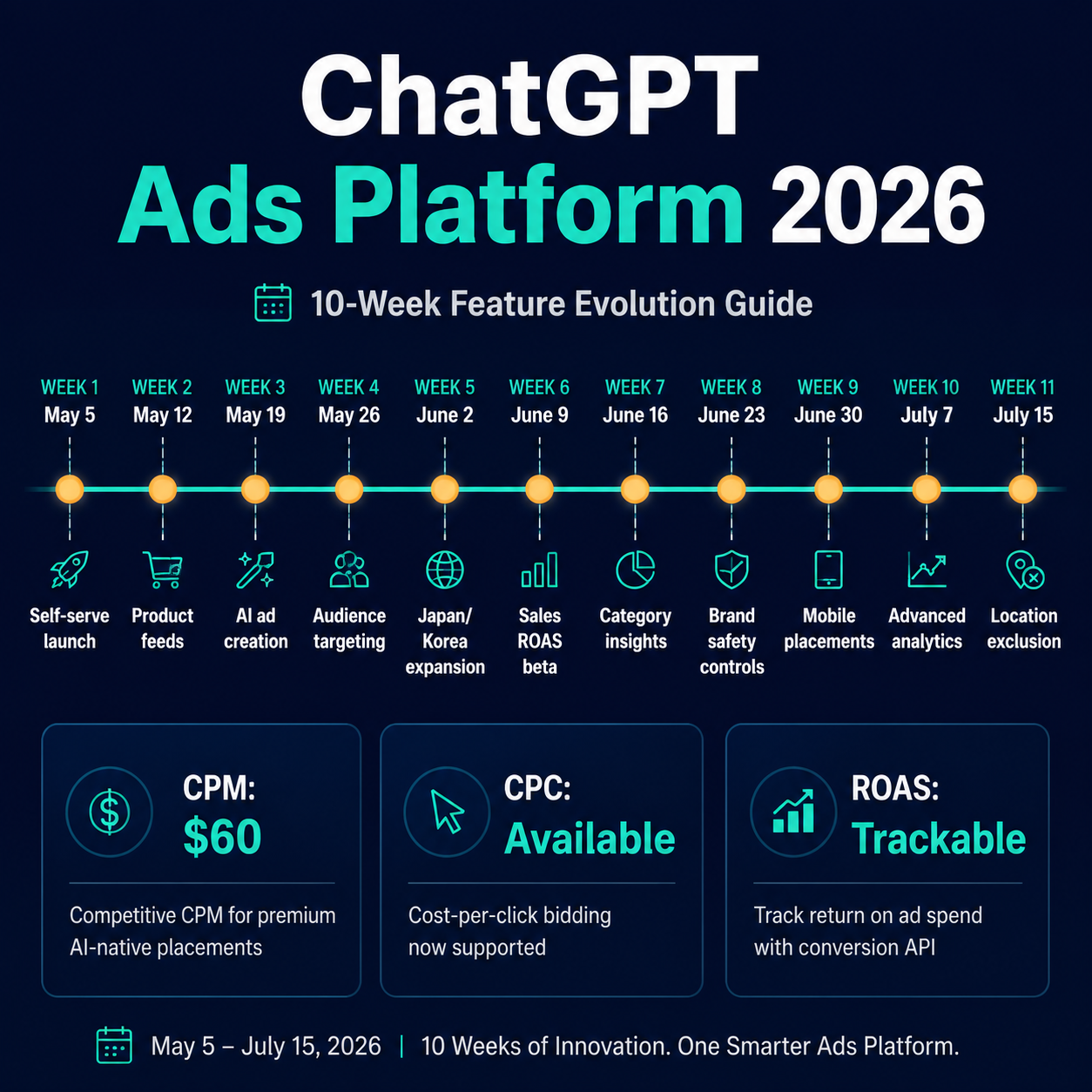
Since the self-serve launch, OpenAI has shipped new features roughly every 5 to 7 days. The pace is faster than Google Ads or Meta Ads managed in their early months, though the feature set is narrower.
Date | Update | What it means for advertisers |
|---|---|---|
May 5 | Self-serve Ads Manager (Beta) opens to all US advertisers | Anyone can create campaigns without an OpenAI sales contact |
May 22 | Ads Manager UI updates, new ad test formats | More placement options beyond the initial sponsored response unit |
May 28 | Conversion-optimized campaigns announced (live June 5) | OpenAI began optimizing delivery for conversions, not just impressions |
Jun 3 | Multi-advertiser placements | Ads can appear alongside multiple brands in a single conversation session |
Jun 11 | Product feed uploads for ad creation | Ecommerce advertisers can generate ads from product data, similar to Google Shopping feeds |
Jun 29 | "Sponsored" label replaced with "Ad" label | Shorter, more standard labeling. Aligns with IAB guidance on ad disclosure |
Jul 6 | AI-generated ad creation | OpenAI can now generate ad copy and creative within the Ads Manager, similar to Google's Performance Max asset generation |
Jul 7 | Audience targeting added | Advertisers can define audience segments, not just rely on contextual matching |
Jul 10 | Overview tab + Japan and South Korea expansion | First international markets. New dashboard tab for campaign-level summaries |
Jul 14 | Attributed sales value, sales ROAS, and product-level reporting | Revenue metrics added. Product-level reporting lets ecommerce advertisers see which products drive ad-attributed sales |
Jul 15 | Location exclusion and audience exclusion controls | Advertisers can now exclude geographies and audience segments, bringing parity with Google and Meta exclusion features |
What the platform does now
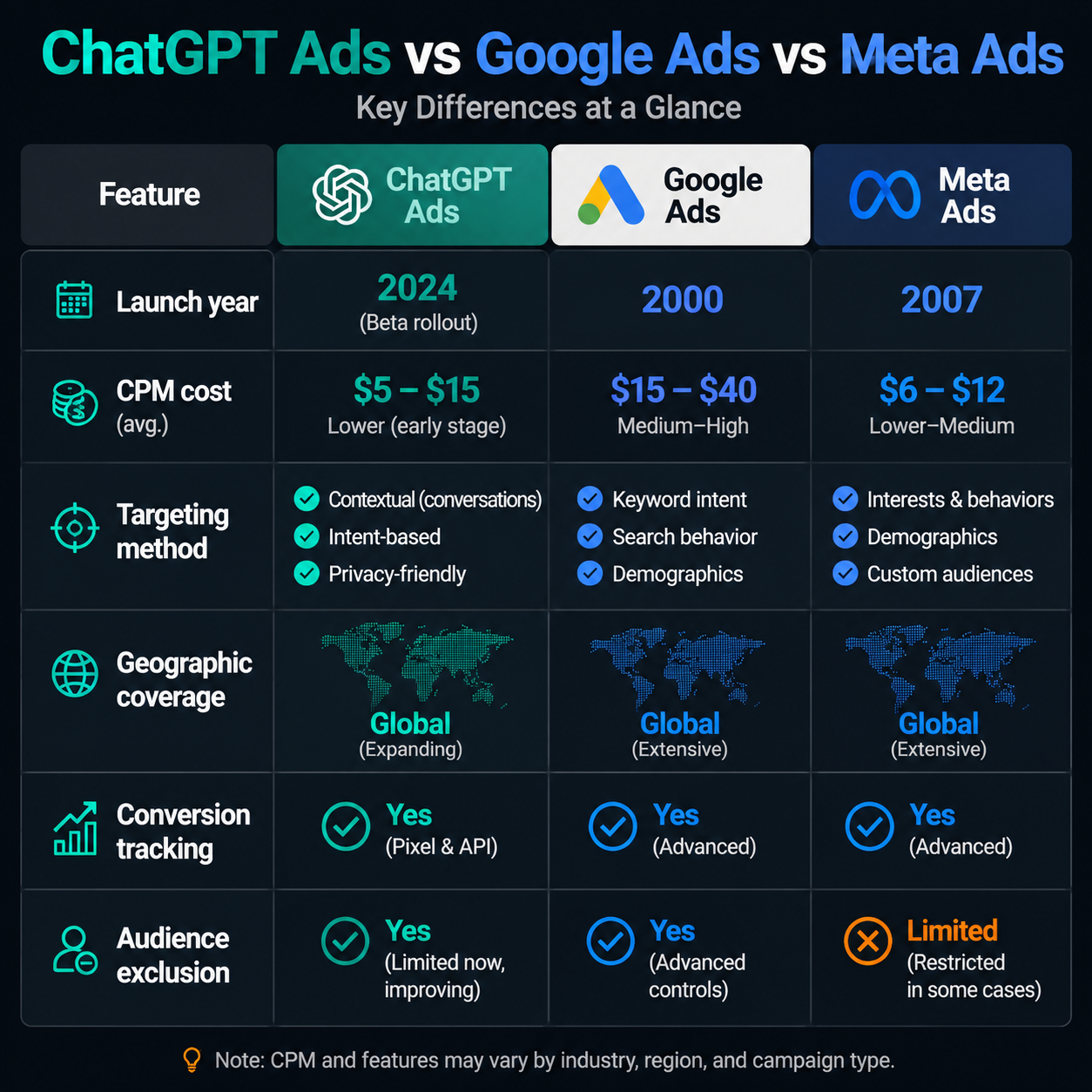
ChatGPT Ads appear as a labeled unit below ChatGPT's response in a conversation. They are matched to the real-time context of the user's current chat, not to historical browsing behavior. This is the core difference from Google or Meta ads: targeting is primarily contextual, based on what the user is discussing in that moment.
Ad formats
- Sponsored response unit: A single sponsored card below the ChatGPT answer, clearly labeled "Ad" (changed from "Sponsored" on June 29)
- Multi-advertiser placements: Multiple brand cards can appear in a single session, introduced June 3
- AI-generated creative: OpenAI can generate ad copy and visuals within the Ads Manager, launched July 6
- Product feed ads: Ecommerce advertisers can upload product feeds and have ads auto-generated, similar to Google Shopping
Targeting
- Contextual matching (default): Ads are matched to the user's current conversation topic and intent
- Audience targeting (added July 7): Advertisers can define audience segments
- Location exclusion (added July 15): Exclude specific geographies from campaigns
- Audience exclusion (added July 15): Exclude specific audience segments
Who sees ads
- Logged-in adult users on Free and Go plans in the US, Japan, and South Korea
- Users on Plus, Pro, Business, Enterprise, and Edu plans do not see ads
- Users under 18 do not see ads
- Expansion planned for Canada, Australia, New Zealand, UK, Mexico, and Brazil
Measurement and reporting
- Impressions and clicks: Available since launch
- Attributed sales value: Added July 14. Shows revenue attributed to ad exposure
- Sales ROAS: Added July 14. Return on ad spend calculated from attributed sales
- Product-level reporting: Added July 14. Per-product performance breakdown for feed-based campaigns
- Overview tab: Added July 10. Campaign-level summary dashboard
- Conversions API and Pixel: Available for conversion tracking and attribution
- No click-level conversion data: The platform reports aggregate conversions but does not expose individual click-level conversion paths
- No third-party validation: No integration with major attribution platforms beyond partner connections
Partners and integrations
OpenAI has built partnerships with four major ad holding groups (Dentsu, Omnicom, Publicis, WPP) and five ad-tech platforms (Adobe, Criteo, Kargo, Pacvue, StackAdapt). These partners provide data connectivity, attribution analysis, and campaign optimization services.
What it costs
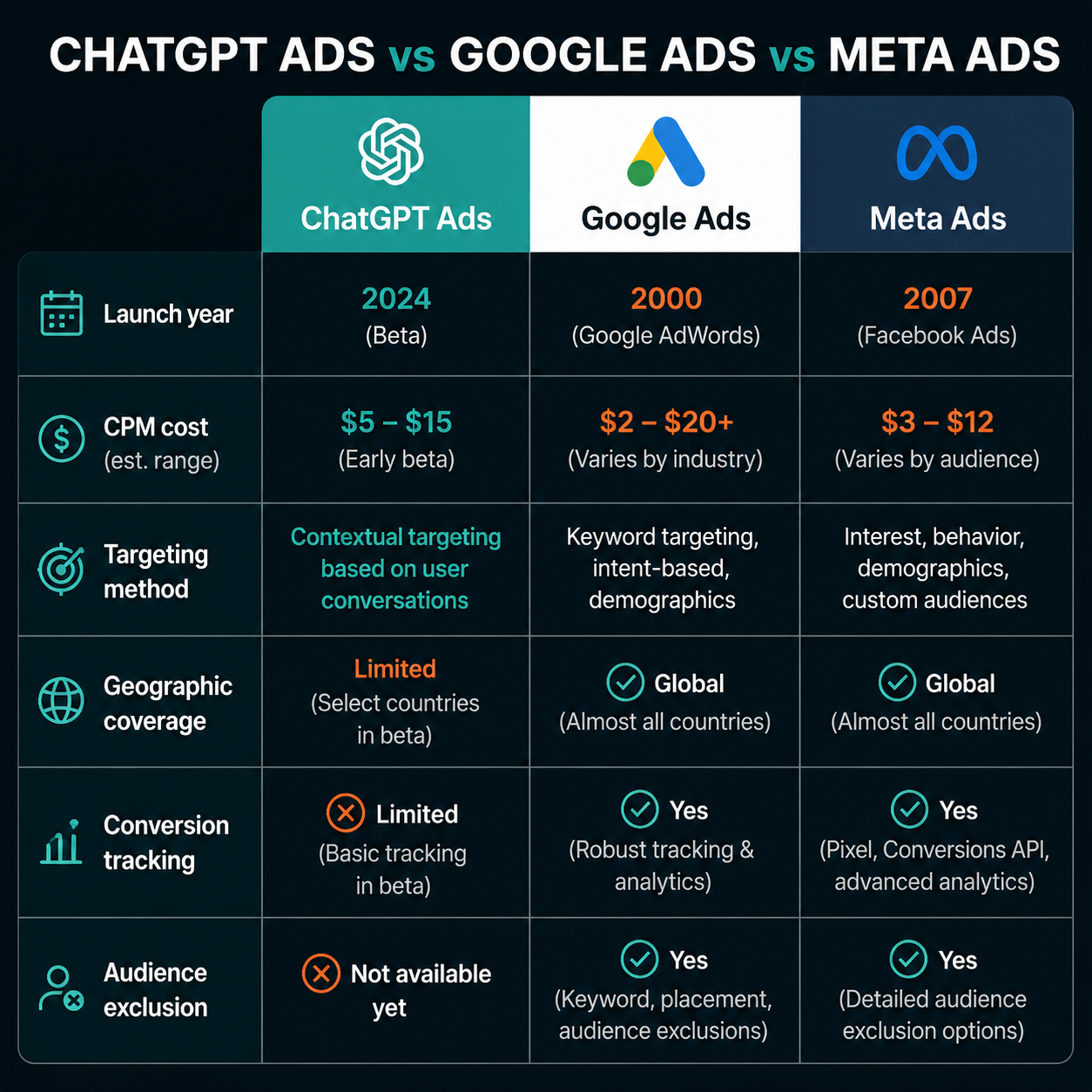
ChatGPT Ads launched with a $60 CPM, which was notably high: approximately 1.6x Google Search CPMs, 3 to 12x Meta CPMs, and 20x Google Display CPMs. In May 2026, OpenAI added CPC bidding, allowing advertisers to pay only when a user clicks.
Early data from Similarweb (reported May 5, before self-serve launch) showed click-through rates that some advertisers found promising but sample sizes were small. ChatGPT referrals have shown conversion rates approximately 1.5x higher than other referral channels, according to OpenAI's partner reporting, though this figure is based on early pilot data and may not hold at scale.
The high CPM makes ChatGPT Ads better suited for high-intent, high-margin products than for awareness campaigns. An advertiser paying $60 CPM needs roughly a 2% click-through rate to achieve a $3 CPC, which is competitive with Google Search for commercial keywords but expensive for lower-intent queries.
What the platform still lacks
Despite the rapid feature rollout, several gaps remain that affect whether marketing teams should invest testing budget now or wait.
Gap | Impact | Workaround |
|---|---|---|
No click-level conversion data | Cannot trace which specific ad clicks led to which conversions, making it hard to optimize creative or landing pages at a granular level | Use UTM parameters and server-side conversion tracking to bridge the gap |
No third-party attribution validation | Cannot cross-check OpenAI's attribution against independent platforms | Rely on partner integrations (Criteo, Pacvue) for independent measurement |
Limited geographic coverage | Only US, Japan, and South Korea are live. No timeline for EU or other major markets | Run US-only tests and extrapolate cautiously |
No API for bulk campaign management | All campaign creation and management is manual through the Ads Manager UI | Use Pacvue or StackAdapt for programmatic management if eligible |
No retargeting based on chat history | Ads are matched to current conversation context only, not past conversations | Design creative for first-touch contextual relevance, not retargeting sequences |
Revenue gap concerns | Reports suggest OpenAI may fall up to 90% below ad revenue targets, which could accelerate feature changes or pricing shifts | Set strict budget caps and review performance weekly |
Should you test ChatGPT Ads now?
The answer depends on your product type, margin, and current channel mix.
Test now if
- You sell high-margin products with clear purchase intent (software subscriptions, financial products, travel bookings, premium retail)
- Your target audience overlaps with ChatGPT's user base (skews professional, technical, early-adopter)
- You already run Google Search or Meta Ads and want to compare cost-per-acquisition across channels
- You have a dedicated budget for experimental channels (suggest $5,000 to $15,000 for a 4-week test)
Wait if
- Your product is low-margin or impulse-purchase (CPM economics do not favor ChatGPT Ads yet)
- Your target market is outside the US, Japan, and South Korea
- You need detailed click-level attribution to justify spend to finance
- Your team cannot absorb another ad platform into weekly reporting routines
What to do this week
If you decide to test, here is a practical 7-day setup plan.
- Day 1 to 2: Apply for ChatGPT Ads Manager access at ads.openai.com. Verify your business and set up the Conversions API or Pixel on your landing pages
- Day 2 to 3: Identify 5 to 10 high-intent conversation topics where your product is relevant. These will be your contextual targeting seeds. Think about what a ChatGPT user would ask before needing your product
- Day 3 to 4: Create 3 to 5 ad variations per topic cluster. Use the AI-generated ad creation feature (added July 6) for a first pass, then edit for brand voice
- Day 4 to 5: Set up conversion tracking with UTM parameters. Use a unique utmsource value (such as `chatgptads`) so you can isolate ChatGPT traffic in Google Analytics
- Day 5 to 6: Launch with a conservative daily budget ($100 to $300 per day). Set location exclusions for any markets where you cannot fulfill orders
- Day 6 to 7: Monitor the Overview tab for impression and click data. Do not optimize creative or targeting until day 7, when you have enough data for meaningful comparison
- Day 7: Review attributed sales value and sales ROAS. If ROAS is positive, increase budget by 20%. If not, pause and analyze which topics or creative underperformed
Metrics to watch
Track these weekly during your test period:
Metric | What it tells you | Target benchmark |
|---|---|---|
CPM (cost per mille) | How expensive is ChatGPT inventory for your topic | Compare to Google Search and Meta CPMs for the same audience |
CTR (click-through rate) | How relevant is your ad to the conversation context | 1% to 3% is reasonable for contextual ads; above 3% is strong |
CPC (cost per click) | Efficiency of your spend | Calculate from CPM and CTR; compare to Google Search CPCs |
Attributed sales value | Revenue from ChatGPT ad exposure | Compare to ad spend to calculate ROAS |
Sales ROAS | Return on ad spend from ChatGPT | Aim for 2x or higher for sustained investment; 1x to 2x for testing |
Landing page conversion rate (from ChatGPT traffic) | How well your landing page converts ChatGPT users | ChatGPT referrals have shown ~1.5x higher conversion rates than other referral channels in early data |
What is still uncertain
Several factors make it difficult to predict ChatGPT Ads' long-term value for marketers.
- Revenue pressure: Reports that OpenAI may fall 90% below ad revenue targets could lead to aggressive pricing changes, new ad placements, or expanded targeting that changes the platform's character
- User experience balance: OpenAI has stated that ads do not influence ChatGPT's responses and that the ad system operates independently from the conversation model. If users perceive ads as intrusive, OpenAI may limit placements or frequency, reducing inventory
- Data privacy evolution: ChatGPT Ads do not use personal conversation data for targeting, but regulatory changes could affect how contextual signals are used
- Competitive response: Google's AI Mode and AI Overviews are evolving their own ad integration. Perplexity and other AI search platforms are also exploring monetization. ChatGPT Ads' pricing and feature advantage may narrow as competitors add similar capabilities
- Attribution quality: Without click-level conversion data or third-party validation, advertisers must trust OpenAI's attribution model. Early-stage attribution is often noisy
FAQ
Can ads influence what ChatGPT says in its response?
No. OpenAI has stated that the ad system and the conversation model are completely separate. Advertisers cannot modify, reorder, or influence ChatGPT's answers. Ads appear as a separate labeled unit below the response.
How is ChatGPT Ads different from Google Ads?
ChatGPT Ads are matched to the real-time context of a user's current conversation, not to search keywords or browsing history. The $60 CPM is significantly higher than Google Search, but early data suggests ChatGPT users convert at higher rates. ChatGPT Ads also lack Google's mature attribution, retargeting, and audience network features.
What is the minimum budget to test ChatGPT Ads?
A meaningful test requires approximately $5,000 over 4 weeks, or $180 per day. This gives enough impression volume to generate statistically useful CTR and conversion data at the $60 CPM level.
Can I use ChatGPT Ads for B2B marketing?
Yes, but results depend on whether your B2B buyers use ChatGPT for work-related conversations. The user base skews toward professionals and technical roles, which aligns with many B2B audiences. Test with problem-solving conversation topics rather than direct product searches.
Does ChatGPT Ads work for ecommerce?
The July 14 addition of attributed sales value, sales ROAS, and product-level reporting makes ChatGPT Ads more viable for ecommerce. Product feed uploads (added June 11) let you generate ads from catalog data. However, the high CPM favors high-margin products over commodity items.
Will ChatGPT Ads expand to more countries?
OpenAI has expanded to Japan and South Korea as of July 10. The company has indicated Canada, Australia, New Zealand, UK, Mexico, and Brazil are next, but has not published specific dates.
Should I shift budget from Google Ads to ChatGPT Ads?
Not yet. Run ChatGPT Ads as an incremental test alongside your existing Google Ads campaigns. Compare CPC, conversion rate, and ROAS across both channels after 4 weeks. Only shift budget if ChatGPT Ads consistently outperforms on your key metrics.
Author: Jasper Quinn, AI Search Product Researcher Tracking 60+ Feature Changes at Auspia. Jasper writes about AI platform updates, ad product evolution, and how search infrastructure changes affect marketing teams.