The short answer
There is no single best AI SEO platform for every team. The right choice is the one that removes the constraint in your current workflow without handing editorial judgment to a machine. Semrush and Ahrefs are strong research environments. Clearscope, MarketMuse, Surfer, and Frase focus on content briefs and on-page guidance. Content-management systems and automation layers can handle approvals and publishing. A newer category, including Auspia, adds AI-search visibility and readiness checks alongside conventional SEO work.
The useful question is not "Which tool writes the most words?" It is: where does work stall today? A team with no keyword evidence needs research first. A team with an approved topic map but a slow editorial queue needs a production system. A team that already publishes regularly may need better refresh priorities, technical checks, or a way to see whether its pages appear in answer-oriented search experiences.
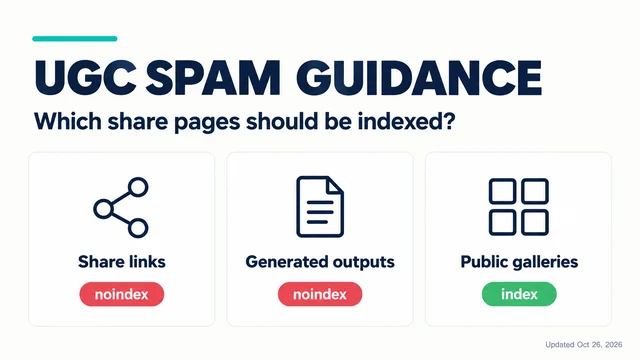
Google's guidance is plain on the point that matters most: using generative AI is not automatically a problem, but publishing many pages without adding value can violate its spam policies. Automation should speed up discovery, drafting, checking, and reporting. It should not turn a thin brief into fifty thin URLs.
Four jobs AI SEO platforms actually do
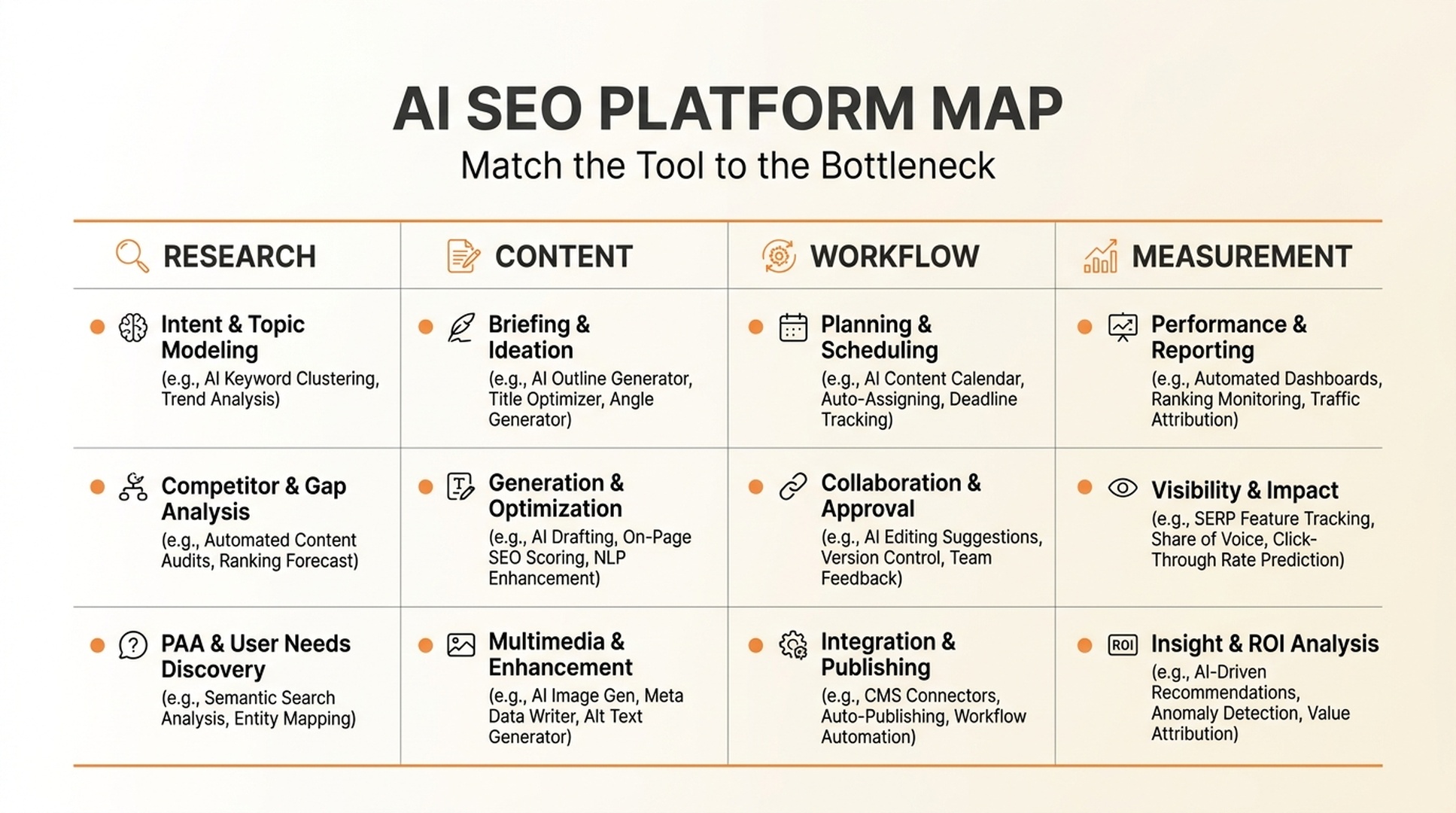
The market gets easier to compare when tools are grouped by job rather than by marketing category.
Job | What good automation looks like | What still needs a person |
|---|---|---|
Research | Clusters related queries, surfaces competitor gaps, groups intent | Deciding which audience and commercial problem matter |
Content production | Creates a structured brief, source checklist, outline, and first draft | Original expertise, examples, claims review, and final voice |
Optimization | Finds missing subtopics, internal-link candidates, title issues, and outdated sections | Judging relevance and avoiding formulaic keyword coverage |
Measurement | Joins rankings, traffic, conversions, crawl signals, and AI-answer checks | Explaining cause and choosing the next experiment |
Many platforms cross these boundaries. That can be a benefit, but it can also leave a small team paying for overlapping dashboards. Start by mapping the handoffs between research, writing, publishing, and reporting. The quietest handoff is usually where the next tool belongs.
A practical platform map
Research suites: Semrush, Ahrefs, and similar platforms
Established suites are usually the starting point for teams that need keyword discovery, rank tracking, competitor analysis, backlink data, and site-audit signals in one place. Their AI features can accelerate query grouping, brief generation, or summaries, but their lasting value is the underlying search dataset and the ability to compare domains over time.
Choose this category when your content plan is based on guesses, when several competitors dominate a topic, or when you need regular ranking and technical reports. Do not choose it only because an AI writer is included. Most teams still need a clear editorial workflow outside the research interface.
Content intelligence tools: Clearscope, MarketMuse, Surfer, and Frase
These tools analyze ranking pages and help writers cover the concepts, questions, and entities that frequently appear in a search result set. Used well, they make a brief more complete. Used mechanically, they encourage writers to chase a score and add sections readers do not need.
They are strongest for a team that has subject-matter knowledge but wants a consistent pre-publication quality check. A good workflow treats the score as a prompt to investigate, not a publishing threshold. If the tool says a term is missing, ask whether it helps the reader answer the query. If not, leave it out.
Workflow and publishing platforms
For content-heavy sites, the real bottleneck is often not a draft. It is the route from an approved idea to a reviewed, published, internally linked, and measured page. CMS integrations, task management, editorial calendars, structured templates, and version control can matter more than another optimization score.
Look for approvals, source fields, reusable content types, link checks, redirects, and a way to flag ownership. AI can draft metadata, create alternate outlines, or prepare refresh recommendations, but the platform should make it difficult to publish unsupported claims by accident.
AI-search visibility tools
Classic rankings remain important, but many teams now also want to know whether their brand or source material appears in AI-generated answers. That requires a different measurement layer: a defined prompt set, repeatable checks, citation or mention capture where available, and a way to connect those observations back to useful pages.
This is where Auspia fits naturally in a broader stack. Teams can use its tools to check website SEO readiness and monitor AI-search visibility alongside their editorial work, rather than treating AI search as a separate, unmeasured content campaign. It is a complement to a research suite, not a reason to abandon core rank, traffic, and conversion data.
Compare platforms by operating fit, not feature count
Before booking demos, score each option against the conditions below. A tool that receives a lower overall score may still be the right choice if it solves the most expensive bottleneck.
Decision criterion | Questions to ask | Red flag |
|---|---|---|
Data quality | Which sources power keyword and ranking recommendations? How often are they updated? | The vendor cannot explain its data or sample size |
Editorial controls | Can you require sources, owners, approval stages, and brand rules? | One-click publishing is positioned as the default |
Integration | Does it connect cleanly to your CMS, analytics, and task system? | CSV export is the only handoff |
Explainability | Can a writer see why a recommendation appeared? | A black-box score decides what to publish |
Measurement | Can you tie work to impressions, clicks, leads, or assisted conversions? | Rankings are the only outcome |
Cost of adoption | Who configures the tool, trains the team, and maintains it? | The plan assumes a dashboard alone changes behavior |
A sensible first 30 days
Start with a small pilot. Choose one commercial topic cluster, five existing URLs, and a single owner. In week one, establish a baseline: rankings, organic clicks, conversion events, crawl errors, and a short list of AI-search prompts if that channel matters to you. In week two, use the platform to create briefs or refresh priorities, then have a subject expert review every claim. In week three, publish or update only the pages that meet your evidence standard. In week four, check whether indexing, impressions, click-through rate, and on-page engagement moved in the expected direction.
The pilot tells you more than a feature tour. It reveals whether the platform fits the way your team actually works.
The failure mode to avoid: automated volume
AI makes it cheap to produce pages that look complete at a glance. Search engines and readers are better at detecting empty coverage than many teams assume. Watch for generic definitions, interchangeable examples, invented statistics, copied competitor structure, and pages that target only a tiny keyword variation.
Google recommends people-first content created for an intended audience, and its guidance on AI-generated content makes the same point from another direction: the production method is less important than usefulness, originality, and policy compliance. Keep a source-review step, make firsthand details visible, and consolidate pages when they do not earn their own reason to exist.
The buying decision in one sentence
Buy a research suite if you lack evidence, a content intelligence tool if writers need better briefs, a workflow layer if approved work does not ship, and an AI-search measurement layer if answer visibility has become part of your acquisition strategy. A mature stack may use all four, but it should have one shared content plan and one accountable owner.
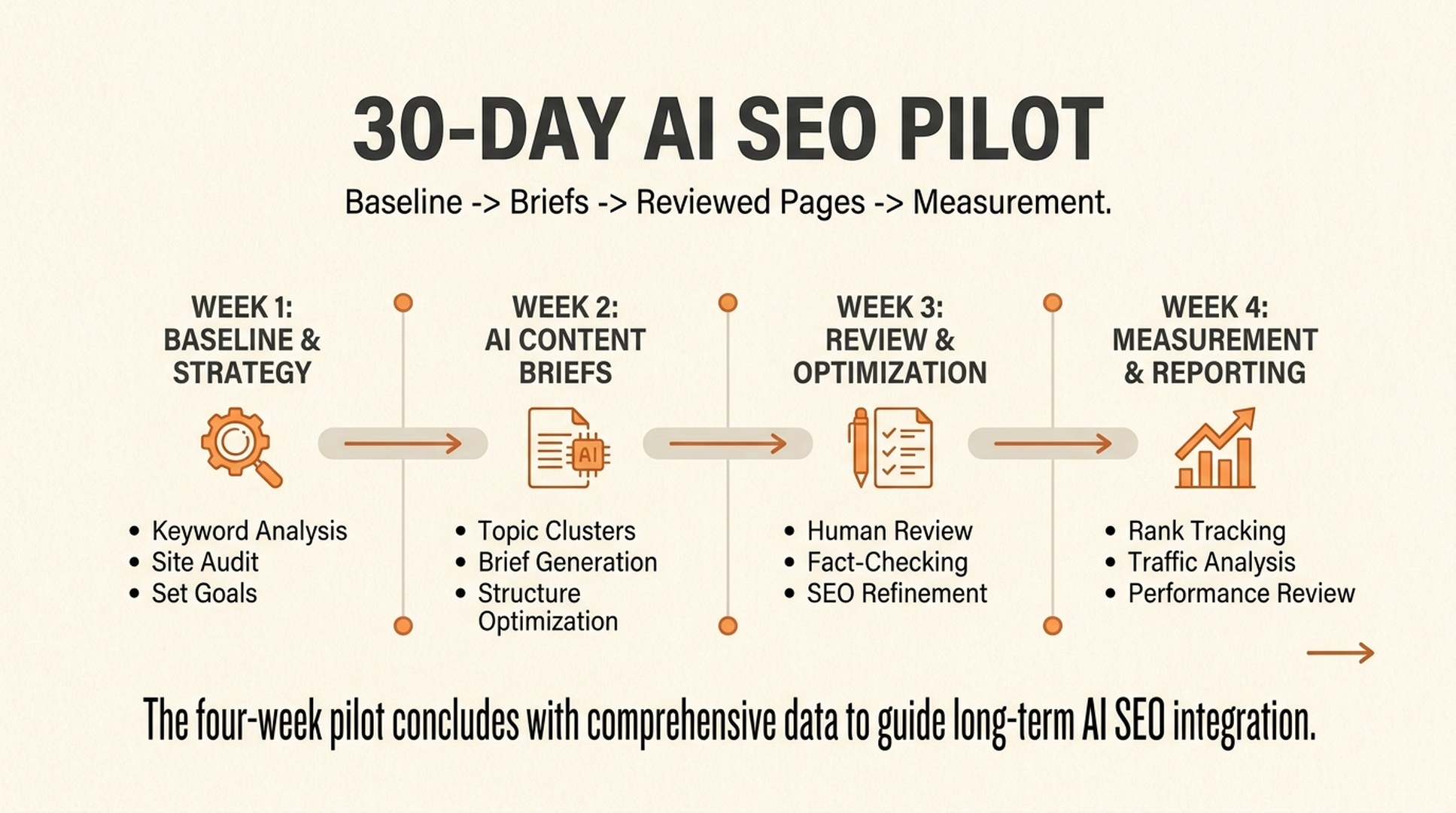
Thirty-day AI SEO platform pilot timeline from baseline through measurement
FAQ
Can an AI SEO platform write and publish a whole blog on its own?
It can technically automate those steps, but that is rarely a sound editorial policy. Keep human approval for factual claims, product positioning, legal or regulated topics, original examples, and final publication.
Do AI SEO platforms replace SEO specialists?
No. They reduce repetitive research and reporting work. Specialists still decide priorities, interpret intent, resolve technical issues, and make sure content is useful to a real audience.
Should a small business use several AI SEO platforms?
Usually not at the start. Choose the one category that addresses the largest constraint, run a defined pilot, and add another tool only when its data or workflow is clearly missing.
What sources informed this guide?
Google Search Central's guidance on creating helpful, reliable, people-first content, generative AI content, and structured data provides the policy and technical baseline.
Author: Alice Monroe, AI SEO Tools Analyst Covering 150+ Tools at Auspia. Alice writes about software selection, AI-assisted research, and content workflows that retain editorial accountability.