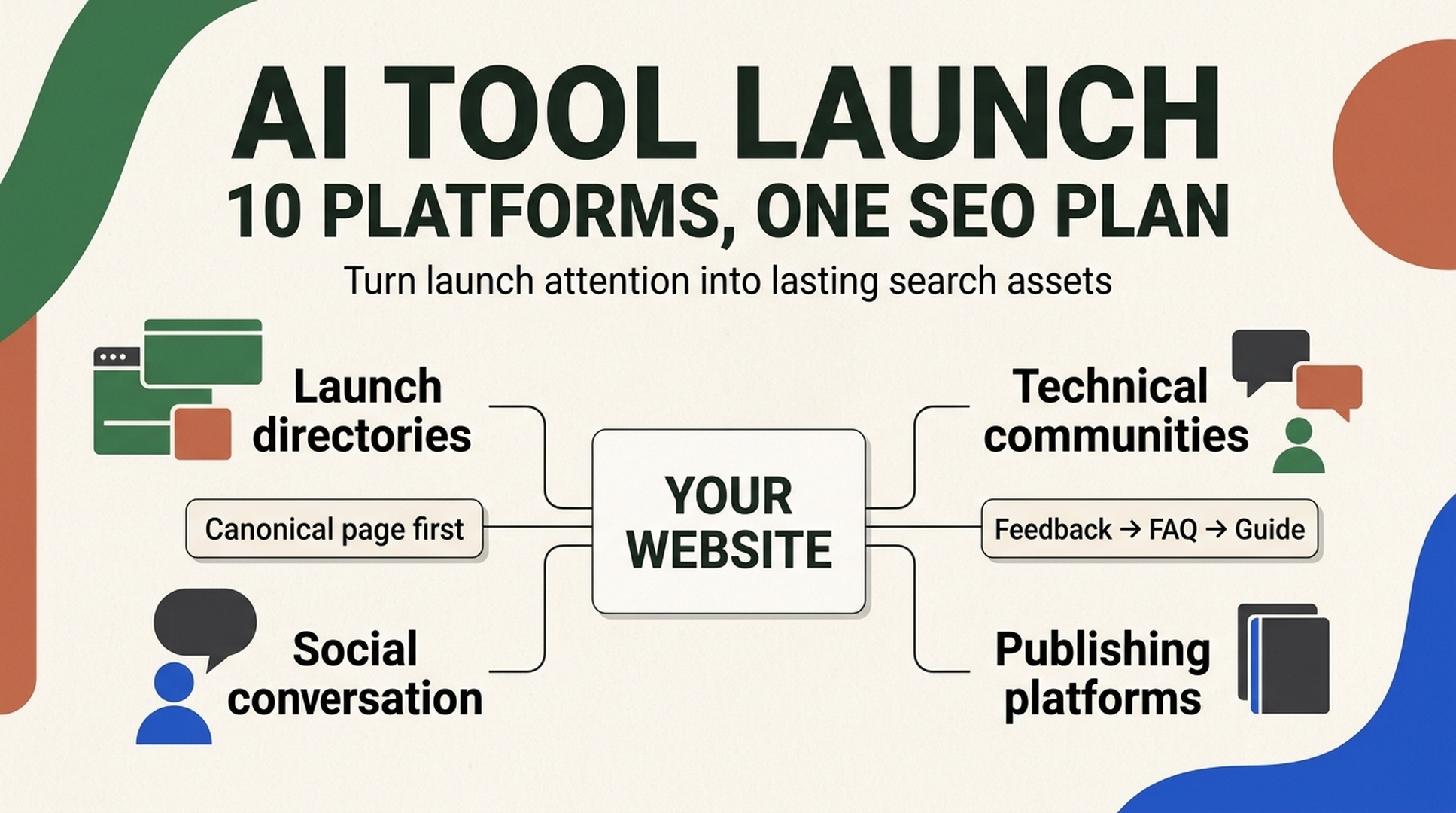
Launching an AI tool on ten platforms can bring attention. It does not automatically build search visibility. The useful distinction is simple: some platforms create a durable page that can rank or earn links; others create the conversations, feedback, and language that make your own site stronger.
Use both. Build one reliable launch destination on your site, then give each platform a job. Product Hunt can concentrate launch interest. Reddit can surface the objections your landing page has not answered. Medium can turn an original lesson into a discoverable article. A Discord post may never rank, but it can lead to the first users who tell you what to fix.
What you will finish with
This workflow is for founders and small growth teams launching a new AI product, feature, or public beta. By the end, you will have:
- one canonical launch page on your own domain;
- a short platform brief for ten promotion channels;
- two reusable content angles, one product-led and one insight-led;
- tracking that separates visits, sign-ups, feedback, mentions, and links; and
- a 30-day follow-up plan rather than a single noisy launch day.
Before you start: have a public product URL, a clear description of the problem it solves, three product screenshots or a short demo, a working analytics setup, and someone available to answer questions quickly. Allow one focused week to prepare, plus another month for follow-up.
Definition of done: every platform post points to the right destination with a tagged link, the destination answers the main buyer questions, and your team can say what happened after the initial announcement.
Build the page that every launch post supports
Do this before writing any community post. Your site is the only asset you fully control, and it is where temporary attention can become a lasting search asset.
Create a launch page or product page with these elements:
Page element | What it needs to answer | SEO value |
|---|---|---|
Clear headline | Who is this for and what work does it remove? | Gives search engines and visitors a specific topic |
Use cases | What can a buyer do in the first session? | Creates language for long-tail queries |
Product evidence | Screenshots, a demo, examples, limits, and pricing context | Makes a thin announcement more credible |
Comparison or alternatives section | What does the product replace, complement, or not do? | Captures evaluation intent without overclaiming |
FAQ | Setup, data handling, availability, integrations, and support | Covers real objections in extractable language |
Primary action | Start, request access, or book a demo | Keeps the launch measurable |
Pick one canonical URL. Do not send half of your announcements to a homepage, some to a temporary campaign page, and others to an app-login screen. If your product is not ready for a full page, make a compact page with the fundamentals and improve it as feedback arrives.
Quality check: someone who has never seen the tool should be able to explain its audience, output, and limits after reading the page for two minutes. If they cannot, a launch campaign will only distribute confusion faster.
Auspia view: Promotion works better when it doubles as research. The questions people ask in public become the copy, FAQ, comparison pages, and help content your site needs next.
Give each platform a distinct role
Trying to make every channel do the same thing produces repetitive posts and weak results. The following map helps you decide where to invest more than a quick announcement.
Platform | Best job during a launch | What to publish | SEO move that lasts |
|---|---|---|---|
Product Hunt | Concentrated discovery and early feedback | A clear product listing, demo, maker comments | Send visitors to a canonical product page; turn recurring questions into an FAQ |
Hacker News | Technical credibility and candid discussion | A concise Show HN-style explanation when it fits the community | Document the technical lesson on your site after the discussion |
Problem validation and community learning | A useful, context-first post in a relevant subreddit | Turn repeated questions into a focused guide, not a copied thread | |
X | Fast awareness and relationship building | Short demo clips, launch updates, replies, and founder notes | Use it to test terminology, then strengthen the page that owns that topic |
BetaList | Early-adopter discovery | A concise startup profile and product positioning | Keep the product description consistent with your site and directories |
HackerNoon | Technical or operator-led publishing | An original tutorial, build story, or opinion with evidence | Link naturally to a relevant resource, not a generic homepage |
Facebook Groups | Niche trust and referral traffic | A discussion that solves a group-specific problem | Use feedback to make a niche landing page or use-case article |
Scroll Launch | Launch-directory visibility | A complete listing with accurate category and proof | Maintain the listing and make sure the destination URL remains stable |
Discord communities | Early users and high-quality feedback | A transparent beta invitation or a useful workflow demo | Capture permissioned insights as anonymized documentation or FAQs |
Medium | Searchable thought leadership | A self-contained article built around a useful insight | Publish a distinct version with a canonical link or clear relationship to your owned article |
Platform rules, editorial standards, and submission requirements change. Check the current guidance before you post, especially around self-promotion, duplicate content, referral links, and launch timing.
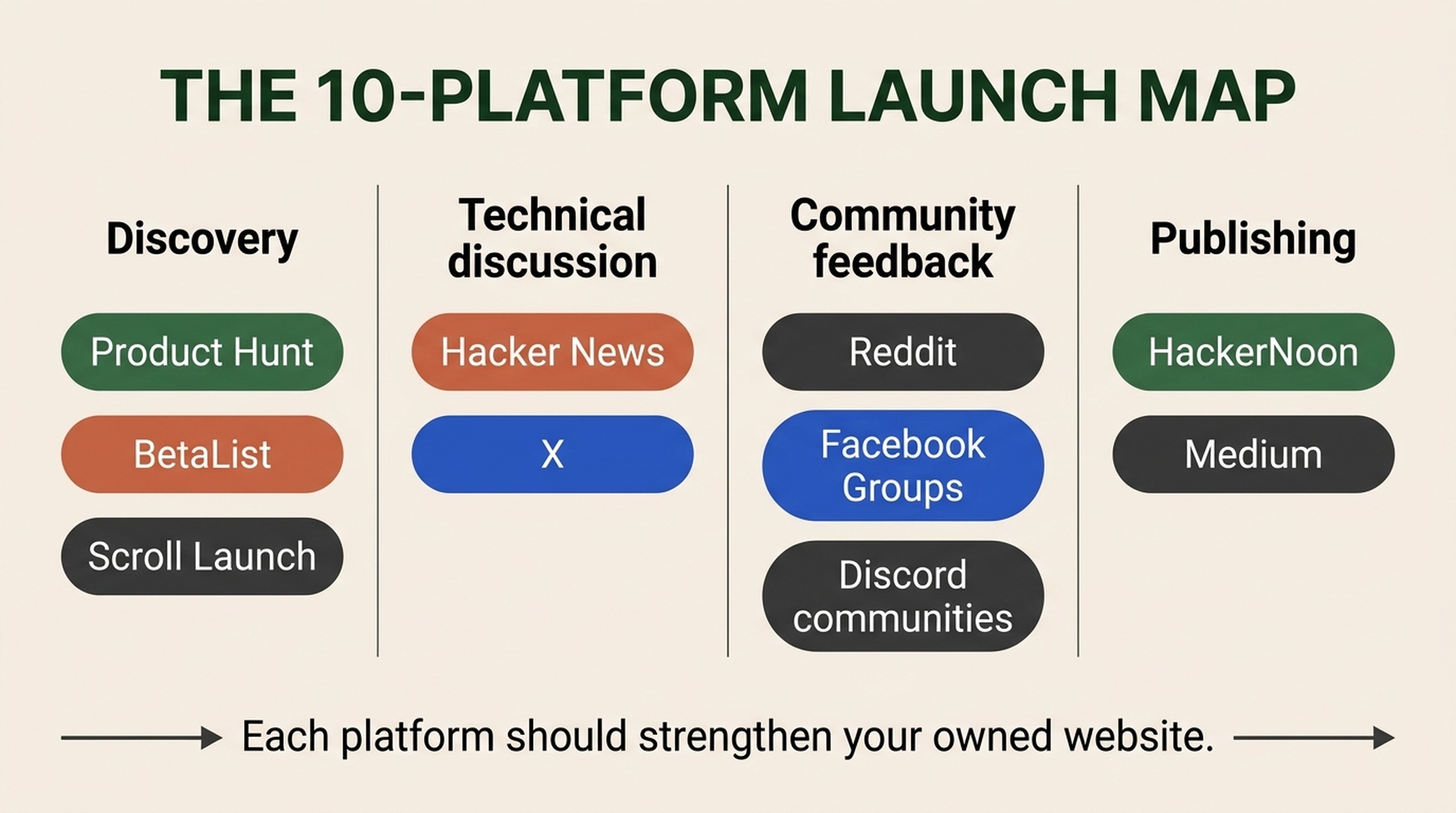
The platform map assigns each channel one primary job so your team can adapt the message instead of duplicating it.
Prepare two stories instead of copying one announcement ten times
The most common launch mistake is a single generic post: "We built an AI tool. Please try it." It gives communities no reason to care, and it gives your future content nothing to build on.
Prepare two short narratives.
Story one: the product story
This is for a listing, a directory, or a direct launch announcement. It should cover:
- the specific job the tool completes;
- who has that job often enough to care;
- the before-and-after workflow;
- what the tool does not do; and
- one concrete next action.
For example, a tool that turns support tickets into product insights should not lead with "AI-powered customer intelligence." Lead with the actual change: "Upload a week of support tickets and get a reviewable list of repeated product problems, linked back to the original conversations." The second version gives a potential user something to evaluate.
Story two: the insight story
This is for communities and publications. Start with a problem, observation, or lesson that remains useful even if the reader never tries your product. A founder might write about how teams lose product feedback because it is split across tickets, calls, and chat logs, then explain the process they used to group it.
The product can appear at the end as a transparent example. The article must still stand on its own. That is the difference between an article someone may search for later and an ad wearing a blog-post costume.
Quality check: remove the product name. If the insight story becomes meaningless, it needs more useful substance before publication.
Launch in a sequence that leaves room to learn
Do not schedule ten posts for the same hour. You will be unable to reply well, and any weak message will spread before you know why it missed.
Days 1-2: start with high-intent discovery
Publish your strongest product listing or directory profile first. For many AI tools, this may be Product Hunt and BetaList, provided the tool is ready for public scrutiny. Use the product story, a short demo, and an honest statement of the product's current limits.
Expected output: a live launch destination, tagged referral links, and a running list of questions from comments, onboarding, and support.
Recovery path: if visitors land but do not start, look at the page before blaming the channel. The issue may be unclear onboarding, missing pricing context, a broken demo, or a promise that the first screen does not fulfill.
Days 3-4: join the technical and problem-focused conversations
Choose Hacker News, Reddit, Discord, or Facebook Groups only where you can contribute to the existing conversation. Read the local rules, recent posts, and comment style first. A community that values technical detail will not respond well to a polished marketing narrative. A practitioner group may want a worked example, not a feature tour.
Write the post for that community's problem. Disclose your connection to the product. Reply to hard questions without turning every comment into a sales close.
Expected output: language that reveals how users describe the problem, which alternatives they already use, and which claims they distrust.
Quality check: record exact phrases, not just your impression. If five people describe the issue as "weekly feedback triage," that phrase may deserve a section on your product page or a future guide. If someone says the tool cannot be trusted with customer data, you may need a security page before more promotion.
Days 5-7: publish the durable explanation
Use HackerNoon or Medium for the insight story. Choose one primary article on your site first, then decide whether an external version should be fully distinct, syndicated with a canonical reference where supported, or summarized with a contextual link. Do not paste the same article everywhere and hope search engines sort it out.
An effective durable article usually answers one question that appeared during launch. Examples include:
- How do product teams turn support tickets into a weekly roadmap signal?
- What should a small team check before sending customer data to an AI workflow?
- When does an AI research assistant save time, and when does it create review work?
Expected output: one resource that can earn search traffic after the launch window and give future outreach a useful destination.
Quality check: the article has a clear reader problem, original examples or process detail, and a link to the product only where it helps the reader continue. A publication page should not be your only explanation; keep the complete, maintained resource on your own site.
Use every platform's feedback to improve your SEO assets
Launch promotion becomes SEO when it changes the quality of your owned pages. Review the first two weeks of activity and sort feedback into four buckets:
Feedback signal | What it usually means | Site action |
|---|---|---|
The same setup question appears repeatedly | Your onboarding is under-explained | Add a setup section, checklist, or short tutorial |
People compare you with the same alternative | Buyers are evaluating a category, not a feature | Create an honest comparison or alternatives page |
Visitors understand the tool but hesitate | The page lacks proof or risk information | Add examples, limitations, security detail, or pricing context |
A post earns qualified discussion or links | The topic has a credible audience | Expand it into a maintained guide with internal links |
This is also the right time to check how the product and content appear in search and answer engines. An AI Search Visibility Checker can help establish a baseline for brand and category prompts. Treat the first check as a snapshot, not a verdict. Brand mentions, pages indexed, referral quality, assisted sign-ups, and qualitative feedback can move on different timelines.
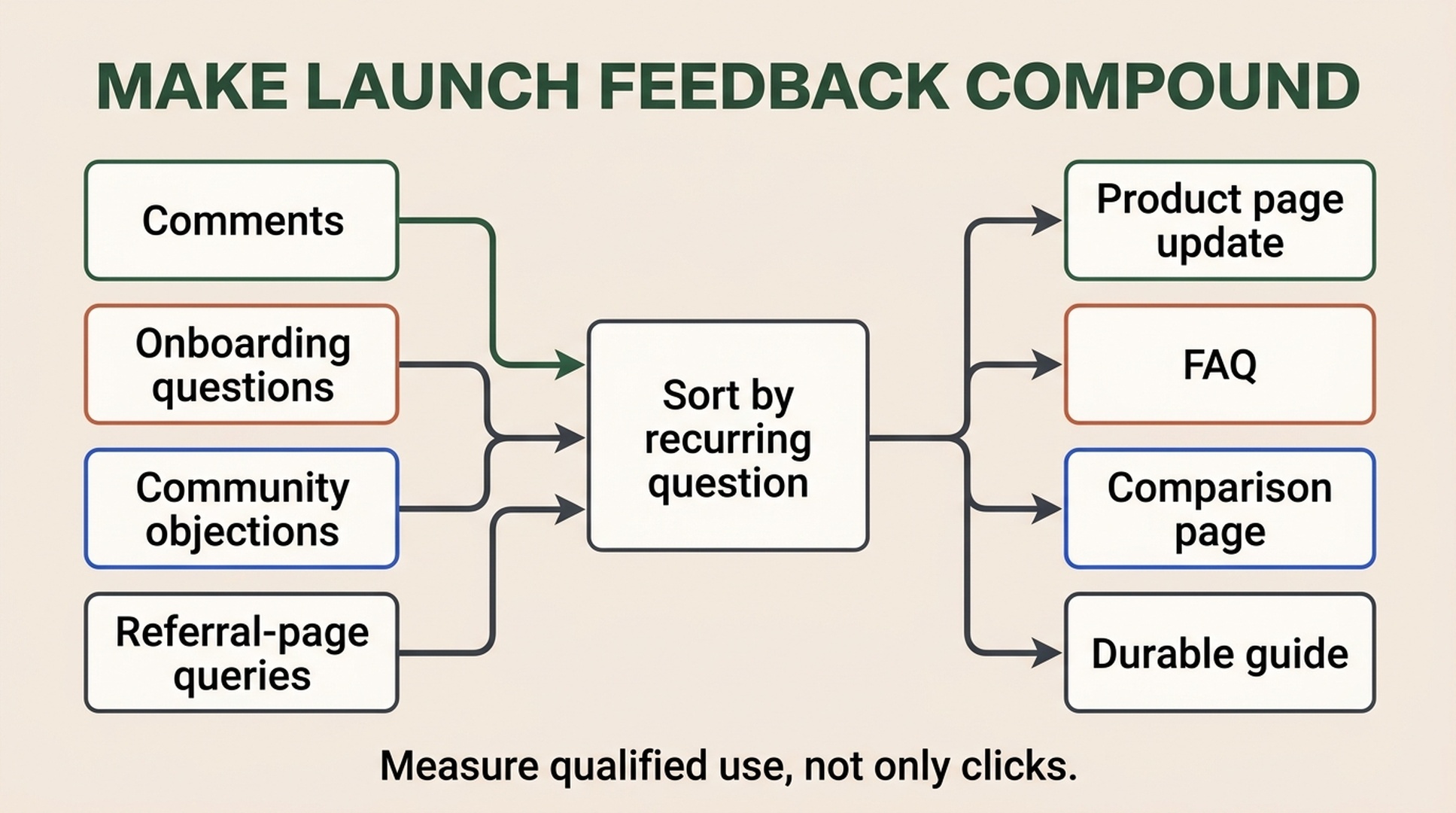
A useful launch leaves behind better owned content: sort repeated questions, then turn them into pages people can find and use.
Track the result without pretending every click has the same value
Use a tagged URL for each platform, but do not judge success by visits alone. A thousand low-intent visits from a directory may be less useful than ten detailed conversations in a focused community.
Build a simple launch sheet with the following fields:
Metric | Why it matters | Review point |
|---|---|---|
Visits by platform | Shows distribution and interest | Daily in launch week |
Activated users or qualified leads | Tests whether the offer matches the audience | Daily, then weekly |
Comment themes | Provides copy and product research | After every conversation |
Referring domains and relevant mentions | Indicates durable discovery or citation potential | Weekly |
Search impressions for launch-page queries | Shows whether your owned asset is gaining traction | Weekly, then monthly |
Content-assisted conversions | Connects the durable article to product interest | Monthly |
Keep a short note beside each number. "Reddit drove fewer visits but two detailed enterprise questions" is often more useful than a bar chart with no context.
A 30-day operating rhythm for a launch that keeps working
The first post is an opening move, not a finished campaign.
- Week 1: respond to every worthwhile comment, repair friction on the launch page, and save the questions people actually ask.
- Week 2: revise the product page and publish one FAQ, tutorial, or comparison asset based on the strongest recurring question.
- Week 3: return to the most relevant community only if you have something new to share: a fix, a lesson, a useful dataset, or a workflow people asked for.
- Week 4: compare the platform data with your baseline. Keep channels that produced qualified users, useful language, credible links, or a repeatable audience. Reduce work on channels that only produced empty traffic.
There is no need to force an appearance on all ten platforms. A developer tool may earn more from Product Hunt, Hacker News, a technical Discord, and one strong article than from a broad social push. A consumer-facing AI tool may need a different mix. The point of the list is coverage of options, not a requirement to be everywhere.
Final launch checklist
- [ ] One canonical launch page is live and easy to understand.
- [ ] Each platform has a specific role and a tagged destination URL.
- [ ] Community posts are written for the community, with your affiliation disclosed.
- [ ] The launch includes an insight-led article, not only product announcements.
- [ ] Questions, objections, and wording are collected in one shared document.
- [ ] At least one product, FAQ, comparison, or tutorial page is scheduled from real feedback.
- [ ] Metrics include qualified outcomes and learning, not only visits.
FAQ
Should an AI tool launch on all ten platforms?
No. Start with the platforms where your likely users already evaluate tools or discuss the problem. A small team is usually better off participating well in three or four places and publishing one strong owned resource than posting thin announcements everywhere.
Is it safe to republish the same launch article on Medium and my website?
It can be, but use care. Publish the owned version first, make the external version meaningfully distinct or use canonical support when the platform provides it, and avoid creating several identical copies. The practical goal is clear ownership of your most complete resource.
Do directory listings help SEO?
Some listings can lead to discovery, relevant referrals, and occasional mentions or links. Do not treat every listing as a ranking asset. Prioritize accuracy, relevance, a stable URL, and the quality of the audience over raw directory count.
What is the most useful thing to do after launch day?
Rewrite the page and create the next resource from the questions that real people asked. That work compounds; a launch post by itself usually does not.
Author: Nina Patel, Organic Growth Strategist for 250+ Content Programs at Auspia. Nina writes about practical launch plans, content strategy, and the small operational choices that turn attention into durable growth.