Yes, but treat the output as a lead list
AI SEO software can automatically find promising low-competition keyword opportunities by processing large keyword sets, grouping long-tail variants, spotting question patterns, comparing competitor coverage, and identifying pages that already receive impressions. That is valuable work. The software cannot know, on its own, whether a keyword is worth winning, whether the search result is truly weak, or whether the visitor will ever become a customer.
The useful output is a shortlist for investigation, not an automatic publishing queue.
Why "low competition" is a slippery label
Most tools estimate keyword difficulty using link profiles, ranking domains, and other observable search signals. Those estimates are useful for sorting a long list. They are not a promise of ease.
A term may have a low difficulty score because it has little demand, because the SERP is unstable, because search engines understand the query as local, because forums and product pages dominate, or because the site lacks the credibility expected for that topic. A term may have a high score but still be reachable through a more specific page, a better angle, or strong first-party experience.
The word "opportunity" needs four tests:
Test | The question | Why it changes the decision |
|---|---|---|
Demand | Do real buyers or users search for this problem? | Low competition with no useful demand is not growth |
Intent | What is the searcher trying to decide or do? | A blog post may not match a product, local, or transactional result |
Competitive fit | Can your site add something clearer or more credible? | Weak-looking results can still satisfy the query well |
Business value | Would a successful visit support a meaningful next step? | Traffic that never fits the offer creates a false win |
What AI is good at during keyword discovery
The best systems go beyond isolated phrases. They help turn scattered search language into a map of problems.
Group query variants by topic and intent
AI can cluster terms such as "how to reduce onboarding time," "onboarding checklist for SaaS," and "customer onboarding automation" into related but distinct intents. This prevents a team from commissioning three near-identical articles.
Find question-shaped gaps
Support tickets, sales calls, reviews, Search Console data, and keyword databases contain phrasing that standard topic lists overlook. AI can normalize those phrases and identify which questions have no current page, no useful section, or only an outdated answer.
Compare a content inventory with competitor coverage
Given a list of your URLs and a competitor's public topic coverage, a tool can identify apparent gaps. The human task is to decide whether the competitor's page deserves to be matched, surpassed, ignored, or replaced by a stronger content format.
Surface "striking distance" opportunities
Pages already earning impressions for related queries can be a better bet than a new low-volume term. AI can identify those patterns across hundreds of URLs, then suggest where a refresh, a new section, or a better internal link may help.
A five-minute SERP reality check
Before approving a keyword, open the results. This short step protects a lot of editorial time.
- Search in the location and language your audience uses.
- Note the dominant formats: guides, product pages, local results, videos, marketplaces, forums, or answer features.
- Read the first few results. What do they answer well? Where are they shallow, outdated, or confusing?
- Check whether your proposed page would offer a distinct answer or simply repeat the same structure.
- Decide what success would mean: an email sign-up, trial, purchase, consultation, or a helpful self-service outcome.
If the result set is full of strong brands, that does not automatically rule out the topic. It may mean the viable angle is narrower, more current, more local, or based on knowledge that the large sites cannot provide.
The long-tail trap
AI tools are very good at generating endless long-tail variations. That can make a content plan look productive while quietly creating cannibalization. Ten phrases can often be answered by one excellent page with well-named sections. Separate pages are justified only when the audience, decision, format, or evidence differs meaningfully.
For example, "best CRM for a five-person agency" and "CRM implementation checklist for an agency" have different jobs. The first is a comparison decision; the second is an implementation resource. But "CRM for small agencies" and "small agency CRM software" probably belong on the same page.
A simple opportunity score that humans can defend
Rather than trusting a single difficulty number, use a transparent score. Give each candidate a 1 to 5 rating for demand signal, intent match, competitive fit, business value, and evidence advantage. Subtract points for technical dependency, legal risk, or likely overlap with another page.
Factor | What a high score looks like |
|---|---|
Demand signal | Appears in Search Console, sales language, or a credible keyword dataset |
Intent match | The proposed format directly supports the searcher's next decision |
Competitive fit | Existing results leave a real clarity, freshness, or experience gap |
Business value | The topic connects to a product, service, or qualified audience need |
Evidence advantage | Your team can add original examples, data, or operational knowledge |
An AI system can calculate the draft score and explain its inputs. The team should set the weighting, because a self-service support article and a high-ticket B2B comparison page have different definitions of value.
From keyword opportunity to content brief
Once a topic passes the check, create one brief that documents the target query cluster, search intent, audience, primary page goal, evidence to gather, related pages, and a reason the page will be distinct. This is where keyword research becomes editorial strategy.
If AI-search visibility is part of the goal, add a small prompt set that reflects the same buyer questions. Auspia's AI Search Visibility Checker can help teams record a starting point for those prompts. It should not be used to manufacture pages around every possible model response; it should help prioritize questions the business can answer well.
The best use of automation: narrowing the field
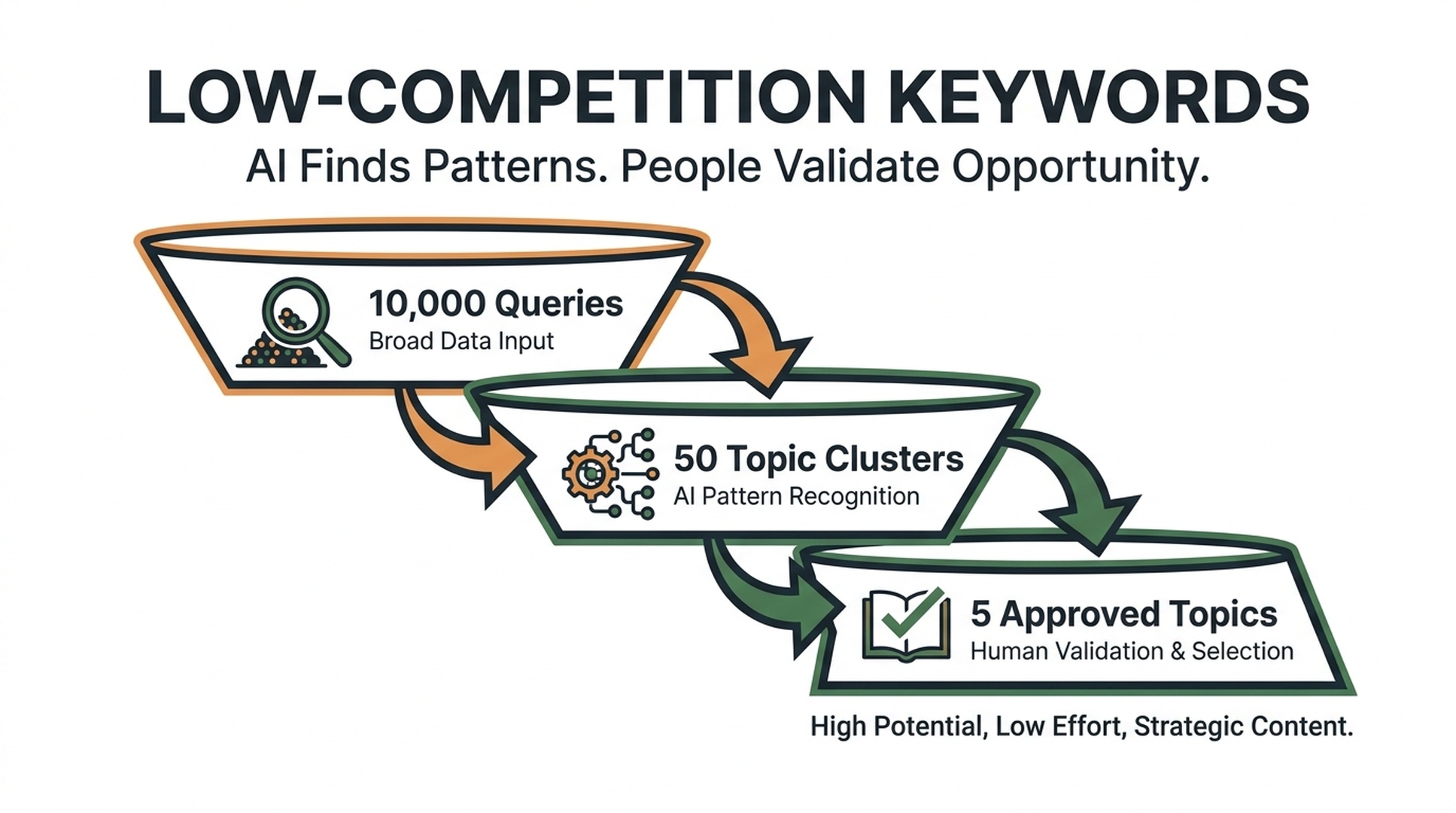
Use AI to turn 10,000 phrases into 50 plausible topic clusters. Use a human review to turn those 50 into the five pages with the clearest audience, evidence, and business reason. That is how automated discovery becomes a content program rather than a pile of keywords.
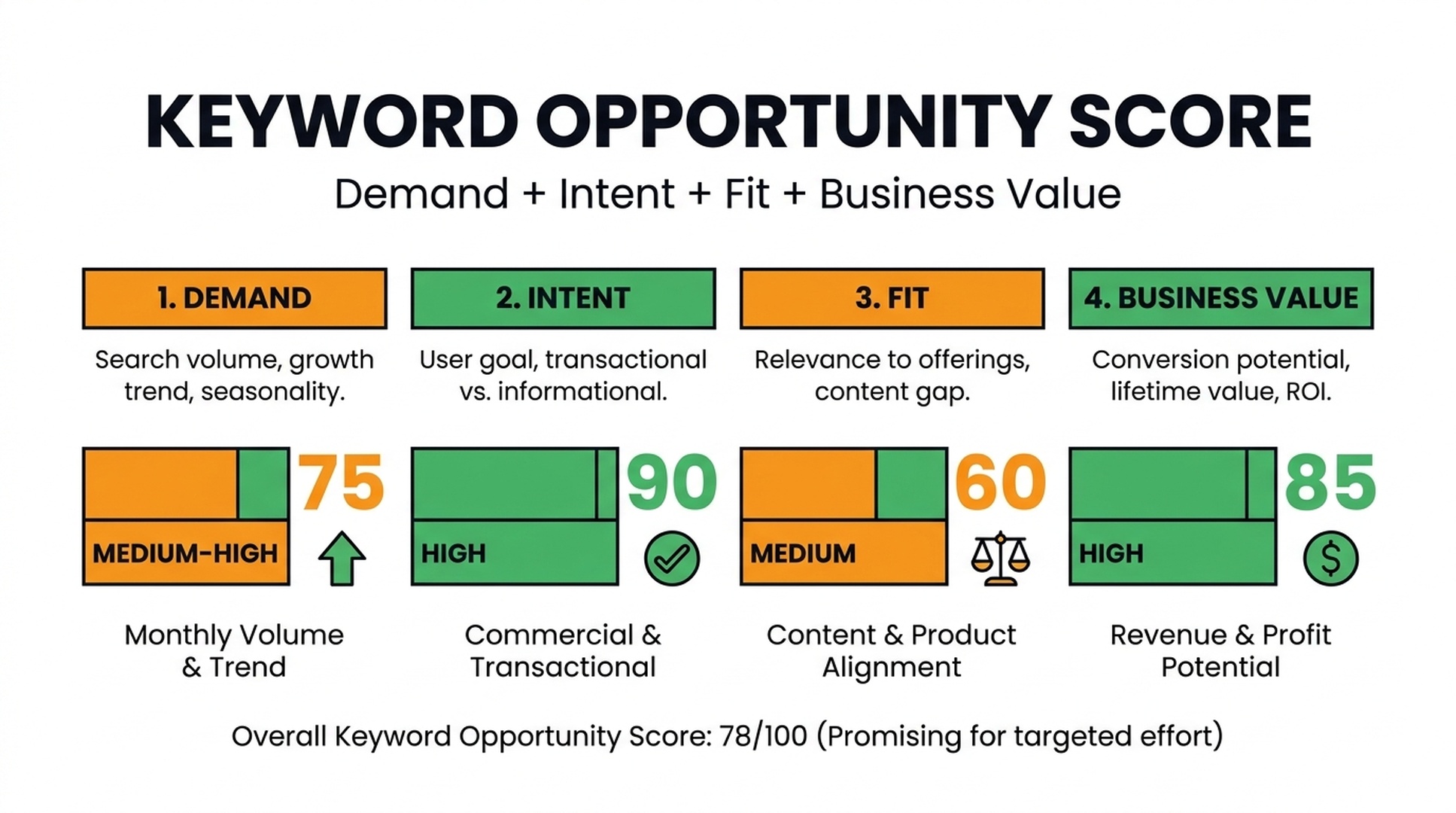
Four-factor scorecard for validating keyword opportunities
FAQ
Can AI find keywords that competitors have missed?
It can find query patterns and gaps that are easy to overlook manually. Whether competitors truly missed an opportunity requires SERP review and an assessment of what your site can offer.
Are low-difficulty keywords always easier to rank for?
No. Difficulty metrics are estimates. Search intent, domain fit, content quality, local factors, and technical access can matter as much as the score.
Should I create a page for every long-tail keyword AI finds?
No. Cluster variants with the same intent into one strong asset. Create separate pages only when the searcher's decision, evidence needs, or preferred format changes.
What should I read about creating helpful pages after keyword research?
Google's people-first content guidance is a useful check against creating pages only because a keyword tool found a phrase.
Author: Olivia Stone, SERP Intelligence Researcher Across 25k+ Queries at Auspia. Olivia writes about search-result patterns, opportunity scoring, and turning keyword data into focused content decisions.