Start with the constraint, not the AI tool
For a small business, AI SEO automation improves organic growth when it takes repetitive work off a limited team: sorting customer questions, finding duplicate pages, drafting a first brief, flagging broken metadata, or turning reporting data into a weekly priority list. It does not make traffic grow simply because more pages are published.
That distinction matters. A local accountant, niche B2B consultancy, ecommerce shop, or service business rarely needs a giant content machine. It needs a small set of trustworthy pages that match how customers search, load properly, answer basic questions clearly, and lead to a useful next step. Automation can help find and maintain that set.
Where a lean team loses time
Most small teams do not struggle because they lack ideas. They struggle because useful ideas disappear between the inbox, the CMS, and the monthly analytics report. One person might be answering the same customer question in sales calls while another is writing an unrelated blog post. A page that ranks on page two is never refreshed because no one notices it. A seasonal service page stays unchanged for two years.
AI can make that work visible. The best use cases are unglamorous:
Recurring task | Useful automation | Human decision |
|---|---|---|
Customer-question collection | Cluster questions from support tickets, reviews, calls, and search queries | Which questions deserve a page, FAQ, or sales answer |
Content planning | Group related topics and identify missing pages | What the business can answer with real expertise |
Existing-page review | Flag thin sections, stale dates, missing internal links, and duplicate intent | Whether the change improves the customer's decision |
Local-page maintenance | Identify inconsistent hours, services, locations, or schema fields | Confirm the facts before publishing |
Reporting | Summarize changes in clicks, queries, and conversions | Decide which result deserves follow-up |
The small-business flywheel
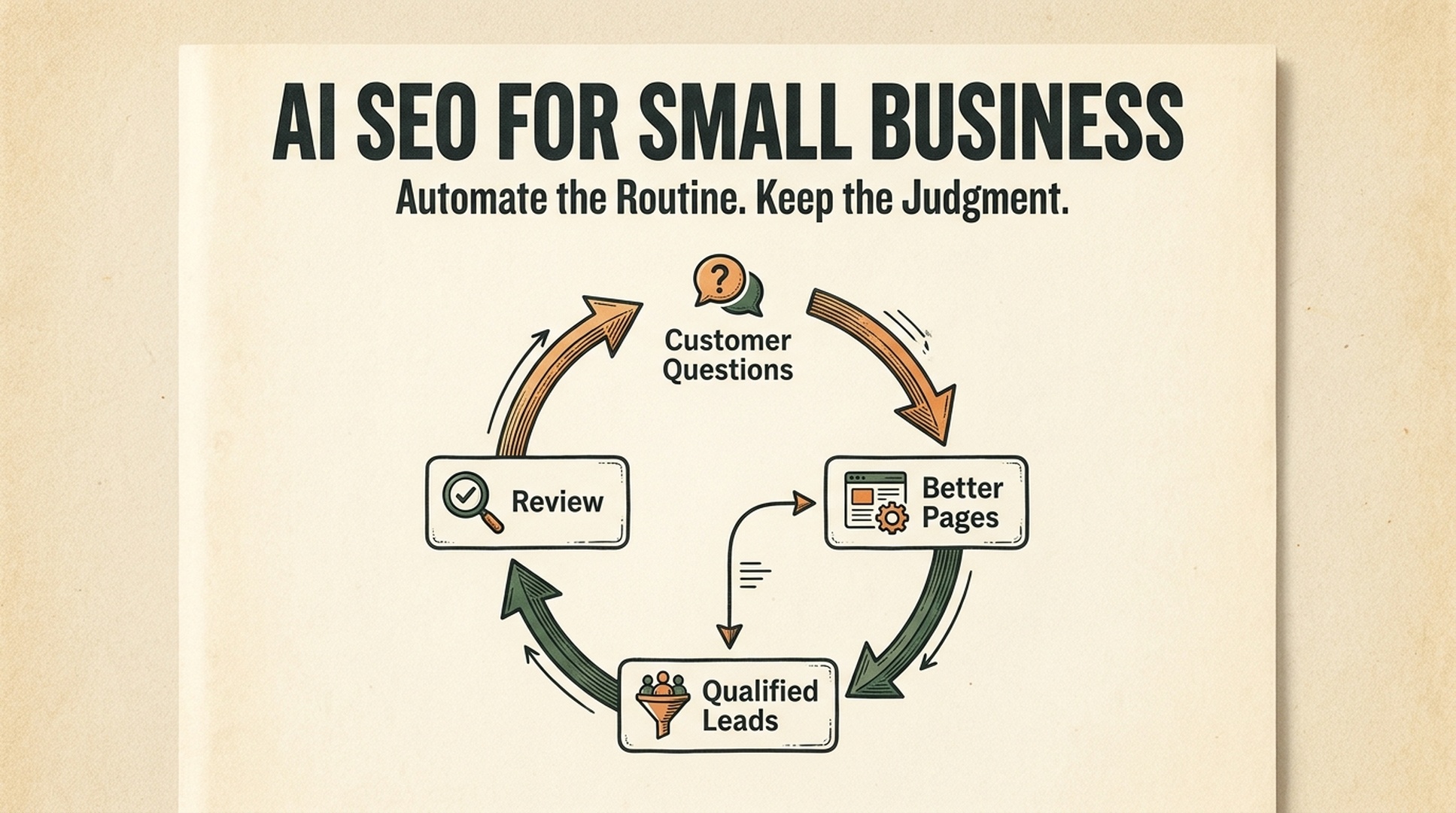
The simplest model is a loop, not a volume target.
- Collect questions that buyers already ask.
- Match each question to an existing page or a necessary new asset.
- Improve one page at a time with accurate examples, service details, and an easy next action.
- Publish only after someone who knows the business checks the claims.
- Measure whether the page earns impressions, qualified clicks, calls, leads, or sales.
- Feed new questions back into the next cycle.
AI speeds up steps one, two, four, and six. The business still owns the truth in the middle. This is especially important in local, financial, health-adjacent, legal, and professional-service markets, where a vague or overconfident statement can cost trust far more quickly than it earns a click.
A concrete example: a three-location home-services company
Imagine a home-services company with three locations. It has service pages, a few old blog posts, and a steady flow of questions about repair timing, pricing factors, and service areas. Instead of asking AI to create 100 generic posts, the marketing owner can give it a more useful job.
First, combine Search Console queries, call notes, reviews, and site-search terms. Ask the system to group them by intent: emergency repairs, cost expectations, maintenance, location availability, and comparison questions. Then compare those groups with existing pages. The output might show that customers repeatedly ask whether a repair is urgent, yet the site only has a short service description.
The next page should answer that question in the company's real service area, explain what customers can safely check, state when they should call, and avoid making promises the technicians cannot keep. AI can draft an outline and propose related questions. A service manager should review the advice. The website owner should check contact details, location coverage, and structured data. That is an automation-assisted page worth publishing.
What to automate first
Start with tasks that are frequent, low-risk, and easy to verify.
Build a question inventory
Once a month, gather questions from Search Console, reviews, customer-support messages, sales conversations, and competitor FAQs. Use AI to remove duplicates and label intent. Keep the original wording nearby. It is often more revealing than a polished keyword list.
Audit the pages you already own
Small businesses frequently have more opportunity in existing pages than in new articles. Use a crawl or SEO checker to spot missing titles, slow pages, duplicate descriptions, broken links, and pages with no internal links. Then prioritize by business relevance and existing impressions, not by an arbitrary audit score.
For a quick first pass, the Auspia Website SEO Score Checker can help make foundational issues visible. Treat the result as a starting list for verification, not a verdict on the business.
Create briefs before drafts
A useful AI brief contains the query, intent, audience, existing pages to link, evidence needed, facts that require approval, and the intended conversion action. If a tool cannot create that level of context, it will usually produce generic drafts.
Turn reporting into a weekly decision
Ask AI to summarize a compact dashboard: pages gaining impressions but not clicks, pages with falling traffic, queries that appear without a matching page, and technical issues that block priority URLs. The weekly meeting should end with one or two decisions, not a long report no one owns.
What AI cannot safely infer
Small businesses should not let a general model invent prices, availability, licensing, client outcomes, qualifications, service areas, safety instructions, or legal claims. It also cannot know why a page converted unless you connect it to reliable analytics and speak with customers.
The temptation is understandable. A generated draft can sound confident. But a confident paragraph about a service the business does not offer is worse than a blank page. Keep a simple rule: if a sentence could change a buyer's expectation or create liability, a knowledgeable person checks it.
Measure growth without chasing the wrong number
Traffic matters, but raw sessions can distract a small team from valuable work. Pair organic clicks with a business signal: booked consultations, quote requests, calls, store visits where measurable, qualified demo requests, or ecommerce revenue. Then look for the path from query to page to conversion.
Signal | What it tells you | A sensible response |
|---|---|---|
Impressions rise, clicks do not | The page is being tested but its result may not earn the click | Review title, snippet, intent match, and SERP competition |
Clicks rise, leads do not | The page attracts interest but may not answer the decision | Add pricing context, eligibility, proof, or a clearer next step |
A page loses impressions | Demand, competitors, indexing, or relevance may have changed | Check the query set and refresh only with new information |
Calls mention unanswered questions | The site is missing a decision-stage explanation | Turn the repeated question into a useful section or page |
A 90-minute weekly routine
Monday: review the five pages with the largest organic change. Wednesday: improve one priority page, with fact review. Friday: capture new questions from customers and add them to the inventory. That is enough to create momentum for a small team.
AI SEO automation earns its keep when it makes this routine easier to sustain. It should leave the owner with more time to speak to customers and improve the pages that matter, not more drafts waiting for someone to read them.
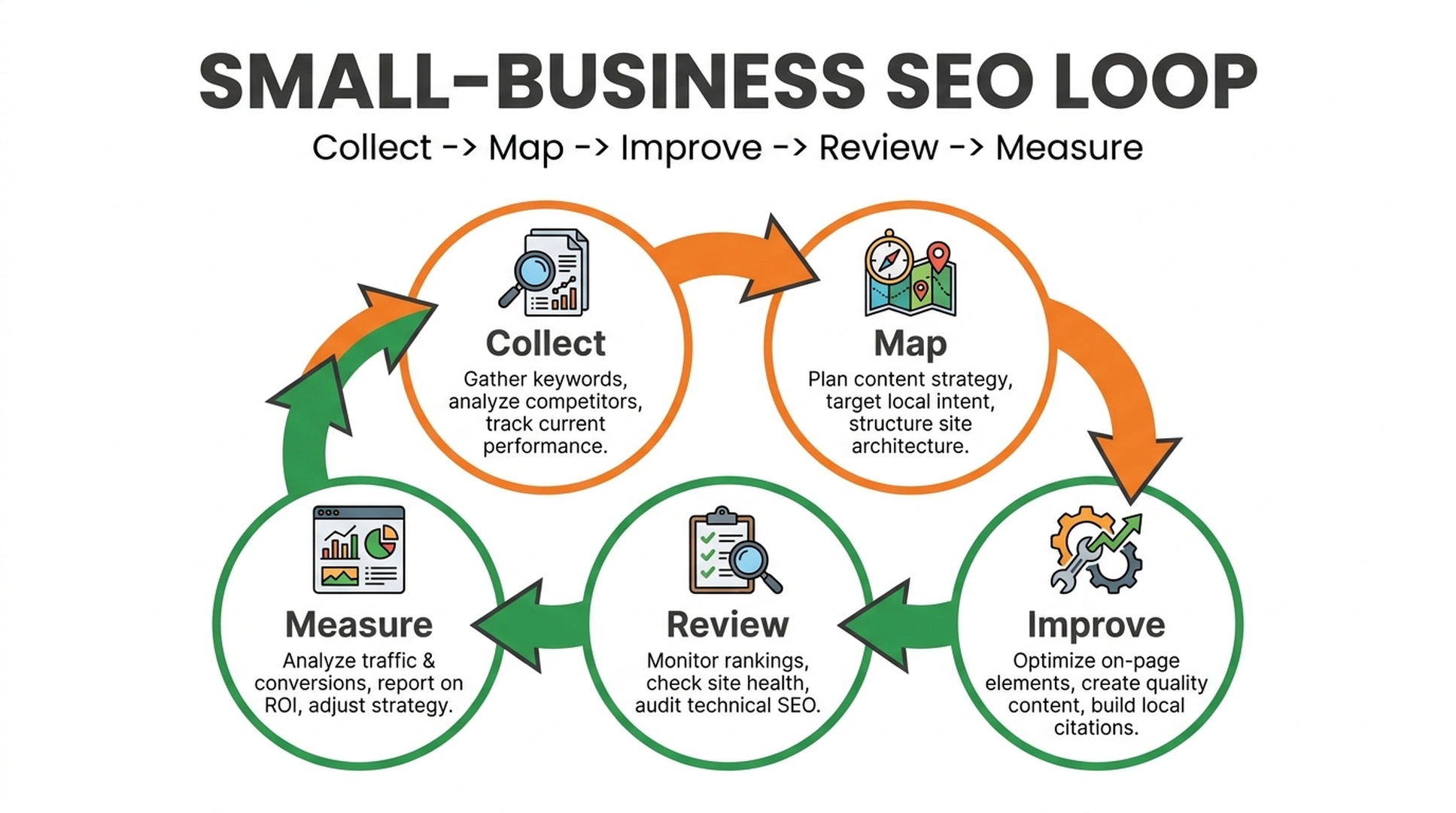
Small-business SEO loop connecting customer questions, useful pages, review, and qualified leads
FAQ
Can AI SEO automation help a business with no content team?
Yes, if one person remains accountable for facts, priorities, and publishing. Start with existing pages and recurring customer questions before committing to a large content calendar.
Will automated blog posts increase organic traffic quickly?
Not reliably. Search growth depends on usefulness, competition, technical access, demand, and trust. Automated volume without original value can create a maintenance problem rather than a growth channel.
Is AI SEO useful for local businesses?
It can be particularly useful for organizing location-specific questions, auditing inconsistent details, and maintaining service pages. Every local fact still needs human verification.
Which Google guidance applies to AI-assisted content?
Google's people-first content guidance and guidance on generative AI content both stress usefulness and policy compliance over the method used to produce a page.
Author: Nina Patel, Organic Growth Strategist for 250+ Content Programs at Auspia. Nina writes about practical content systems for teams that need more useful organic growth without a large in-house department.