Affordable means the workflow pays for itself in learning or output quality
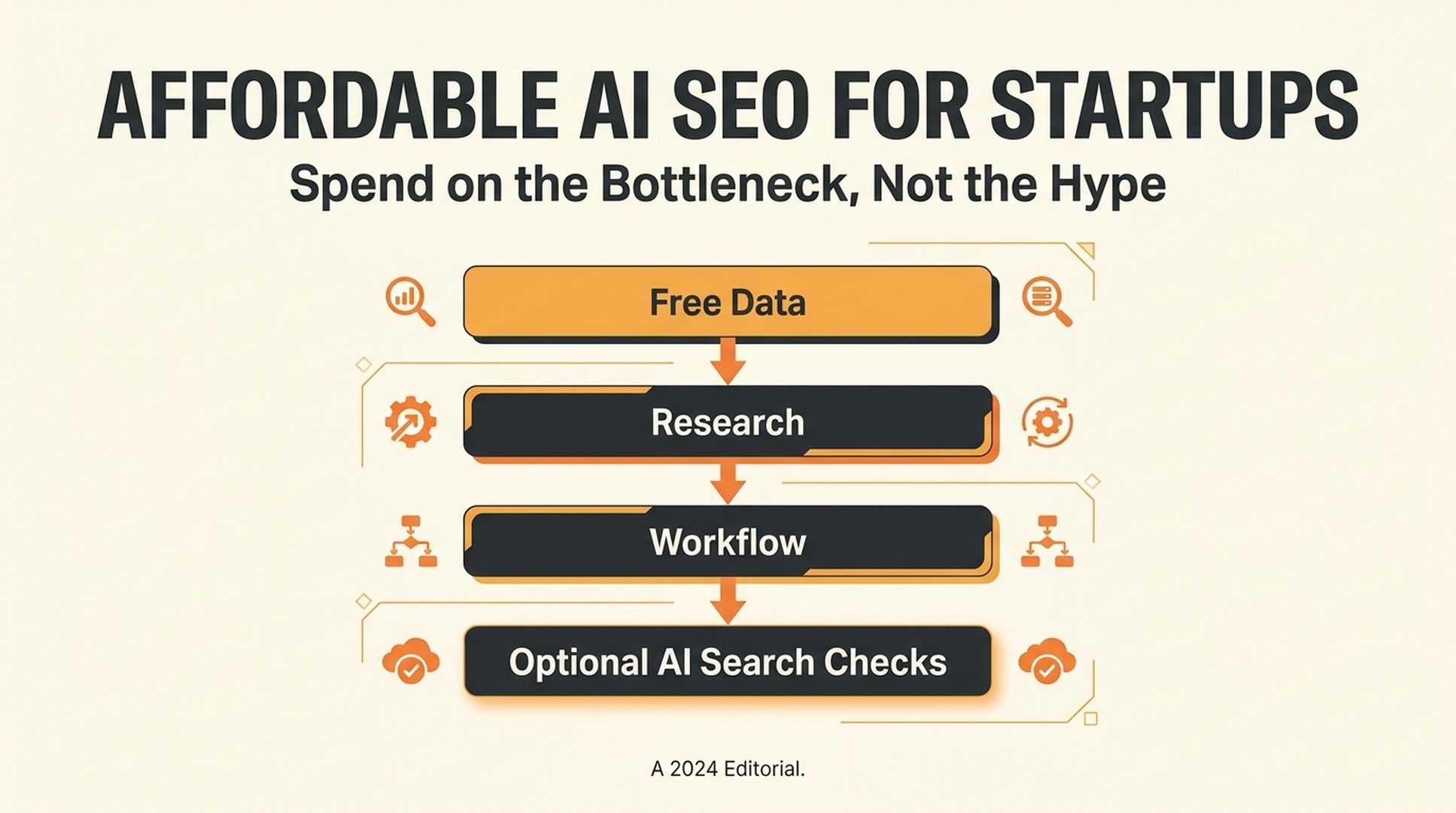
For a growing startup, an affordable AI SEO option is not simply the lowest monthly price. It is a setup that helps the team make better content and technical decisions without adding more review work, data confusion, or unused subscriptions. In many cases, the best starting stack uses free first-party tools, one paid research or optimization capability, and a clear human review process.
Avoid buying an enterprise platform to solve a problem that five hours of customer research and a good content brief would solve. Equally, do not treat a cheap AI writer as an SEO system. The bill is low, but the editorial debt can be high.
The lean-stack options
Option 1: First-party data plus an AI assistant
Use Google Search Console, analytics, customer-support data, and sales-call notes as the evidence base. An AI assistant can cluster queries, identify recurring questions, prepare refresh briefs, summarize monthly changes, and turn approved notes into a first draft. This is the lowest-cost entry point, but it requires a disciplined owner.
Best for: early teams with fewer than 100 important URLs and a clear product or service focus.
Option 2: One research suite plus a controlled writing workflow
Add one paid source of keyword, competitor, rank, or audit data. Use it to decide priorities, then keep content creation in a shared workflow with source notes and review gates. This is often a better use of budget than subscribing to several overlapping AI writers.
Best for: startups that have traction, competing categories, and a regular publishing cadence.
Option 3: A focused content intelligence tool
If the research process already works but briefs and updates are inconsistent, a focused optimization tool can help writers cover important concepts and identify content gaps. The team must resist treating an optimization score as the editorial goal.
Best for: teams with subject experts and a growing library that needs stronger quality control.
Option 4: Add AI-search readiness checks only when the question is real
If buyers increasingly ask conversational or answer-oriented questions in your category, add a limited prompt-measurement practice. Do not buy it just because the market calls everything "GEO." Use a small set of real buyer questions and review them at a reasonable cadence.
Auspia's AI Search Visibility Checker can be a focused addition for that purpose. It helps a startup assess priority prompts alongside normal SEO work, without requiring the team to replace conventional measurement.
A startup budget model
Set a budget by work function, not by vendor count. Exact prices change, but the allocation logic is durable.
Budget band | Suggested focus | What to defer |
|---|---|---|
Minimal | First-party data, one AI assistant, manual technical checks, one owner | Multiple subscription dashboards and scaled publishing |
Modest | One research or audit product, controlled briefs, basic rank tracking | Expensive enterprise integrations and autonomous publishing |
Growing | Research suite, content workflow, technical monitoring, prompt measurement if justified | Tools with overlapping datasets or unused seats |
Before adding a subscription, write the task it replaces and the output it should improve. "Use AI for SEO" is not a task. "Turn monthly Search Console exports into five review-ready refresh briefs" is.
Save money by automating the right things
The cheapest wins are often tasks that consume recurring hours: cleaning query exports, grouping questions, finding pages with declining impressions, checking metadata patterns, preparing a content inventory, and creating a weekly report. These tasks have bounded inputs and can be checked quickly.
The expensive mistakes are automated activities that create more work: generating a huge backlog of thin topics, publishing unreviewed claims, producing images with no information value, or buying data that nobody uses in a decision.
A low-cost 60-day rollout
Days 1-15: establish a baseline from Search Console and analytics. Pick one buyer problem and inventory the existing pages that address it. Days 16-30: use AI to cluster questions, identify two content gaps and three refresh candidates, then write briefs with source requirements. Days 31-45: publish or update only the reviewed pages and fix any obvious technical blockers. Days 46-60: review impressions, clicks, qualified actions, and the actual time saved. Decide whether the next dollar belongs in data, technical work, content expertise, or measurement.
The result is a purchasing decision grounded in your own workflow, not a feature list.
Free and low-cost guardrails
Keep a shared source-of-truth document for product facts. Require an editor or product owner to approve claims. Track every content change in a simple log. Use a page template that asks for intent, audience, evidence, internal links, and a next action. Set a monthly cleanup session for duplicated topics and stale drafts.
These practices cost little and make any software investment work better.
When a cheaper tool is the wrong tool
Do not choose a low-cost option if it cannot export your work, keeps no revision history, has unclear data sources, lacks permission controls, or relies on automatic publication for its value proposition. A startup needs flexibility. The cheapest tool becomes expensive when the team cannot verify its output or leave it cleanly.
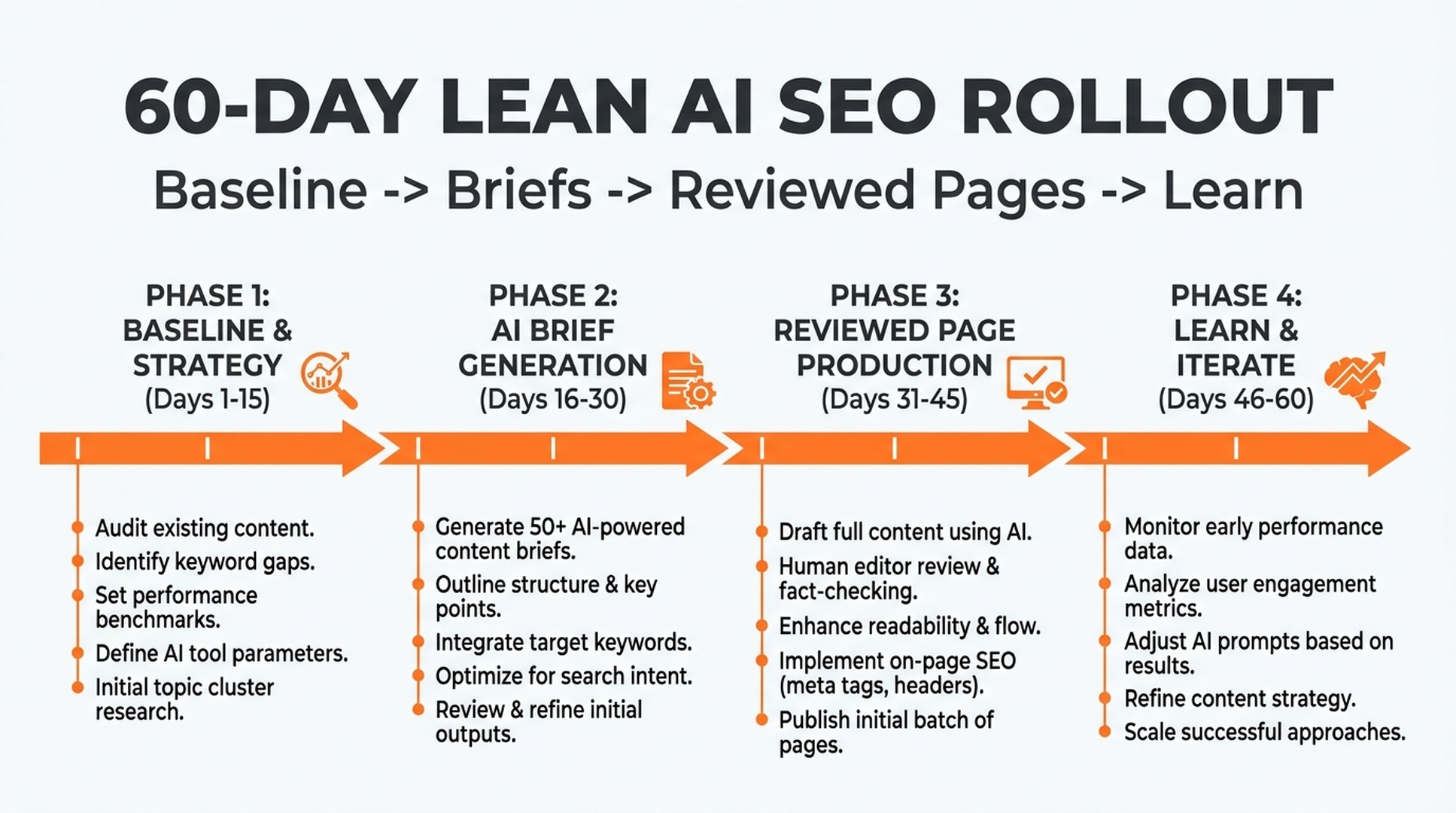
Sixty-day lean AI SEO rollout for a growing startup
FAQ
Can a startup do AI SEO with free tools?
Yes, for a focused workflow. Search Console, analytics, customer research, and an AI assistant can support query clustering, content briefs, and reporting. The trade-off is more manual setup and validation.
What should a startup pay for first?
Pay for the bottleneck that is preventing useful work: reliable research data, technical monitoring, or a controlled editorial workflow. Do not pay for several tools that all generate drafts.
Is automated publishing a good way to save money?
Usually not at the start. The cost of correcting inaccurate, duplicate, or poorly positioned pages can exceed the time saved. Begin with draft automation and manual approval.
What content standard should a lean team use?
Google's people-first content guidance is a good baseline: create content for a real audience and avoid producing pages primarily to attract search visits.
Author: Alice Monroe, AI SEO Tools Analyst Covering 150+ Tools at Auspia. Alice writes about practical software choices, lean SEO stacks, and automation that a growing team can actually maintain.